


*************
*****************
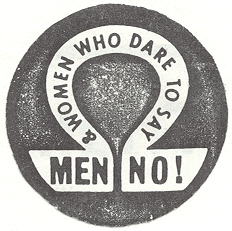
*** Men and ***
*** ***
**** Women Who ****
**** ****
**** Dare to ****
**** ****
************* Say No *************
******* *******
********* *********
Mennonite Resistance to Draft Registration
1980 - 1985
by
Mark Becker
Bachelor of Arts, Major in History
Bethel College
North Newton, Kansas
July 1985
Table of Contents
Chapter
I. AN OVERVIEW OF CONSCRIPTION IN THE UNITED STATES
The Revolutionary and Civil Wars
The First World War
World War Two
The Korean and Vietnam Wars
Between Vietnam and the 1980s
Resistance to Mass Registrations (1980-1981)
Indictments (1982-1983)
Solomon Legislation (1983-1984)
A New Wave of Resistance? (1985)
III. RESISTANCE AND THE CHURCH
IV. RESISTANCE AND THE SCHOOLS
Bethel College
Goshen College
Eastern Mennonite College
Other Colleges
APPENDICES
I. Chronology
II. Selective Service System Warning Letter
III. To the Park View Congregation:
IV. Draft Proposal (Estes Park Statement)
V. Bowling Green Statement
VI. Oral History Interviews
VII. Selective Service System Registration Form
PREFACE
This paper began during the spring of 1984 as a Social Science Seminar research project at Bethel College in North Newton, Kansas. It quickly grew beyond what was needed to meet those course objectives and, after a year and a half of work and numerous drafts, took on this present form. This paper is a revision of (and hopefully an improvement over) the Social Science Seminar paper, which won the Mennonite Contributions Contest and a Thresher Award at Bethel College in May 1985. In preparation for writing this paper, I conducted fifty-seven oral history interviews from April to October of 1984. About half of these interviews took place around Bethel College, but in order to give this project a broader perspective I spent July of 1984 hitchhiking four thousand miles around the eastern United States in pursuit of other information and interviews. These interviews are now a part of the Oral History collection of the Mennonite Library and Archives at Bethel College and are available for the purpose of historical research. In addition to these oral history interviews, I drew on the personal files of numerous people, information in the Mennonite Library and Archives, and my own personal experiences in an attempt to weave a narrative that portrays the experiences of Mennonites who stood against registration during the early 1980s.
I am not a casual observer or a passively interested bystander of the events that I describe in this paper. In 1980, while a student at Freeman Junior College in Freeman, South Dakota, I choose to refuse to register with the Selective Service System. I believe that to register for the draft would be inconsistent with the style of life that I want to lead and a violation of the Judo-Christian ethics that I base my actions on. Although I have dealt extensively with the issues involved in the topic of draft resistance, I have not directly experienced most of the events described in this paper.
This paper deals primarily with Mennonite resistance to registration, not Mennonite responses. A very small number of Mennonites chose to not register. Probably a smaller percentage of Mennonites resisted than what was the national average. But much more research could and should be done on this and related topics. This project concentrated mainly on Bethel College's story; I encourage other scholars to research and record the history of resistance at their particular locality. I am willing to provide whatever assistance I can in the furtherance of study in this field. I will make copies of this paper available to whoever desires one. I can be contacted through my parents (c/o Harold Becker; RR 2 Box 127; Marion, SD; 57043; ph. (605) 648-3760). Except for the cartoons, this material is not copyrighted. Feel free to make and distribute copies of all or parts of this paper as needed. Please identify the author and title of this paper in any and all reproductions. Also, I welcome receiving any and all comments, suggestions, corrections, and critiques regarding this paper.
I should make a note on terminology for those readers who are less familiar with Mennonite institutional structures. There are about forty Mennonite church conferences. This paper concentrates on two of them--the General Conference Mennonite Church (GCMC) and the Mennonite Church (MC), which was formerly referred to as the Old Mennonite Church (OM). There is a distinction between the term Mennonite Church, which is a specific conference; and the Mennonite churches, by which I mean Mennonites in general. The Mennonite Central Committee (MCC) is an umbrella organization involving most Mennonite conferences. In addition, on occasion I use male pronouns to refer to nonregistrants. This is not because I oppose the use of inclusive language but because so far only males have been subject to draft registration.
Several people have been instrumental in helping to bring this paper to its present form. I must make special thanks to my history professor and advisor Dr. James Juhnke, and to my friends Garth Isaak and Sue Flickinger. They took great interest in this project, read and critiqued numerous drafts of this paper, and provided me with many fresh insights and ideas on this topic. Also, Dr. Keith Sprunger and the rest of my Social Science Seminar class gave me invaluable feedback on this paper. Lastly, I must thank Dick Koontz, Bethel College's Director of Financial Aid, and Jim Dunn, the General Conference's Secretary of Higher Education, for their untiring efforts to establish the Student Aid Fund for Nonregistrants. Without their work I would not have been able to attend college and this paper would not be a reality.
Mark Becker
Bethel College
July 31, 1985
CHAPTER I
AN OVERVIEW OF CONSCRIPTION IN THE UNITED STATES
In an essay on the history of Mennonites and military conscription, James Juhnke, a history professor at Bethel College in North Newton, Kansas, defined three major eras of the draft in twentieth-century United States history. These are the First World War, World War Two, and the Cold War from Korea to Vietnam. (1) The pre-twentieth century conscription experience in the United States can be effectively grouped into one category, which deals mainly with the Revolutionary War and the Civil War. This paper deals primarily with post-Vietnam War developments, but it is important to put this story into its proper context. Even though many draft-age eighteen- to twenty- year-olds are not aware of the historical background of conscription, present developments in the United States' draft laws are built on this legal and political tradition.
The Revolutionary and Civil Wars
During the colonial period and up into the Civil War, raising a militia was the responsibility of the local or state government. The local government raised a militia for a specific battle or war and then disbanded it when its task was completed. There was no such thing as a standing army and no need for a peacetime draft. But there were people opposed to participation in the military. Such resistance can be traced back to the arrival of Quakers in New England in 1635 and of Mennonites in 1683. (2) Since raising a militia was a local problem, dealing with conscientious resisters to military service was also a local problem. Treatment of these people varied from area to area, but most were allowed either to hire a substitute to fight for them or pay a fee to be excluded from the militia. In 1661, Massachusetts was the first colony to make such legal provisions for conscientious objectors. (3) Although some conscientious objectors used the route of hiring substitutes to avoid military service, it was not designed for, nor used exclusively by, them. It became primarily a way for the wealthy elite to avoid military service. (4) There was no consensus among Mennonites whether it was alright to use this method to avoid military service. (5)
On July 18, 1775, at the beginning of the Revolutionary War, the Continental Congress adopted a resolution which recognized that certain people would have religious scruples against fighting but it urged these people to "Contribute Liberally" to the war cause. (6) Fourteen years later, the First Congress considered, but did not include, a conscientious objector clause in the United States' Constitution. (7)
The Civil War was not only the United States' first modern war but it also the first time that the raising of an army was a federal instead of a local or state responsibility. Both the North and the South allowed draftees either to hire a substitute or to pay a fee-three hundred dollars in the North and five hundred dollars in the South-to avoid military conscription. (8) A system of forced conscription that allowed the rich to buy their way out while forcing the poor to serve led to draft riots in 1863. (9) Mennonites were less prepared to respond to this draft and more Mennonites ended up in the army. (10)
The First World War
Although the United States Army fought the Spanish-American War in 1898, there was never a need for military conscription between the Civil War and the First World War. During the 1870s, eighteen thousand Mennonites came to the United States in an attempt to escape having to perform alternative service in lieu of military service in Russia. But during the First World War these Mennonites faced a universal conscription in the United States with no provisions for exemptions for conscientious objectors. Secretary of War Newton D. Baker attempted to get all of the conscientious objectors to report to the military camps; he would decide later what to do with them. Thus Mennonites ended up in military camps where they were given orders to perform tasks that violated their consciences. When they refused, they could be court martialed and sent to a military prison. (11) Almost thirty percent of conscientious objectors, more than 145 people, court martialed in this manner were Mennonites. (12) Two Hutterian Brethern men died as a result of this mistreatment. (13) In addition, 4,750 civilians (including many who had refused to register) were convicted by civilian courts for violations of Selective Service law. (14) Six to eight hundred Mennonites and about one thousand Hutterites emigrated to Canada in order to avoid military conscription. (15)
World War Two
In order to avoid the hassles of the First World War, the historic peace churches (the Mennonites, Quakers, and Brethern) reached a compromise with the United States government over the matter of conscientious objectors. Instead of entering the military such people would be placed in Civilian Public Service (CPS) camps where they would do work in the national interest such as with the park service or in mental hospitals. The churches had administrative control over the CPS camps, including paying almost four million dollars to run them. Nearly 12,000 men received conscientious objector status, including 4665 Mennonites. (16) Mennonite historian James Juhnke concluded that "The Peace Churches operated a part of the Selective Service program for the government, and they did it, for the most part, to the government's satisfaction." (17) Many Mennonites seemed to forget that the CPS program was a compromise with the government. For many, performing some sort of alternative service became the preferred, if not the only, option.
The Korean and Vietnam Wars
For the most part, the policies, attitudes and relationship of Mennonites with the government over conscription issues remained constant after World War Two. The Selective Training and Service Act of 1940 expired on March 31, 1947 and for fifteen months there was neither registration nor a draft in the United States. A year later, on March 17, 1948, President Truman introduced his famous Truman Doctrine in response to Soviet moves in Eastern Europe. The Truman Doctrine is best known for beginning the Marshall Plan to reconstruct Europe, but it also included plans to revitalize the Selective Service System. Registration began once again on August 30, 1948 and continued without a break for almost 25 years.
Numerous people (including Mennonites) resisted this return to registration. Several conscientious objectors who had already performed alternative service in World War Two found themselves faced with conscription a second time around. A few men began to question if it would not be better to resist registration itself rather than join what they viewed as a return to another war. By December 1949 (during a time when few people were drafted) the government indicted sixty-two men for not registering. Larry Gara, dean of men at Bluffton College in Bluffton, Ohio, received a eighteen month prison sentence for counseling a nonregistrant, an illegal activity under the new draft law. (18) But it was not until the Vietnam War that resistance to the draft became more common. Between 1964 and 1973 the Selective Service System reported nearly 200,000 draft violators to the Justice Department and close to a million men refused induction or failed to register. (19) Over fifty Mennonites refused to cooperate in one form or another with the Vietnam War draft. (20)
Between Vietnam and the 1980s
On April 1, 1975, President Gerald Ford terminated the registration program that had been in effect since 1948. The Selective Service System had not issued any draft induction orders since December 1972 and the System was on a standby status. (21) Instead of a program of continuing registration, the Selective Service planned for a massive one day registration on March 31, 1976. However, Congress did not allocate the Selective Service System enough funds to carry through with this registration plan. On January 23, 1976, the Selective Service's National Director Bryon Pepitone announced that he was canceling these registration plans. With this decision, the Selective Service moved to a deep standby status. (22)
Although the next four years were quiet years for the Selective Service, they were not years of inactivity. The Selective Service continued to revise its regulations in order to create a more efficient and uniform system of drafting. Slowly, support for a return to a system of draft registration began building in Congress. But Congress could not mandate registration without President Jimmy Carter's cooperation and Carter was resisting pressures to move in this direction.
CHAPTER II
REGISTRATION IN THE 1980s
Resistance to Mass Registration (1980-81)
On December 26, 1979, the Soviet Union invaded Afghanistan. President Jimmy Carter, in an attempt to signal to the Soviets his disapproval of this military action, announced in his State of the Union address on January 23, 1980, his intention to revitalize the Selective Service System. "An attempt by any outside force to gain control of the Persian Gulf region will be regarded as an assault on the vital interests of the United States of America," Carter stated in his speech, which became known as the Carter Doctrine, "and such an assault will be repelled by any means necessary, including military force." Carter noted that the volunteer army was adequate to meet the United States' current defense needs, but that he would begin draft registration in order to "meet future mobilization needs rapidly if they arise." (23)
On November 9, 1979, Carter had signed a Department of Defense authorization bill that included a requirement for him to submit to Congress a report on the
desirability and feasibility of resuming registration, classification, and/or induction procedures. He was also to report on whether women should be registered,
and on the feasibility of "faceless registration" procedures. Faceless registration would be "a method of automatically registering persons . . . through a
centralized, automated system using existing records" such as school records. (24) On February 11, 1980, after the Soviet moves in Afghanistan, Carter presented
his "Presidential Recommendations for Selective Service Reform" to Congress. He requested authorization for the registration of women and the money to carry
out registration procedures. He did not opt for a faceless registration, apparently because of an uncertainty over whether the Selective Service System could
access records that would ensure a complete registration of all people in the desired age groups. Rather, the Selective Service would conduct registration at
United States Post Offices. Carter did not recommend beginning classification or induction procedures. (25)
Although support for registration had been growing in Congress, it was far from unanimous. Representative Patricia Schroeder, a Democrat from Colorado, responded to Carter's report with the statement that, "The tragedy of Vietnam has been all but forgotten or ignored as the President rekindles fires of patriotism. We cannot accept the Carter Administration's premise that people should be registered-his reasons just do not hold water." (26) In addition, numerous groups and religious organizations came out with statements condemning a peacetime draft and/or registration. Thirty thousand people marched in protest against registration and the draft in Washington, D.C. on March 22, 1980. (27) Even the Selective Service itself had, previous to Carter's State of the Union address, declared peacetime registration to be "redundant and unnecessary." (28)
The House of Representatives approved funding for registration on April 22, 1980. (29) On June 3 the Senate began its debate over registration appropriations. Senator Mark Hatfield, a Republican from Oregon, led a filibuster on the Senate floor while an anti-draft organization known as CARD (Committee Against Registration and the Draft) held a vigil against registration on the Capitol steps. Hatfield's filibuster ended on June 10 and two days later the Senate also passed legislation that approved funding for the Selective Service System. The Senate's version differed slightly from the House's and, on June 25, the House passed the Senate's version. (30) On July 2, 1980, President Carter issued a Presidential Proclamation that ordered registration procedures to begin once again. All males born in 1960 and 1961 were to register during the two-week period of July 21 to August 2, 1980. Men born in 1962 were to register during the week of January 5 to 10, 1981. Continuous registration was to begin again on January 5, 1981, which meant that starting with those born in 1963, men were required to register within thirty days of their eighteenth birthday. (31)
Two legal challenges faced Carter's registration plan. The first, and most significant, concerned his proposal to include women in the registration program. In March 1980, the House Armed Services Subcommittee on Military Personnel had "tabled" this proposal. In June, the Senate voted against including women in the registration program. (32) Conservatives tended to oppose the registration and drafting of women. Phyllis Schlafly saw the registration of women as a waste of taxpayers' money and a threat to family life. "There is no evidence in history that a unisex army is the way to win battles or to defend the country," she said. (33) Some religious conservatives in the Anabaptist tradition adopted the dualistic position of consenting to the registration of men but remaining adamantly opposed to the registration of women as being in violation of their traditional nonresistance beliefs. (34)
Since Congress had not granted the President the authority to induct women, some people saw their registration as impeding, rather then enhancing, national defense. For the most part, though, national defense was not the issue. Carter, in a statement on February 8, 1980, claimed that "There is no distinction possible, on the basis of ability or performance, that would allow me to exclude women from an obligation to register." (35) The Selective Service's National Director, Bernard D. Rostker, claimed that including women was an issue of equality, not preparedness. (36) Some women did see registration as a step toward equality, but many feminists agreed with Representative Schroeder's statement that she did not "think we should divide ourselves on the issue of whether women should be registered or not. We should be saying that we oppose registration for everyone-males and females." (37)
In 1971, Robert Goldberg had filed a court case against then Selective Service Director Curtis Tarr, claiming that the Military Selective Service Act (MSSA) was unconstitutional because women were excluded from registration. The draft ended before this case came to a resolution. On July 15, 1980, Goldberg reintroduced this case in a United States District Court in Pennsylvania as Robert L. Goldberg v. Bernard Rostker, the director of the Selective Service. On Friday, July 18, the District Court ruled that a male-only draft was unconstitutional and enjoined the Selective Service from carrying out the registration program that was to begin the following Monday. The next day the Selective Service obtained a stay of this decision from Supreme Court Associate Justice William J. Brennan, Jr. pending a review by the Supreme Court. Hence, the two-week period of registration during the summer of 1980 proceeded as Carter had originally planned it. (38) Almost a year later, on June 25, 1981, the Supreme Court, in a six to three decision, reversed the District Court's ruling on Goldberg. In determining that a male-only draft was constitutional, the court observed that women would not serve in combat and that "the purpose of registration is to develop a pool of potential combat troops." (39) Ironically, Brennan, who had stayed the lower court's decision, dissented from the majority decision.
The second legal challenge to the registration law concerned the Selective Service's use of Social Security numbers on the registration forms. On November 24, 1980 the District Court for the District of Columbia in Wolman v. Rostker decided that this use was a violation of the Privacy Act and enjoined the Selective Service from requiring these numbers. The court, in its decision, stated that the Selective Service needed these numbers for "verification of identity" and that Congress should amend the Privacy Act in order to give the Selective Service access to these numbers. (40) But unless Congress did so, the Selective Service could not require the numbers and men who had registered during the summer could ask the Selective Service to remove their number from their registration file. (41) On December 30, six days before the 1981 period of registration was to begin, the District of Columbia's Court of Appeals stayed the District Court's decision and again the Selective Service was able to carry on its registration program as had been previously planned. (42)
Almost a year later, on December 1, 1981, President Ronald Reagan approved legislation which gave the Selective Service System the authority to request Social Security numbers from registrants. The Selective Service also gained access to Social Security files for "enforcement purposes." (43) This legislation also required that the Director of Selective Service provide the names and addresses of registrants to the Department of Defense in order to assist them in military recruitment. (44) This legislation effectively put an end to Wolman v. United States. On March 25, 1982, the District of Columbia's Court of Appeals sent this case back to the District Court level for further consideration in light of this new legislation. (45) The District Court terminated litigation in this case on July 2, 1982. (46)
Perhaps relatively low compliance rates and the legal decisions that resulted from the ensuing prosecutions were more threatening to Carter's registration plans than these two court cases. A month after the summer of 1980 registration period, the Selective Service System announced that 93 percent of those required to register had complied. In addition, the Selective Service took a random sample that showed that 1.8 percent of those registering had made an indication on the registration form that they were doing so under protest or that they were conscientiously opposed to participation in the military. Approximately 3.5 million men registered during that first two-week period. (47) Anti-draft organizations such as CARD were initially skeptical of the Selective Service's relatively high compliance figures. The Boston Globe reported that Selective Service had only achieved a seventy-five percent compliance rate. Barry Lynn, then the head of CARD, called for the U.S. General Accounting Office (GAO) to do an independent audit of the count. The GAO report confirmed the accuracy of the Selective Service's compliance figures. (48)
During the spring of 1981, the Selective Service System reported that the compliance rate for the January 5 to 10, 1981 registration period was eighty-seven percent, which was down from the summer registration period. (49) As shown in Table I, the Selective Service waited for late registrations to come in before releasing the figures. The "on time" registration rate was significantly less. The one-week period of January 5 to 10, 1981 was the last of the massive registration blocks. The continuous registration of men born in 1963 began on January 5, 1981. The Selective Service admitted that these men were registering at a rate "somewhat below" that of the two previous registration periods. (50) Attaining a high compliance rate proved to be a continual problem for the Selective Service System.
TABLE I: COMPARATIVE COMPLIANCE RATES (51)
| Registrations: | Men born:
1960-61 |
1962 | (1973) |
| On time | 87% | 77% | (77%) |
| One month late | 94% | 80% | (83%) |
| Four months late | 95% | 87% | (90%) |
| Final Total | Pending | Pending | (99.5%) |
| Men born in: | |||||||
| % Registrations as of: | 1960 | 1961 | 1962 | 1963 | 1964 | 1965 | 1966 |
| March 31, 1982 | 93.2 | 96.7 | 93.2 | 91.5 | -- | -- | -- |
| Sept. 30, 1982 | 94.6 | 97.6 | 94.5 | 94.1 | 84.6 | -- | -- |
| March 31, 1983 | 98.0 | 99.2 | 97.7 | 97.4 | 88.9 | 86.6 | -- |
| Sept. 30, 1983 | 99.3 | 99.7 | 97.2 | 98.8 | 94.4 | 85.2 | -- |
| March 31, 1984 | \______________ | 99.1 | ______________/ | 86.7 | 85.5 | ||
The Selective Service took several steps in an attempt to increase this sagging compliance rate. One was to threaten nonregistrants with prosecution. On June 17, 1981, the Selective Service sent out about 150 letters to suspected nonregistrants, threatening them with such action if they did not register within 15 days. (52) (See Appendix II for the text of this letter.) This constituted the Selective Service's "passive enforcement" system. The Selective Service Law Panel of Los Angeles, a lawyers' anti-draft network, charged that "contrary to public announcements from Selective Service, most of these men informed on themselves by writing to Selective Service and defiantly stating that they had no intention of registering." In an attempt to frighten other nonregistrants into registering, the Selective Service tried to create the impression that friends and neighbors had reported on these men. (53) On July 20, 1981, the Selective Service referred 134 suspected nonregistrants to the Justice Department. The Justice Department then proceeded to turn these names over to local U.S. Attorneys, whose responsibility was to prosecute suspected nonregistrants. (54) In the midst of all this activity, Rostker resigned as the National Director of Selective Service System on August 1, 1981. (55) President Reagan appointed General Thomas K. Turnage to this position. (56)
On November 2, 1981, the District Attorney for Northern Iowa sent a letter to Rusty Martin, a public nonregistrant, informing him that he had been "constructively registered." The District Attorney filled out a registration card with information that Martin had included in his letters to the government stating his refusal to register. (57) Essentially, this was the type of "faceless registration" that President Carter had decided against using when he reintroduced registration in 1980. The Selective Service canceled this registration when Martin refused to accept it and the Justice Department expressed second thoughts about attaining registrations through this procedure. (58)
The U.S. Attorney in Minnesota planned to indict Scott Aaseng on December 11, 1981, when he received word from the Justice Department that indictments against nonregistrants were to be temporarily suspended until Reagan decided whether he would continue draft registration. (59) Later Aaseng chose to register in order to spend more of his time and energy working on nuclear war issues. He stated that his views against war had not changed, but he was torn between the idea that registration was complicity with war and that it was just a piece of paper. He also noted that pressure from the media was harder to deal with than governmental pressures. (60)
During his Presidential campaign, Ronald Reagan had claimed that he opposed registration. In a letter to Senator Mark Hatfield, Reagan stated that "the most fundamental objection to draft registration is moral…registration destroys the very values that our society is committed to defending." Libertarian streaks in his philosophy led him to oppose registration except in the case of a "most severe national emergency." (61) A debate raged within his Republican administration whether or not to continue a peacetime registration program. In the end, Reagan became convinced that dropping registration would send the wrong signal to the Soviets. (62) On January 7, 1982, Reagan publicly announced his intent to retain registration "in order to save critical time in mobilization during an emergency." He referred to a report released by the Presidential Military Manpower Task Force that claimed that registration could save the United States as much as six weeks in mobilizing emergency manpower. (63) Later, it was discovered that peacetime registration only saved two weeks over a postmobilization. Furthermore, the report assumed that there would be no volunteers and ignored the fact that it would take about half a year to train new inductees. (64)
When Reagan announced his decision to continue registration, he also provided for a "grace period" of thirty to sixty days in which nonregistrants could register without facing the threat of prosecution. On January 20, Selective Service National Director Turnage announced that the grace period would last through February 28. He thought that most of the nonregistrants would register during this time period. (65) The legal implications of the grace period were somewhat unclear. The grace period was only a policy decision and not an amendment to the Military Selective Service Act nor a Presidential Proclamation. It did not negate any previous duty to register nor did it create any new duty to register. (66)
On April 12, after the grace period had expired, the Military Manpower Task Force met to discuss prosecution strategies. Fearing that prosecuting nonregistrants might fire up anti-nuclear groups, they suggested that the first indictments be in more secluded areas of the country. But the Selective Service System could not make decisions like that; it was the Justice Department's job to decide when and where the indictments would come down. (67) And they waited with the first indictments until summer when schools were out and organizing protests would be more difficult.
Indictments (1982-1983)
From the beginning of registration during the summer of 1980 the Selective Service System threatened, and many nonregistrants expected, immediate prosecutions for not registering as required by the Military Selective Service Act. At the end of the initial two week registration period, Joan Lamb, public affairs director for the Selective Service System announced their intention to enforce the registration law. "Some people will be used as examples of what could happen if you don't register," she stated. She conceded that it would take several months for the Selective Service to collect information in order to begin prosecutions, but she also stressed that if nonregistrants "get to the Post office very quickly, they won't be in any trouble." (68) But the Selective Service was plagued continually by sagging registration rates. They blamed this on a lack of public awareness, contending that most nonregistrants were simply unaware of the registration requirement. "The government's primary goal is registration," the Selective Service claimed, "not prosecution." (69) Once the government began prosecution there would be "a big influx of people registering," Selective Service Director Turnage claimed. (70)
Before the Justice Department could move ahead with prosecutions, legal questions over the constitutionality of a male-only registration and the Selective Service's use of Social Security numbers needed to be settled. It was almost two years after registration had started during the summer of 1980 that the first person, Benjamin Sasway, a political and moral resister from San Diego, California, was indicted for not registering. This was the beginning of a series of prosecutions. Within one month four other nonregistrants had been indicted, and a total of thirteen received indictments by the end of the year. Thereafter, prosecutions fell off drastically. Three people were indicted during 1983 for not registering, and only two were indicted during 1984. Eighteen people faced charges of not registering for a draft that did not yet even exist. As of July 1985, twelve of these cases resulted in convictions and two are still awaiting trial. Seven resisters spent time in prison and two performed some sort of alternative service work as their sentence. Although the maximum penalty for refusing to register was a $10,000 fine and/or five years in prison, only one convicted nonregistrant (Rusty Martin) received the maximum $10,000 fine and Paul Jacob was the only one sentenced to a full five year prison sentence, although four and a half years were suspended. (See Table II for a list of, and information on, indicted nonregistrants; Table III for a statistical summary of prosecutions.)
Table II: Indicted Nonregistrants
| Name and Address | Type of Resistance | Date of Indictment | Date of Trial | Defense Issue | Resolution |
| Ben Sasway San Diego, CA |
Political/Moral | June 30, 82 | Aug 24-26, 82 | Selective Prosecution; Illegal Promulgation | Guilty verdict; sentenced on Oct 4, 82 to 30 months in prison. Lost appeals. Entered prison April 29, 1985. |
| Enten Eller Bridgewater, VA |
Brethern Religious | July 13, 82 | Aug 17, 82 | Religious Defense | Guilty verdict; sentence included registering which Eller refused. Resentenced to 2 years "Alternative Service"; served June, 83-Jan 85. |
| Mark Schmucker Alliance, OH |
Mennonite Religious | July 22, 82 | Sept 20-Oct 5, 82 | Selective Prosecution | Guilty verdict; sentenced on Oct 19, 83 to 3 years probation, $4000 fine and 2 years service. Completed service, but appeal of verdict pending. |
| David Wayte Pasadena, CA |
Political/Ethical | July 22, 82 | no trial | Selective Prosecution; Illegal Promulgation | Won pretrial hearing on selective prosecution issue, but lost Gov't appeal of decision. Entered "Guilty" plea; sentence pending. |
| Russell Ford Middletown, CT |
Philosophical Political | July 30, 82 | April 14, 83 | Philosophical Defense | Guilty verdict; sentenced on June 6, 83 to "time served" (month spent in Middletown, CT jail after arraignment). |
| Gary Eklund Des Moines, IA |
Moral/Political | Sept 1, 82 | Oct 27, 82 | Selective Prosecution; Continuing Duty | Guilty verdict; sentenced to 2 years in prison. Lost appeals. Entered prison May 10, 85. |
| Michael McMillan Madison, WI |
Philosophical | Sept 1, 82 | no trial | -- | Registered on Dec 17, 82. Placed on "pretrial diversion program" that included a year's probation. |
| Gillam Kerley Madison, WI |
moral/Political | Sept 9, 82 | pending | Selective Prosecution; Illegal Promulgation | Case dismissed because Gov't refused to turn over material for hearing on selective prosecution. Gov't appealed dismissal. Appeal Pending. |
| Chuck Epp Henderson, NE |
Mennonite Religious | Sept 22, 82 | June 21-25, 84 | Constructive Registration | Argued that letters to Selective Service entailed registration. Gov't withdrew case at urging of trial judge. |
| Kendal Warkentine N. Newton, KS |
Mennonite Religious | Sept 22, 82 | no trial | CO Box | Sentenced on March 7, 83 to 2 years unsupervised probation and ordered to register on special form indicating his conscientious objection to war. |
| Paul Jacob Little Rock, AR |
Libertarian | Sept 23, 82 | July 1-2, 85 | Libertarian Defense | Went underground at time of indictment. Arrested Dec 6, 84. Sentenced to 5 years in prison with 4½ suspended. |
| Rusty Martin Cedar Falls, IA |
Political/Moral | Oct 5, 82 | no trial | Continuing Duty | Sentenced on April 25, 85 to 3 years probation, which included registering, a $10,000 fine, and attendance at 2 naturalization ceremonies. |
| Edward Hasbrouck Cambridge, MA |
Political | Oct 6, 82 | Dec 15, 82 | Philosophical
Defense |
Guilty verdict; given a 6 months suspended sentence, 2 years probation and 1000 hours community service. Imprisoned Nov 22, 83 - April 9, 84. |
| Dan Rutt Detroit, MI |
Religious | Jan 20, 83 | pending | Selective Prosecution | Activity postponed pending the Wayte decision. |
| Sam Matthews Richmond , IN |
Baptist Religious | March 10, 83 | July 14, 83 | Constructive Registration | Guilty verdict; sentenced Aug 26, 83 to year and a day in prison. Released 3 months later when Schmucker decision overturned. |
| Steve Schlossberg Minneapolis, MN |
Presbyterian Religious | Oct 3, 83 | no trial | CO Box | Registered in exchange for a SSS letter acknowledging his CO claim. Placed on 90-day "pre-trial diversion" program. |
| Andy Mager Syracuse, NY |
Moral/Social/ Political | Aug 22, 84 | Jan 8-10, 85 | International Law | Guilty verdict; sentenced on Feb 4, 85 to 3 years in prison with 2 ½ years suspended. |
| Phetsamay Maokhamphio Nashville TN |
Philosophical | Dec 12 , 84 | no trial | -- | First private nonregistrant indicted. Registered and placed in a pre-trial diversion program on March 22, 85. |
The eighteen resisters approached their prosecutions in various manners, often determined by what their philosophy of resistance was. Religious resisters usually received probation and/or an alternative service term as their sentencing; Sam Matthews was the only one of the seven resisters who spent time in prison who approached the issue from religious point of view. Enten Eller, a religious resister from the Church of the Brethern, did not want to make his stand against the government but simply wanted to follow faithfully his personal conscience. Eller stated that he was "not interested in fighting a big legal battle…that clouds the real issue" as to why he did not register. (71) I have not registered simply because the U.S. Government has asked be to do something God would not have me do," Eller wrote in a statement describing his position on this issue. Yet he viewed his nonregistration "as constructive and positive, demonstrating in the best way I know the love and peace of God for everyone, even those threatening me with imprisonment. For this reason," he continued, "I have chosen to be open and to cooperate with the Government and the U.S. Attorney as much as I conscientiously can, for I do not have hatred of authority." (72)
TABLE III: PROSECUTION STATISTICAL SUMMARY (73)
18 Indicted:
12 Convicted (Eller, Sasway, Schmucker, Eklund, Hasbrouck, Ford, Matthews, Warkentine, Martin, Mager, Wayte, Jacob)
1 Plead guilty and registered as a conscientious objector after conviction (Warkentine)
1 On appeal by defendant (Schmucker)
1 Dismissed on pre-trial motion (Kerley) (Appeal by Gov't)
1 Awaiting trial, pre-trial motions denied (Rutt)
3 Registered before trial, entered pre-trial diversion program (McMillan, Maokhamphion, Schlossberg)
1 Gov't withdrew charges during trial (Epp)
Similarly, Kendal Warkentine, a Mennonite resister from North Newton, Kansas, stated that "for me to register would have necessitated my compliance with a system I felt was in direct conflict with what God wants for mankind." Warkentine concluded, "In such a conflict (like registration) the Christian has no choice but to obey God and disobey man." (74) In an attempt to be nonresistant to what the government would do to him, he stood mute at his arraignment, refusing to enter a plea to the charge of registering. The judge would not accept this plea, nor one of "nolo contendere," which means "I do not contest the charge." Eventually the judge entered a plea of guilty for Warkentine and he became the first indicted nonregistrant to have such a plea. Part of Warkentine's sentencing was to register on a special form that allowed him to claim his conscientious objector status. (75) This increased pressure on the government to include a "CO check-off box" on the registration form, a provision which would allow conscientious objectors to affirm their objection at the time of registration.
Others, such as Gillam Kerley from Madison, Wisconsin, used a political and legal defense. He pled "not guilty by reason of sanity" and filed about thirty pre-trial motions including one to dismiss the case on the grounds that everybody's time could be better spent working to prevent nuclear war. Kerley also moved that the judge declare the courtroom a nuclear free zone. (76) Edward Hasbrouck, a convicted nonregistrant who worked closely with Massachusetts Open Resistance, had more philosophical reasons for resisting, once describing his resistance as being "anarchist, pacifist, nonviolent, and revolutionary." (77) Paul Jacob, a former state chairperson of the Arkansas Libertarian Party, went underground after his indictment on September 23, 1982. In a "statement from the underground," Jacob claimed that the draft is slavery and that by resisting he remained free. (78) Posters stating "Paul Jacob Is Free" became a symbol among segments of the anti-registration movement. So far, Jacob is the only indicted nonregistrant to go underground. Over two years after his indictment, Jacob was arrested at his home in Little Rock, Arkansas where he had been living openly for a year. (79)
These resisters used several defenses with varying degrees of success. The argument in selective, or discriminatory, prosecution, the defense most commonly employed, was not simply that the government prosecuted one nonregistrant while ignoring more than 800,000 other nonregistrants, but that the government's prosecution of one particular nonregistrant was politically motivated. The government has broad discretion over choosing who to prosecute, but it is a violation of a nonregistrant's First Amendment right to free speech if the government chose to prosecute that person in order to silence his vocal opposition to draft registration. (80)
Several indicted nonregistrants raised this issue in pretrial hearings, but in most cases the trial judge ruled against this defense. In a significant decision, District Court Judge Terry J. Hatter of Los Angeles, California dismissed David Wayte's indictment because of both selective prosecution and illegal promulgation of regulations. Hatter had established Wayte's right to a full hearing on the selective prosecution issue, but the government, claiming "executive privilege,'' supposedly in order to protect the Reagan Administration's internal deliberations on this issue, refused to let White House Counselor Edwin Meese testify or to turn over White House, Selective Service, and Department of Defense documents that Hatter had determined were important for Wayte to build his case. Thus the issue became the right of the government to hold back internal documents pertaining to their prosecution policies, rather than the issue of selective prosecution itself. (81)
The government appealed Hatter's decision to the Ninth Circuit Court of Appeals. In a two to one decision, the Appeals Court reinstated Wayte's indictment, ruling that the government's "passive enforcement" prosecution policy which resulted in the indictment of only those individuals who identified themselves to the government was not unconstitutional. Furthermore, the Appeals Court ruled that Wayte had not sufficiently proven that the government had intentionally selected him out for prosecution because of his vocal resistance to registration. (82) Wayte petitioned for an "en banc" rehearing of his case by the entire panel of judges on the Ninth Circuit Court of Appeals, but this was denied. However, the Supreme Court agreed to rule on the selective prosecution issue. On March 19, 1985 in a seven to two decision the Court upheld the Appeals Court ruling against Wayte. In the majority decision, Justice Lewis Powell pointed to the government's "beg policy" of giving resisters a final chance to register before proceeding with a prosecution as evidence that the prosecution was based on a failure to register and not a resister's activities. In the dissenting opinion, Justice Thurgood Marshall stated the court should not have decided the issue, but rather have given Wayte more evidence from the government for his pre-trial hearing. The Supreme Court did not decide if the government was justified in invoking executive privilege when faced with the requirement of turning over internal documents relating to his selective prosecution defense. Since this decision dealt with a pre-trial defense, Wayte's case returned to the District Court level for his trial. (83)
Shortly after their decision in Wayte, the Supreme Court refused to hear appeals from Ben Sasway and Gary Eklund on the selective prosecution issue. The Sixth Circuit Court of Appeals had previously decided that Mark Schmucker was entitled to a full evidentiary hearing on the selective prosecution issue. The government appealed this ruling to the Supreme Court. After its decision in Wayte, the Supreme Court remanded this case to the Sixth Circuit to be reconsidered in light of its ruling in Wayte. Activity on a pre-trial motion relating to the selective prosecution defense in Dan Rutt's case was also postponed pending resolution of the Wayte case. Similar to Judge Hatter's decision in Wayte, District Court Judge James Doyle in Madison, Wisconsin dismissed charges against Gillam Kerley when the government "respectfully declined" to release documents important to his selective prosecution defense. The government appealed this decision. (84)
A variation of this defense was the argument that a person's deeply held religious beliefs prevented him from registering. For the government to force such a person to register would be a violation of his First Amendment right to freedom of religion. (85) Nonregistrants have had minimal amounts of success in arguing this defense in court.
Another commonly used defense dealt with whether or not a person had a continuing duty to register. According to Carter's Proclamation that began registration, men born in 1960 through 1962 were to register during assigned one-week periods, and men born in 1963 and thereafter were to register within thirty days of their eighteenth birthday. There were no provisions for a person to register after this time period. Thus, the government's indictments which often followed the pattern of
"Beginning on or about July 22, 1980 and continuing to at least May 28, 1982, John Doe did knowingly and willfully fail, evade and refuse to present himself for and submit to registration."
would be invalid because of the error in the date that the nonregistrant committed the "crime" of not registering. (86)
Several indicted nonregistrants sought to raise this issue in pre-trial motions, but only Rusty Martin was successful in his attempt. Edward McManus, the Federal Judge for the Northern District of Iowa, ruled that in order to convict a nonregistrant the government must prove that he "knowingly and willfully" refused to register during the specific time period in which he was to have registered. The government immediately appealed this ruling to the Eighth Circuit Court of Appeals. (87) Meanwhile, Gary Eklund also appealed to the Eighth Circuit his trial judge's decision that there was a continuing duty to register.
Normally the statute of limitations (the time period in which a person can be prosecuted for committing a crime) for not registering would expire in five years. If there were no continuing duty to register, it would mean that men who were to have registered in 1980 could no longer be indicted for not registering after the summer of 1985. Unfortunately, in 1971 Congress raised the statute of limitations for this offense to age 31, but they did not specifically state that there was a continuing duty to register. (88) In a five to four decision the Eighth Circuit Appeals Court decided that although the law was somewhat unclear, raising the statute of limitations did create a continuing duty to register. The dissent pointed out that although the Military Selective Service Act gave the President the authority to require the registration of eighteen to twenty-six year old men, Carter's Proclamation ordering registration listed only specific times in which men were to register and therefore did not create a continuing duty to register. The Supreme Court refused to hear Eklund and Martin's appeal of this decision. Only the Eighth Circuit Court of Appeals (which covers Arkansas, Iowa, Minnesota, Missouri, Nebraska, and South Dakota) has ruled on the continuing duty defense, and it could be decided otherwise in courts outside of the Eighth Circuit. (89)
Several indicted nonregistrants have sought to employ more technical defenses in an attempt to render the draft law itself invalid. Most commonly, this type of defense dealt with the issue of illegal promulgation of regulations. Federal agencies must publish proposed regulations in the Federal Register for a thirty-day comment period before they can become law. On June 16, 1980, the Selective Service issued its proposed regulations for the administration of registration. Just over a month later, on July 18, the Selective Service published these regulations in their final form, claiming an immediate effective date. However, the final form contained three changes from the previously published proposed form, changes for which the Selective Service did not allow a public comment period. Three days later registration began. (90) In addition, under the Military Selective Service Act Carter's Presidential Proclamation 4771 of July 2, 1980, which ordered the resumption of registration procedures was subject to a similar thirty-day public comment period. Registration began only nineteen days after Carter's Proclamation. (91)
On November 15, 1982, Judge Hatter dismissed the indictment against David Wayte on the basis of selective prosecution and the invalidity of Carter's Proclamation, but he ruled against a defense motion that the Selective Service had also illegally promulgated its regulations, which provided for the resumption of registration. In an appeal to the Ninth District Court of Appeals, the government successfully argued that there is a distinction between a Presidential Proclamation and a regulation and that Carter's Proclamation was not subject to the same thirty-day comment period as were other regulations issued under the Military Selective Service Act. Had Wayte won this issue, it would had rendered Carter's Proclamation invalid and essentially terminated registration until a President properly issued a Proclamation beginning registration. Several other indicted nonregistrants have unsuccessfully raised this defense in pre-trial hearings. Only in the Ninth Circuit Court of Appeals (which has jurisdiction over California, Oregon, Washington, Nevada, Hawaii, Arizona, Guam, Alaska, Idaho, and Montana) is there a ruling on this issue and it possibly could be successfully argued elsewhere. (92)
In the Federal District Court in Wichita, Kansas, Chuck Epp argued that from letters he had written stating his refusal to register the government already had the information it requested on the registration form. By demanding that he sign such a form, Epp argued, the government was not demanding information but his symbolic obedience to a registration he disagreed with. Trial Judge Frank Theis pressured the government into dropping charges against Epp in exchange for considering him "constructively registered." (93) After waiting several months, Epp had still not received an acknowledgement letter from the Selective Service System for this "registration," and it was unclear as to what the Selective Service had done with it. (94)
Vietnam War-era resisters occasionally used a similar defense, arguing that if a local draft board had all the information about a person that it needed that person could be considered constructively registered and not in violation of the draft law. (95) Anti-draft organizations noted that if the Selective Service had enough information to mail a nonregistrant a letter, then they probably had enough information to register that person. (96) Rusty Martin, a nonregistrant who wanted to use his trial to promote draft resistance, resisted such an attempt by the government to register him. Martin persuaded the Selective Service to cancel this "constructive registration." Other nonregistrants have not been successful in using this defense in their trials. (97)
Courts have consistently ruled against other possible defenses which would seem to have legal merit. These include arguments that draft registration is unconstitutional because conscription is involuntary servitude, a violation of the Thirteenth Amendment's abolishment of slavery; and that since females and people outside of a specific age group are not subject to registration it is discrimination against young males. (98)
Solomon Legislation (1983-1984)
Even the threat of legal prosecution was not enough to force most resisters into registering. Early in 1982 a Republican Representative from New York, Gerald Solomon, decided that it was time to "get tough" on nonregistrants. He began proposing legislation that would prohibit nonregistrants from receiving federal governmental assistance, federal jobs, or from participating in other federal programs. On February 2, 1982, he introduced a House Concurrent Resolution that urged Reagan to take such action, but it did not have the force of law. (99) On May 6, a similar bill was introduced in the Senate as an amendment to the Department of Defense's 1983 Authorization bill. (100) On July 28, 1982, the House of Representatives passed Solomon's amendment. A conference committee worked out the differences between the House's version and the one that the Senate had passed, (101) and, on September 8, 1982, Reagan signed the Department of Defense Authorization bill into effect with the Solomon Amendment attached. This legislation went into effect on October 1, 1983. (102)
Solomon threatened to amend every piece of federal assistance legislation in order to make it illegal for nonregistrants to receive any federal aid. On August 5, 1982, such an amendment attached to the Job Training Program Act (JTPA) passed Congress. (103) The JPTA was designed to provide job training services for disadvantaged youth, many of those being poor black males-a group with one of the highest nonregistration rates. The stipulation of registration for participation in the JPTA became the Selective Service's main tool in forcing low-income youth to register for the draft. Unlike many middle class college students who could find alternative sources of aid, most people dependent on the JPTA had few alternatives but to register. (104)
On November 24, 1982 the Minnesota Public Interest Research Group (MPIRG) filed a court case that challenged the new law on the basis that it was a bill of attainder (punishment without the protection of a trial); that it violated a nonregistrant's Fifth Amendment protections from self-incrimination; and that it discriminated against poor, young males. (105) In a preliminary ruling of March 9, 1983 (which he upheld on June 17), Minnesota District Judge Donald D. Alsop decided that the Solomon Amendment was unconstitutional. On June 29, the Supreme Court stayed this injunction pending its review. (106) In a six to two decision on July 5, 1984, the Supreme Court upheld the constitutionality of this amendment, deciding that it was not a bill of attainder and that it did not violate a nonregistrant's Fifth Amendment rights. They agreed with the District Court that it did not provide the protection of a trial, but they also pointed out that a nonregistrant could still register and receive aid. The Solomon Amendment was intended, the court noted, to increase compliance with the registration program, not to punish those who failed to register. (107)
Solomon continued to propose legislation to prevent nonregistrants from obtaining financial aid, but none of his other amendments have passed. The educational community was becoming more hostile to the administrative burden that such legislation created. One aid privately predicted that there would be no more Solomon Amendments. (108)
While Solomon attempted to improve the compliance figures for the Selective Service's registration program, Les Aspin, a Democratic Representative from Wisconsin, introduced legislation to reduce the penalty for failure to register for a peacetime draft from felony to a misdemeanor. (109) Although Aspin has introduced several versions of this legislation, to date none of them have succeeded. Other Representatives saw the registration program itself as being faulted and took steps to bring it to an end. The Sabo-Green bill was the best example of Representatives trying to do this.
On January 27, 1983, Representatives Martin Sabo (D-MN) and Bill Green (R-NY) proposed a bill that would rescind funds for the Selective Service's draft registration program. This action would, in effect, put an end to the draft registration program. (110) In the House, this bill had fifty sponsors. Mark Hatfield introduced similar legislation in the Senate. (111) Sabo and Green argued for an end to registration from a pragmatic standpoint, rather than an ideological or philosophical one. They pointed to a U.S. General Accounting Office report that showed that a high percentage of registrant addresses were outdated because the registrants had moved and not informed the Selective Service of their change of address. (112) Noting the high number of nonregistrants, they concluded that "the level of compliance is inadequate for a fair conscription system should the need occur." Lastly, they wondered if a post-mobilization registration would not be a preferred, and perhaps more efficient, alternative to a peacetime registration. (113)
The House Appropriations Subcommittee for HUD-Independent Agencies (which controls the funding for the Selective Service) held hearings on the Sabo-Green bill on February 24, 1985. (114) In addition to the American Civil Liberties Union and Draft Action, Robert Kreider testified for the National Inter-religious Service Board for Conscientious Objectors in favor of the Sabo-Green bill. Kreider, a Mennonite historian and head of the Peace Studies Department at Bethel College, went beyond the pragmatic arguments against registration and noted that "many nonregistrants refuse to register because they deeply believe this requirement violates their fundamental religious, moral or ethical convictions." Kreider pointed out that most conscientious objectors resist identification with the military and that registration "represents a blank endorsement of all future foreign and military policy." (115)
Many informed people thought that this legislation had a good chance of passing due to the popularity of budget cuts, but the Sabo-Green bill never made it out of the House Appropriations Subcommittee. Just hours before the subcommittee vote on May 4, 1983, registration opponents had the verbal support of a majority of subcommittee members. Unfortunately, it was defeated by a six to four margin when one supporter failed to show up for the vote and another voted against the bill. For all practical purposes, this was the end of attempting to use budgetary restrictions to end registration. (116)
A New Wave of Resistance? (1985)
On February 23, 1985, President Reagan's appointment of Edwin Meese as Attorney General gained congressional approval. This appointment signaled the beginning of a new and harder line policy against those who refused to register for the draft. Already the Justice Department had been moving in new directions with prosecutions against resisters. On December 13, 1984 the government indicted Phetsamay Maokhamphio, a Laotian refugee and a conscientious resister. This was the first indictment of the government's "active enforcement" program which sought out private, or quiet, nonregistrants instead of only prosecuting those who had made their resistance known to the government. The government sought to use this case as an example of the fairness of its prosecution policy, but it went unnoticed until three months later when the New York Times printed his name in a list of indicted nonregistrants. Because of Maokhamphio's poor knowledge of English, he thought he would be drafted as soon as he registered. Once he understood the law better, he registered, but the government refused to dismiss the case. When Maokhamphio moved from Nashville, Tennessee to Lafayette, Louisiana the new District Attorney agreed to a pre-trial diversion program whereby he was given a year's probation. (117)
Several court cases had been on hold for almost a year, their outcome pending the Supreme Court's decision on the selective prosecution issue in the Wayte case. When the Court handed down their decision against Wayte on March 19, 1985, it opened up the way for the resolution of numerous other cases. In the following months, six nonregistrants were either convicted or had reached the end of their appeals process and began serving a sentence.
As part of the reform of the Federal Criminal Law, on January 1, 1985, the maximum fine for refusal to register rose from $10,000 to $250,000. In November 1986, the U.S. Sentencing Commission will review a proposal to raise the maximum prison sentence for draft violations from five to six years. The practical effect of this penalty change could be minimal because it is uncommon for judges to give nonregistrants the maximum allowable sentence. In addition, on October 12, 1984 Congress repealed the Youth Corrections Act. Formerly a nonregistrant sentenced under this Act could have his felony conviction for not registering expunged from his record upon completion of his sentence. (118)
In 1982 the Selective Service began extensive crosschecking of its registration records with other governmental records in an attempt to locate possible nonregistrants. The Selective Service then sent a series of letters to these nonregistrants threatening them with prosecution if they did not comply with the registration law. As of July 1985 only two indictments resulted from this action, those being Maokhamphio and Schlossberg (who had responded to such a warning letter). On May 25, 1985 the Selective Service sent out a mass mailing of 158,000 warning letters informing nonregistrants that their names had been sent to the Department of Justice. (119) While it is impossible for the government to prosecute all of these nonregistrants, this mailing may signal a new round of prosecutions similar to what occurred in 1982.
CHAPTER III
RESISTANCE AND THE CHURCH
The Mennonite Central Committee's U.S. Peace Section had already realized several months before Carter's State of the Union Address that a return of registration was not far in the future. Hence they had been planning an Assembly on the Draft and National Service for the spring of 1980. Carter's action suddenly made this issue much more relevant and pressing.
On March 27-29, 1980 a group of about four hundred students, parents, pastors, church leaders, and others met at Goshen, Indiana for this Assembly. Several people had prepared papers on different aspects of Mennonites and conscription. A series of five papers laid out five options for young Mennonites to choose from. These options were:
- Selective Participation in Military Service
- Noncombatant Military Service
- Alternative Service
- Conscientious Resistance
- Emigration
Generally, the first two options, selective participation in military service and noncombatant military service, have not received official church sanction from the Mennonites. Most Mennonites have chosen the third option, registering with the Selective Service with the intent of gaining a conscientious objector status and performing some sort of alternative service.
During this time period there was some discussion of the last option, emigration. During the Vietnam War a number of people had chosen to resist the draft by leaving the United States. Most of them had gone to Canada, but in 1973 Canada changed its immigration laws, making emigration to that country more difficult. However, the Canadian government has stated that an applicant's draft status in another country is irrelevant to his or her eligibility for immigration to Canada. (120) During the past five years, few people have chosen emigration as a response to registration. Once this step is taken, a person may be barred from ever returning to the United States. For some resisters, this option was too costly. Others believed that they needed to remain in the United States and fight militarism here. Richard Moore, of the Committee to Aid War Objectors in Vancouver, British Columbia, has perhaps done more then anyone else in raising emigration as a possible option. Moore himself emigrated to Canada in 1971 after deserting the U.S. Air Force in Vietnam. He edits the DRC-NEWS (Draft Resistance in Canada News). (121)
But it was the fourth option, conscientious resistance, that left the largest impact on the Goshen conference. Dennis Koehn, a Vietnam-era nonregistrant, presented a paper on this option. Many people at this conference did not question the government's demand of registration, but were rather concerned with working out a Mennonite response if the Selective Service should resume inductions. But for many young people at the conference, the ones who would be most directly affected with registration, registration, not alternative service proposals, was the issue. A dramatic turning point at the conference occurred when a participant became frustrated with the refusal of certain elements of the conference to acknowledge that many people were dealing with issue of whether or not they should register. He asked all of those who were possibly facing registration and were considering not registering, to stand up. Many of the young people present stood up. (122) For many young Mennonites, resistance had become a legitimate option. Nonregistration was an issue that the Mennonite churches would have to deal with.
For many of the students who stood up at this conference, much of their processing and development of the issue came from late night discussions in dorm rooms. But the Mennonite churches dealt with this issue of nonregistration in a much more formal setting, often with selected delegates and approved agendas. The MCC conference at Goshen was only one of these, albeit the most significant in defining how Mennonites would respond to registration. The Mennonite Central Committee (MCC), in addition to various Mennonite conferences (especially the General Conference Mennonite Church and the Mennonite Church), continued to set up committees and call meetings to discuss different aspects of registration and the draft. They spent much of their time responding to alternative service proposals. Nonregistration was only one, although the most visible, of several agenda items for the Mennonite churches.
The Mennonites did not deal with conscription issues only when there was registration or a draft. After the Vietnam War, the Mennonite Central Committee's U.S. Peace Section had continued to watch the Selective Service System and had remained active in opposing moves toward conscription. When it appeared that the Selective Service System would resume registration in 1976, the Peace Section responded with a strongly worded statement that read, "We continue to view the draft as inherently evil and as an essential element in the militarization of American society." (123) At a conference similar to the one held at Goshen in March of 1980, seventy-five people met in Kansas City, Missouri on November 11 and 12, 1977. These people released a consensus statement in which they stated their opposition to military conscription. But in case of a return to military conscription, they viewed alternative service, nonregistration, and emigration as all being "faithful responses." (124)
The conference in Goshen had several concrete results. One was the creation of a "Draft Resisters' Fund." (125) The MCC U.S. Peace Section set up this fund, but the General Conference Mennonite Church and other Mennonite groups also set up legal defense funds. These were often "last resort" funds, with the intention that if a nonregistrant needed financial assistance he would first seek help closer to home. In several cases, attorneys assisted Mennonite resisters for little or no expense. Often law schools or the American Civil Liberties Union (ACLU) took on such cases for only a small fee. MCC also established a network of Mennonite lawyers who would be willing to provide legal aid to conscientious objectors to war. (126) This network was not extensively used, probably mainly due to the fact that most lawyers are not well versed in the technicalities of Selective Service law.
 Another result of the Goshen conference was the establishment of a newsletter that would provide a support network and communication
link among Mennonite draft resisters. Fred Loganbill, an MCC volunteer with the National Inter-religious Service Board for
Conscientious Objectors (NISBCO), and Phil Shenk, from Sojourners, both lived in Washington, DC and put out the first issue of the
Mennonite Non-Cooperators' Newsletter in April of 1980. They intended for the newsletter to be "a newsletter written by and for....
young Mennonites (who are) giving serious thought to resisting the military conscription process in some way or another as an expression
of (their) conscientious objection to war and war preparations." (127) After this issue, two nonregistrants from Harrisonburg, Virginia,
André Gingerich and Luke Hurst, agreed to carry on this responsibility.
Another result of the Goshen conference was the establishment of a newsletter that would provide a support network and communication
link among Mennonite draft resisters. Fred Loganbill, an MCC volunteer with the National Inter-religious Service Board for
Conscientious Objectors (NISBCO), and Phil Shenk, from Sojourners, both lived in Washington, DC and put out the first issue of the
Mennonite Non-Cooperators' Newsletter in April of 1980. They intended for the newsletter to be "a newsletter written by and for....
young Mennonites (who are) giving serious thought to resisting the military conscription process in some way or another as an expression
of (their) conscientious objection to war and war preparations." (127) After this issue, two nonregistrants from Harrisonburg, Virginia,
André Gingerich and Luke Hurst, agreed to carry on this responsibility.
Gingerich and Hurst had a major impact on the formation of Mennonites' responses to registration. Prior to the MCC conference at Goshen they had already begun to process the issue of registration with their home congregation in Harrisonburg, Virginia, the Park View Mennonite Church. In a letter addressed to the Park View Congregation they stated that found "it increasingly difficult to see the process of registering and then applying for CO (Conscientious Objector) status as the only option or as the most faithful one." Pointing to the lack of a clear distinction between registration and a draft and war, and the legitimacy that registering and claiming a CO status would lend to a system that drafted others, they concluded that it made most sense to not register. (See Appendix III for the complete text of the letter.)
On Sunday morning, April 13, Gingerich and Hurst met with the Park View congregation in order to discuss this issue. A support and advocacy group called the Support and Liaison Committee grew out of this discussion. (128) This was followed up by a business meeting on Sunday evening, June 30 in which the congregation further discussed Hurst and Gingerich's action of not registering. In the end, the congregation drafted a statement which expressed its support in terms of legal assistance, financial aid, prayer, and spiritual counsel for those of its congregation who could not, in conscience, register for the military draft. (129) "There was a lot of hostility, especially among men who had done CPS (Civilian Public Service) service in World War Two," Gingerich reported. "They thought we were negating their experience. (130) "But for the most part, this discussion had positive and encouraging results, rather than creating a defensive or antagonistic atmosphere. Unfortunately, this was not always possible. Because of the immediacy of the registration issue for them, many young Mennonites had spent many more hours carefully deliberating this issue than had their pastor or congregation. It was difficult and frustrating to be "counseled" by people who had not seriously dealt with this issue.
Just prior to the two-week period of registration during the summer of 1980, the General Conference Mennonite Church (GCMC) held its tri-annual conference in Estes Park, Colorado. The issue of registration hung heavy over many people during that conference. At one session, six men who were facing registration in the next several weeks stood up and said that because of their beliefs they could not "in good conscience register with the Selective Service." They appealed to the Anabaptist tradition of refusal to carry the sword and to the GCMC's 1971 statement The Way of Peace, which pledged the Church's resources to those who chose a costly road of discipleship in responding to registration. (See Appendix IV for the content of the statement.) The members of the GCMC meeting at this conference responded to these men by passing, by an overwhelming majority, a resolution which declared their personal, spiritual, and financial support for them. (131)
A year later, the Mennonite Church (MC) held its biannual General Assembly at Bowling Green State University in Ohio. Here, four men also brought before the conference their decision to resist registration. They noted the close connection between registration and war and wondered if, by accepting a conscientious objector status, Mennonites inadvertently furthered the aims of military conscription by taking friction out of the war machine and by granting the conscription system the legitimacy to draft others for war. (See Appendix V for the entire content of this statement.) The delegates to this assembly responded to this statement with a standing ovation. Several of the nonregistrants, who found such a response "somewhat disorienting" but "certainly gratifying," were left wondering how committed the church actually was to peace when a few minutes later the delegates responded silently to a call to resist paying war taxes. (132)
During the summer of 1980 with registration recently reinstated and no one knowing how far in the future a draft was, the Mennonite Central Committee's U.S. Peace Section decided to hire a person to train draft counselors. This person was Jim Amstutz, a 1976 Bluffton College graduate who had already spent several years working with peace issues in the Mennonite church. Amstutz spent the first several months of his time at MCC putting together a draft counselor's manual, starting Draft Counselor's Update, a monthly newsletter for draft counselors, and developing weekend training sessions for draft counselors. For the following several years he spent a lot of time traveling and doing draft counselor training seminars. There was a conservative element in the Mennonite churches that criticized Amstutz and the MCC U.S. Peace Section for spending too much time with nonregistrants and the whole issue of nonregistration. Amstutz defended his work, saying that this was a misperception because his work with nonregistration was just more visible then his other activities. The Peace Section also spent a lot of time monitoring and interpreting the alternative service proposals and negotiating with the Selective Service. (133)
During January 1-3, 1982, Amstutz led a New Years retreat at the Laurelville Mennonite Church Center in Pennsylvania on "The Draft: To Register or Not to Register." Amstutz had intended for the retreat to be for young men facing registration deadlines, for their parents, and for others who were looking for a dialogue about options and support for their convictions. As it turned out, many of the twenty-five participants had already decided to resist registration. Melvin Hess, a Lancaster, Pennsylvania attorney, provided information on the legal process that a nonregistrant would go through if he was prosecuted. John Stoner of the Peace Section provided input on church-state relations. The participants left this weekend retreat "with a strong sense of unity and with the hope that (they) might meet again soon." (134)
Early in 1983, Greg Smucker (who was in Voluntary Service in Washington, DC) and André Gingerich (who was studying at Swarthmore College in Pennsylvania) formed a proposal to create a "Mennonite Nonregistrants Coordinating Committee." They saw a need to strengthen support links between Mennonite nonregistrants, and a need to generate dialogue with the wider Mennonite church on issues of militarism. Initial agenda items dealt with preparing for the upcoming Bethlehem '83 conference of the Mennonite Church and the General Conference Mennonite Church, and encouraging the church to oppose the Solomon Aid Amendment, which would cut off financial aid to students who had not registered. (135)
Nine people joined the Mennonite Nonregistrants Coordinating Committee (MNCC): Dave Boshart and Jon Nafzinger of Goshen College; André Gingerich of Swarthmore; Eldon Mast and Juanita Shirk of Eastern Mennonite College; Mike Hurst, Dave Leaman and Greg Smucker of Washington; and Dave Lohrentz of Bethel College. The committee had a representation from all of the areas where Mennonite groups were actively opposing registration. Unfortunately, distance and high travel costs prevented more Bethel students from attending. Gingerich and Smucker had intended to maintain a proper male-female ratio in the make-up of the committee, but Shirk was the only woman on it. "Women can't choose not to register, of course, but that doesn't mean they can't be involved," Shirk said, reflecting on her role with the MNCC. "I was glad I was there (at the MNCC meeting)." (136)
The Mennonite Nonregistrants Coordinating Committee (MNCC) had its initial meeting on February 12-13, 1983 in Washington, D.C. A large portion of the time at this meeting was spent brainstorming for ideas for the upcoming Bethlehem '83 conference. Another item of discussion dealt with the future of the Mennonite Conscientious Resisters' Newsletter. They decided to bring the newsletter under the supervision of the committee. The nonregistrants at Goshen College had edited it for almost a year and thought that it was time for someone else to take that responsibility. The three nonregistrants from Washington (Greg Smucker, Dave Leaman, and Mike Hurst) agreed to take on the editorship. (137)
The Mennonite Nonregistrant's Coordinating Committee held its second meeting at Goshen College on May 27-29, 1983. Again, a lot of discussion centered around the upcoming Bethlehem '83 gathering. It was becoming more and more of a problem to find funding and editors for the newsletter. The committee considered the possibility of having the church's "Peace Bureaucrats" (people such as Bob Hull, the General Conference's Peace and Justice Secretary, and Edgar Metzler, the Mennonite Church's Director of Peace and Social Concerns, who dealt with draft and registration issues as a part of their portfolios) take over the responsibility of it. (138) This idea was dropped because the newsletter was intended to be "written by and for" Mennonite nonregistrants.
About fifteen conscientious resisters showed up at the Moyers Lake Campground the weekend before the Bethlehem '83 conference began. This was the weeklong residence for many of the resisters at the conference. These people concentrated on seminars on draft registration that they had planned, and on improving the dialogue with the Church. But for the most part, most of the issues of great significance had already been settled at the Estes Park conference in 1980 and at Bowling Green in 1981. Both the General Conference and the Mennonite Church had taken the position of supporting both registrants and nonregistrants. The church leaders were hesitant to push the issue any further, and the nonregistrants were becoming frustrated by this attitude. (139)
During the summer of 1983, the United States Department of Education implemented the Solomon Amendment that cut off federal financial aid for nonregistrants. This new regulation caught the schools and their financial aid offices in a bind; the Department of Education was requiring them to obtain registration complicity statements from all of the students that received federal financial aid. Several conscientious resisters inquired into the possibility of the schools simply ignoring this requirement. But if a school took such a step the government could retaliate by cutting off all financial assistance to that school, meaning a loss of millions of dollars. "EMC's financial dependence on the government makes such an action unthinkable," Al Keim, Dean of Eastern Mennonite College, said commenting on the cold reality of the situation. Keim, who was very supportive of the nonregistration stance, continued, "this institution is not willing to destroy itself for the sake of a few male students." (140)
Obviously that option was not practical. The conscientious resisters began looking for alternative sources of funding for nonregistrants who were losing aid. When colleges began to discuss setting up special funds to replace the lost aid, Representative Solomon introduced an amendment that would make such funds illegal. Solomon dropped this amendment because of increased hostility from the educational community over the administrative burden such legislation created. (141) Eventually, several colleges set up such funds. André Gingerich worked hard at Swarthmore College to make sure that the funds would be replaced. Earlham College, Yale University, and Princeton University all made similar provisions. (142)
At Bethel College, Dick Koontz, the Director of Financial Aid, worked hard from the beginning to assure that nonregistrants received the aid necessary for them to go to school. In February of 1983 the Bethel Board of Directors passed a proposal for a "Special Fund" that would replace money that nonregistrant students were deprived of. Because Bethel's Administration chose not to support nonregistration, Harold Schultz, the President of Bethel, did not want this fund widely publicized. Rather, Bethel would solicit contributions for this fund from "friendly sources." (143)
In an effort to make the administration of such alternative aid funds as uniform as possible, the General Conference Mennonite Church and the Mennonite Church agreed to work together to develop a "Student Aid Fund for Nonregistrants." The guidelines for the fund stated that, "students eligible to participate are nonregistrants at Mennonite schools and nonregistrant Mennonite students at other schools who have taken this position by reason of Christian calling and commitment." (144) In the General Conference office in Newton, Kansas, Fred Loganbill and Jim Dunn worked hard to set up this fund. In a press release requesting money for this special fund, they defended the nonregistration position by pointing to official church documents such as the 1971 "Way of Peace" statement that expressed the conference's support for nonregistrants. They drew a parallel between the need for funds now and the fact that the Mennonite churches contributed almost $3.4 million for the administration of Civilian Public Service camps during 1941 to 1947. (145) During the 1983-84 school year (the first school year that the Solomon Amendment deprived nonregistrants of aid), about twenty nonregistrants (all of them attending Bethel, Goshen, or Eastern Mennonite College) needed approximately seventy thousand dollars. The need was about the same for the 1984-85 school year. The conferences had some difficulty in raising this money, but were able to meet all of the students' needs. (146)
CHAPTER IV
RESISTANCE AND THE SCHOOLS
For the most part, resistance to draft registration is a story that takes place in the schools. At the retreat on registration at the Laurelville Mennonite Church Center in January, 1982, a group of nonregistrants counted all of the Mennonite nonregistrants that they were aware of. Of the sixty to eighty nonregistrants that they knew of, twenty attended Bethel College in North Newton, Kansas; ten were at Eastern Mennonite College (EMC) in Harrisonburg, Virginia; ten at Goshen College in Goshen, Indiana; and four at Hesston College in Hesston, Kansas. (147) The numbers of nonregistrants changed from year to year, but undoubtedly many more Mennonites resisted registration. An unknown number of people kept very quiet about their resistance, some not even telling their closest friends. Others, often due to governmental or family pressures, registered but remained adamantly opposed to registration. And many women, though not directly affected by the registration requirement, actively opposed registration.
Most nonregistrants from the 1980s were too young for the Vietnam war protests to have directly influenced them. When President Carter reintroduced registration in 1980 many eighteen and nineteen year-olds were unprepared for it. One resister from Bethel College stated the registration was "a foreign concept" and its reintroduction "quite a bit of a surprise" for the students. (148) Others had been carefully watching developments in Washington, D.C. and realized that it was only a matter of time before registration and the draft were resumed. During October 1979, before Carter announced his plans to resume registration, Goshen College's campus ministries held a forum on conscientious objection. Five students presented varying views on registration, from noncooperation to pro-military. (149) Once Carter announced his plans to reinstate registration such forums flourished, often attracting hundreds of people. They provided background information on registration and recent political developments, discussion on various possible responses to conscription, and a chance for people to test their beliefs in front of a mock draft board. (150) In addition, many informal meetings and late night rap sessions in college dormitories helped those faced with registration work out how they would respond.
Mennonite draft resisters came from all over the United States, but most of their activity was centered on the campuses of Bethel College; Eastern Mennonite College; and Goshen College. Each Mennonite college took on an identity of its own that seemed to determine the amount and style of resistance to registration on each particular campus. (151) Bethel College has a reputation of being a liberal General Conference Mennonite school with a long tradition of a President and faculty that are willing to take more radical stances on social issues than are people at other Mennonite schools. Hence, nonregistrants at Bethel tend to be more plentiful, political, and perhaps more secular than other places. Bluffton College in Bluffton, Ohio, another General Conference Mennonite school, has a student population that is only twenty percent Mennonite. Instead Bluffton draws on a population that has less concern for traditional Mennonite ethics and social concerns. Accordingly, that college has fewer students involved in the draft resistance issue. A third, and by far the smallest, General Conference college is Freeman Junior College in Freeman, South Dakota. Although Freeman is perhaps the most conservative General Conference Mennonite college, a relatively large number of nonregistrants come from there. Much of their activity takes place elsewhere though.
The Mennonite Church has three colleges in the United States. A different organizational structure affects the "flavor" of these schools. Goshen College, Eastern Mennonite College, and Hesston College are all owned and operated by the Mennonite Church, while Bethel, Bluffton, and Freeman, although affiliated with the General Conference Mennonite Church are organized as separate corporate identities with a higher degree of autonomy. Being a part of the church's organizational structure tends to make Goshen, EMC, and Hesston religiously more conservative than the General Conference affiliated schools. This contributes to creating schools that are more aware of their Mennonite/Anabaptist heritage. Being under the organizational umbrella of the church has given the administrations of those colleges the opportunity to be more progressive in their support of nonregistrants. The self-identity of these colleges results in nonregistrants whose political and social actions tend to have more of a religious and Mennonite flavor.
Mennonite Brethern colleges (Tabor College in Hillsboro, Kansas and Fresno Pacific College in Fresno, California) come from a more evangelical tradition. There is less of an emphasis on social or political action at them which has resulted in a minimal amount of anti-registration activity.
Bethel College
During the spring of 1980 when an appropriations bill for registration came up for a vote in Congress, a group of concerned students held a letter writing session to express their opposition to registration. About sixty-five to seventy people signed a statement protesting registration, with several students noting their intent to not comply with any registration program. The following fall, a group of these resisters on the Bethel campus formed a nonregistrant support group which they entitled "Conscientious Resisters at Bethel," or CRAB. This group was once described as "an island of radicalism in an ocean of conservatism." (152) Initially, this group met off campus and included as many women as men. CRAB's activity increased when the Mennonite Conscientious Resister's Newsletter came to Bethel, but the height of its activity occurred during the fall of 1982 when two nonregistrants at Bethel were indicted. CRAB applied for and received club funding from the Student Senate, using this money to help organize activities around the court cases. (153)
On February 19-21, 1981, the Bethel College Peace Fellowship hosted a conference entitled "Conscience and Registration: An Active Response." About eighty people attended this conference, which brought people from around the country together to discuss the issue of registration. (154) The conference had a variety of resource people including Robert Kreider, a historian at Bethel who gave an historical overview of conscription in the United States; Delton Franz, director of the Washington, D.C. MCC U.S. Peace Section Office, who described three hot spots most likely to experience U.S. military intervention (Central America, the Persian Gulf, and Poland); and Tom Graff, a Vietnam era resister who emigrated to Canada, spoke on immigration options.
Another resource person, Christine Hamilton (from the Arvada, Colorado, Mennonite Church), addressed the issue of women and registration. During this conference a group of women from Bethel gathered together to discuss how they could join in the struggle against conscription and militarism. Several women at Bethel first began seriously dealing with the issue of registration during the spring of 1980 when it appeared that they would also be required to register, a proposal that was later defeated. During the fall of 1980 a group of students, including some of these women, went to a conference on civil disobedience in Denver, Colorado. This led a group of women to work on a statement expressing their support for male nonregistrants. It was a difficult statement to write because they not only wanted to support the nonregistrants, but to incriminate themselves along with them. (155) Eventually five women signed this statement which expressed their support for nonregistrants on an interpersonal level and during any prosecutions, and stated their intent to work at building public awareness of draft related issues. (156)
The readership of the Mennonite Non-Cooperators' Newsletter had grown from a list of 40 names when it was started in April of 1980, to over 250 subscribers by the time of the conference at Bethel. After editing the newsletter for almost a year, Gingerich and Hurst decided that it was time for the editorship to move on to new people and a new place. (157) Three Bethel students, Sue Flickinger, Jennifer Hiebert, and Joe Smucker, agreed to take on this responsibility. Along with the change in editorship came a change in the name to the Mennonite Conscientious Resisters' Newsletter (MCRN). As editors of the Mennonite Non-Cooperators' Newsletter, Gingerich and Hurst had received negative feedback on the name of the newsletter due to its negative connotations. (They once editorialized that "cooperation with one set of values always implies non-cooperation with another" set. (158)) The resisters at Bethel chose the name Mennonite Conscientious Resisters' Newsletter over Mennonite Nonregistrants Newsletter in order to incorporate those who were conscientious resisters without having committed a felony. (159)
Several Bethel students wrote to the Selective Service System informing them that they had not registered and why they were taking this action. During June of 1981, two of these, Chuck Epp from Henderson, Nebraska, and Scott Jost from North Newton, Kansas, received warning letters threatening prosecution if they did not register. (160) With the possibility of prosecutions and prison sentences coming much closer, CRAB began working on ideas of how to respond if and when a Bethel student was arrested for not registering. They drew up and signed a statement advocating conscientious nonregistration. (161) Later that fall, Jost and Kendal Warkentine (also from North Newton) received warning letters from the District Attorney's office in Wichita urging them to register. (162) Richard Gross, head of the Wichita FBI office, indicated that he had the names of three Bethel students to investigate. These were probably Jost, Warkentine, and Epp. (163)
For Scott Jost, the pressures of prosecution became too great. He had not become any less idealistic, but realistically he had trouble believing that spending several years in prison would be worth the satisfaction of knowing that he was right. In March 1982, he finally gave in and registered, thoroughly defacing the registration card in the process. "Registration is the hardest thing I have ever done," Jost said. (164) "If I had to do it over again I would not register and not tell anyone," Jost said, reflecting back on his experiences with the Selective Service System. "I still believe registration is very wrong and very evil. I wish more than anything that they didn't have my name." (165)
From mid-June through mid-August of 1982, four Bethel College students (Chuck Epp, Sue Flickinger, Mark Friesen, and Stephanie Hiebert) traveled among Mennonite churches in the Midwest and West presenting educational programs on peace issues. The General Conference Mennonite Voluntary Service program and the Peace and Social Concerns Committees of the Northern and Western District Conferences sponsored this traveling Peace Team, which spoke about the draft and registration in addition to broader military spending and intervention issues. (166)
On June 12, 1982, 750,000 people demonstrated in New York City against the nuclear arms race. One of the Mennonite nonregistrants at this rally, David Lohrentz, stayed after the rally for a gathering of nonregistrants from around the country. They discussed networking and setting up contingency plans to implement if and when there were indictments. With these ideas from this meeting, he came back to Bethel and helped set up the "Mid-Kansas Nonregistrant Support Group." (167) This group met several times during July of 1982 to discuss legal defenses, media appearances, and writing up a support statement. Dwight Platt, a professor at Bethel who had been imprisoned in the early 1950s for not registering, noted that the crime was not that Epp and Warkentine had not registered, but that they refused to register. Nonregistrants threatened with prosecution could register at that point and still escape prosecution. It used to be that the act itself of not registering was the crime. (168) Eighty people signed the Mid-Kansas Nonregistrant Support Group statement which pledged their personal and financial support for those nonregistrants who were prosecuted.
It was obvious that Chuck Epp and Kendal Warkentine would be the first nonregistrants from Bethel to be indicted. The FBI had interviewed Warkentine during the summer, but they could not find Epp because of his travels with the Summer Peace Team. (169) Later Epp, along with Bob Hull and Fred Loganbill, who worked with peace and justice issues for the General Conference Mennonite Church, and Mark Friesen and Garth Isaak, two nonregistrants from Bethel College, met with the FBI. The meeting was for both Epp and the FBI an attempt to acquire more information on the other's motives and methods of operation. (170)
The federal grand jury handed down the indictment against Epp and Warkentine on September 21, 1982. (171) The District Attorney claimed to have the names of two other nonregistrants that he could indict. These were probably Isaak and Lohrentz, but no more indictments have come down in Kansas. (172)
Lohrentz set up a press conference at the Lorraine Avenue Mennonite Church in Wichita the day after the indictments. At it Epp read a prepared statement in which he noted that registration was a "symbolic threat which can only lessen world security," a military threat that he could not support. Warkentine said that registering for the draft would violate his religious convictions, and that he had no choice but to obey God and disobey the government. (173) Stephanie Hiebert read the Mid-Kansas Nonregistrant Support Group statement that had been signed during the summer. (174) At this same time, Harold Schultz, the President of Bethel College issued a statement in which he pointed out that "the great majority of students" registered. While Bethel would support the right not to register, it refrained from supporting the position of nonregistration as the church conferences had. Schultz's statement also stated that Bethel supported the right of the U.S. government to prosecute Epp and Warkentine. (175)
On February 14, 1983, just before Warkentine's sentencing, the faculty of Bethel College also released a statement expressing their support for Warkentine and Epp. James Juhnke, a professor of history at Bethel who was very supportive of nonregistrants, drew up this statement that affirmed Warkentine and Epp as being a part of the the Anabaptist-Mennonite Christian heritage, deplored the Justice Department's selective prosecution tactics, and called "for an end to the compulsory registration system which causes unnecessary disruption and which is not achieving its policy objectives." (176)
At his arraignment on October 10, 1982, Warkentine wanted to be nonresistant to what the government would do to him and therefore stood mute. The magistrate would not accept this and entered a plea of "not guilty" for him. Warkentine tried to change the plea to "no contest," but Judge Sam Crow refused this because he wanted the case to be judged in a manner consistent with previous nonregistrant trials. Instead, Crow entered a plea of guilty for him. (177) Warkentine became the first indicted nonregistrant to have such a plea.
A group of about 160 supporters showed up at Warkentine's sentencing in Wichita, Kansas on March 7, 1983. Warkentine had expected to receive a short prison term followed by a voluntary service term, but instead he was given two years of unsupervised probation with the condition that he register within ten days on a special form that would acknowledge his conscientious objection. In order to express their solidarity with Warkentine, eight nonregistrants from Bethel and Hesston College had planned on holding a press conference after the sentencing to publicly announce their refusal to register. This group of nonregistrants decided to wait for a more appropriate time for this action when they discovered that Warkentine had received such a light sentence. (178)
Junior Elder, the Kansas State Director of Selective Service provided Warkentine with a standard registration form on which he had typed in after the statement "I AFFIRM THE FOREGOING STATEMENTS ARE TRUE" the addition "and hereby declare that I am conscientiously opposed to serving in the armed forces." The significance of this registration is a bit vague. The Selective Service was not classifying registrants, and, as Selective Service spokesperson Joan Lamb noted, "We've accepted other (registrations) like that without a judge's ruling. (179) Warkentine has stated that the registration form was not exactly what he had expected, (180) but this ruling increased the pressure on the government to include a "CO check-off box" on the registration forms. (181)
In August of 1984, Warkentine was released seven months early from his probation. Since he had been sentenced under the Youth Corrections Act, this felony conviction was expunged from his record. Following his release from probation, Warkentine began teaching at the Christian Challenge School in Wichita, Kansas. (182)
Chuck Epp followed a different course of action with his case. He plead "not guilty" and filed a series of pre-trial motions on the issues of selective prosecution, illegal promulgation, and the continuing duty to register. (183) Judge Frank Theis granted Epp a pre-trial hearing on the selective prosecution issue. The hearing, which took place on May 23, 1983, consisted of testimony from governmental officials who had been involved in developing the prosecution policy which led to Epp's indictment. The defense acquired additional strength when the court discovered a memo that David Kline, a Justice Department lawyer in Washington, D.C., had written in March 1982 which stated that "with the present universe of hundreds of thousands of non-registrants the chances that a quiet non-registrant will be prosecuted is probably about the same as the chances that he will be struck by lightning." (184)
Epp expected to hear the judge's decisions on his pre-trial motions in a couple of months. But Theis, apparently not wanting to make a precedent setting decision on these issues, procrastinated on making a ruling. It was a year later when Epp's right to a speedy trial forced the case to court. When the Supreme Court agreed to hear testimony on Wayte's selective prosecution case, it looked like the trial might be delayed again. Instead, Theis ruled against Epp's pre-trial motions, including the one that dealt with selective prosecution. In the trial, which began on June 21, 1984, Epp argued that he had already, in essence, registered by way of the letters that he had written to the Selective Service System stating his refusal to register. Epp's attorney, Eric Bruce, noted that Epp had already provided the Selective Service with all of the information it requested. "Who makes the decision as to what constitutes registration?" Bruce asked. David Cox, the assistant director of the Selective Service, claimed that they could not accept Epp's letters as registration because they lacked the OMB (Office of Management and Budget) number found on registration forms, an idea Judge Theis thought to be "ludicrous." Theis recessed the trial to his chamber where Epp and the government worked out an agreement. Epp wrote on a piece of scrap paper the information requested on the registration form, the same information that he had already provided to the Selective Service in his letters, and handed it to the prosecuting attorney. After several long distance phone calls to Washington, D.C., the Justice Department agreed to accept this information as registration and moved to dismiss the charges against Epp. (185)
This settlement brought a whole series of questions to Epp's mind. "Did I compromise my position? And, who won?" Epp wondered. (186) Epp's attorney Eric Bruce declared, "I think we won. The government just plain backed off." (187) Epp had not taken the symbolic step of obedience of signing a registration form, and he had communicated through the media his concerns with the arms race and the United States' moves in Central America. After his trial, Epp met briefly in the courtroom with his supporters. "I think I'm fairly satisfied with the settlement," Epp said. He concluded, "I'm mostly glad it's over." (188)
Goshen College
During the summer of 1980 several Goshen students publicly announced their decision to not register. They, along with others concerned with the recent moves toward registration and a draft, placed an advertisement in the Goshen News challenging young men to think before registering. They also set up a "registration information" table outside the Goshen Post Office during the two-week period of registration during the summer of 1980. (189) The Goshen News printed an article that Byron Becker had written describing why he was refusing to register. This piece elicited about fifty letters to the editor, both supporting and attacking Becker and the stance that he was taking. But for the most part, thework on the nonregistration issue started the fall of 1980 when these students returned to college. The nonregistrants organized themselves into a support group which met once a week for discussion and Bible study. (190)
In October 1981, two nonregistrants at Goshen, Craig Miller and Greg Smucker, received warning letters from the District Attorney in South Bend. One month later, two FBI agents came to the Goshen campus to interview these two men. After the interviews, the agents met with other nonregistrants and the nonregistrant support group. (191) Don Blosser, a Bible professor at Goshen who worked extensively with draft and registration issues, met first with the FBI agents when they came on campus and made sure that the students knew that they were coming. (192) In December Byron Becker also received a letter from the District Attorney. Instead of responding to the letter, Becker, Smucker and Miller went to South Bend and talked with Jerome Frese, the DA, attempting to establish a friendship with him. They found him to be somewhat sympathetic who, as a Catholic adherent to the just war theory, thought that the Vietnam War was not just. Frese found himself in a tight spot, for he had a job to do. After this visit, Becker, Smucker and Miller's cases closely paralleled each other. (193)
During the previous year students at Bethel College had put together the Mennonite Conscientious Resistor's Newsletter. When the nonregistrants had their "gathering of the tribe" at the Laurelville Mennonite Church Center over New Years of 1982, they decided that it was time for the editorship of the newsletter to move on. Eight or nine public nonregistrants at Goshen agreed to take on this responsibility. The editorial stance of the newsletter changed slightly when it moved to Goshen. "The nonregistrants at Goshen are refusing registration primarily on religious grounds," Smucker editorialized in the first issue of the newsletter published at Goshen. "We are not as much a part of the mainstream resistance movement as some of the rest of you may be." "But," he went on to say, "they would openly welcome other points of view." They saw the newsletter as having a four-fold purpose: to provide a network between conscientious resistors; to be a forum for an exchange of ideas; to present input on registration related issues; and to provide information on registration developments. (194)
About a year later the newsletter came under the supervision of the newly formed Mennonite Nonregistrants Coordinating Committee. A small group of Mennonite nonregistrants in Washington, D.C. put out the next two issues before it moved on once again. (195)
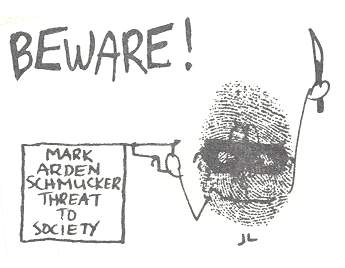 Mark Schmucker, a Goshen College senior from Alliance, Ohio, was the first Mennonite indicted for not registering since registration had
been resumed in 1980. His indictment, which came down on July 22, 1982, was a surprise. Becker, Smucker, and Miller had been
expecting to be indicted first. The difference was that the District Attorney in Cleveland prosecuted Schmucker while Frese in South
Bend, who was investigating the other three nonregistrants, dragged his feet on issuing indictments for nonregistrants.
Mark Schmucker, a Goshen College senior from Alliance, Ohio, was the first Mennonite indicted for not registering since registration had
been resumed in 1980. His indictment, which came down on July 22, 1982, was a surprise. Becker, Smucker, and Miller had been
expecting to be indicted first. The difference was that the District Attorney in Cleveland prosecuted Schmucker while Frese in South
Bend, who was investigating the other three nonregistrants, dragged his feet on issuing indictments for nonregistrants.
Schmucker's jury trial began on October 1, 1982 in Cleveland. He had pled "not guilty" because "pleading guilty doesn't give us a chance to challenge the constitutionality of the law-can the government force religious, conscientious resistors to register?" (196) A group of five Goshen students, Terry Stutzman, Director of Information Services, and Blosser (who went as the official college representative) attended Schmucker's trial. At the trial Blosser testified that Schmucker "was not out in left field, that he was solidly within church tradition." (197) During the closing arguments Gary Arbeznik, the District Attorney, made a strong statement against the stance that Schmucker was taking but his voice cracked and he seemed about ready to cry. Later he admitted that he had requested that the Justice Department drop the case, but they refused. The judge also admitted that "presiding over this case is not a task I would have chosen." On October 5, the jury found Schmucker guilty and Judge Ann Aldrich sentenced him to three years of probation, two years of service, and a $4000 fine, but Schmucker was not required to register. He began his service on October 26 at Emmaus Home, a center for mentally retarded adults, in Marthasville, Missouri. (198)
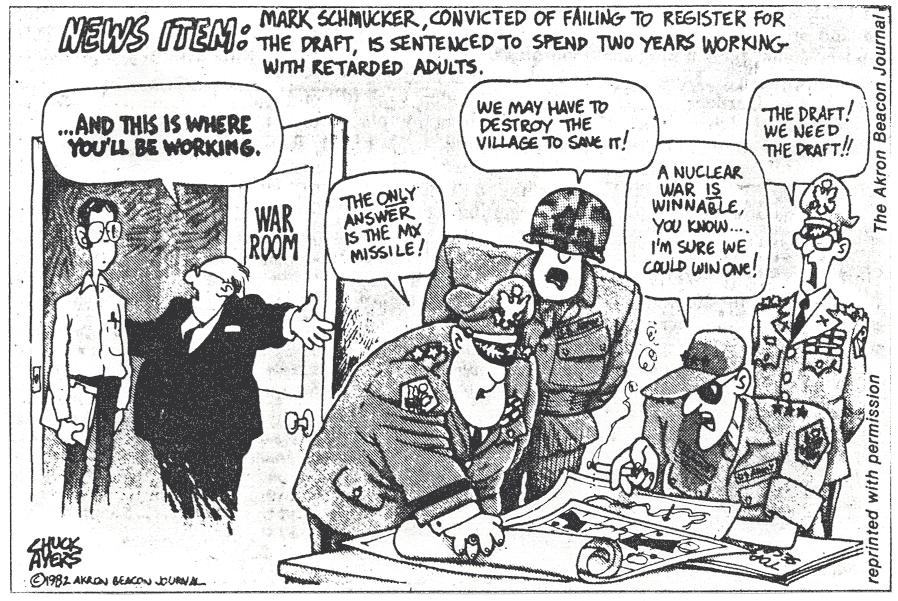
Throughout this experience, J. Lawrence Burkholder, the President of Goshen College, remained very supportive of Schmucker and his nonregistration stance. He appeared in a TV interview with Blosser and another nonregistrant, and offered to testify at Schmucker's trial even if it would mean losing some support for the college from conservative constituents. (199) After the trial, Burkholder released a statement stating Goshen College's official support for Schmucker. (200)
Schmucker decided to appeal his conviction in order to test the Selective Service law and to help out other court cases. But he did not appeal his sentencing. "We consider the sentence a victory," Blosser said. "We bear the court no hostility for its decision." (201) On November 25, 1983 the Sixth Circuit Court of Appeals overturned Schmucker's conviction. They ruled that Judge Aldrich should have granted him a evidentiary hearing on the issue of selective prosecution. The government is in the process of appealing this decision, but Schmucker was released from his service assignment. (202)
Meanwhile, another Goshen student, Todd Friesen, received a letter from the District Attorney. After an interview with the FBI Friesen decided to register. "The cost of nonregistration is too expensive to merely conform to other people's expectations," Friesen said. (203)
For almost a year after Schmucker's indictment in July of 1982, Becker, Smucker, and Miller expected their indictments to come down at any time. But Frese, the District attorney, kept stalling on handing down indictments. It was a heavy time for the three nonregistrants. They appreciated that Frese did not want to prosecute them, but it left them not knowing how to plan for the future. After May 1983, the three nonregistrants no longer received monthly threats of indictment. Maybe, Becker speculated, the Justice Department decided that the compliance figures were good enough so they quit pushing Frese to hand down indictments. (204) Two years later, in April of 1985, FBI agents looking for information on these nonregistrants visited Goshen College. Their case had been transferred from the District Attorney in South Bend to one in Fort Wayne, Indiana who claimed that he had "no reluctance to prosecute" them. The three nonregistrants, who thought that the issue of registration was dead, had left Goshen College, moving on to other issues and concerns. (205)
After considering immigrating to Canada, going underground, or plea-bargaining, Becker (now married and known as Weber-Becker) decided to register. "I don't feel as articulate now on thie (sic) issue as I did two years ago," Weber-Becker said. "It caught me off guard and my priorities have shifted." In 1984, the maximum fine for refusal to register was raised from $10,000 to $250,000 and Weber-Becker did not want to flirt with possibly having to pay such a large amount of money. "Spending such large amounts of money is as much an ethical question as is registration," he said. Registering "was the best among bad options," Weber-Becker and his spouse, Ann, concluded. "I think we'll probably feel for a long time a very deep sense of regret that we couldn't find a fourth option." Greg Smucker also decided to register, but Craig Miller "quietly disappeared" and the District Attorney could not locate him. (206)
Blosser, noting the lack of an "emotional push" against registration that existed when registration began in 1980, concluded that nonregistration had become "a pretty dead issue." (207) But several of the nonregistrants reacted rather strongly against this statement. They noted that legal questions about registration, specifically dealing with the "continuing duty" defense, still needed to be decided and that nonregistration could still play a major role in resistance to U.S. military activity in Central America. "We feel that increased threats (of prosecution) should in some way call for increased rather than decreased resistance," Phil Stoltzfus, one of the nonregistrants, noted. (208)
Eastern Mennonite College
Because of its relatively close proximity to Washington, D.C., it was easier for Eastern Mennonite College students to attend anti-registration demonstrations there and to draw on resource people who worked there than it was for students from other Mennonite schools. For example, at a forum on registration on February 8, 1980, Delton Franz from the Mennonite Central Committee's U.S. Peace Section Washington, D.C. office spoke on recent events that led to a renewal of draft registration. (209) Twenty EMC students participated in a demonstration against registration and the draft on March 22, 1980. (210)
On May 2 and 3, 1980, the Virginia Conference had an assembly on registration and the draft at EMC. Keim and George R. Brunk III, the dean of Eastern Mennonite Seminary, presented speeches which provided a framework for discussion. Brunk, who did not see registration as a military act, argued that nonregistration was an ambiguous witness and was not constructive persuasion. This assembly wrote a statement that recommended that people register as conscientious objectors, but supported those who felt they could not register. (211) Later the Virginia Conference changed this statement to give only recognition and respect to nonregistrants. André Gingerich commented that this statement seemed to give "second-class membership for nonregistrants, the individuals who have likely done more thinking on the issue and who are choosing a more costly response." (212)
In order to witness against registration, about thirty concerned people in the Harrisonburg area formed a group called Christians for Peace. During the summer of 1980 registration period they maintained a presence at the local post office, which they began and ended with worship services. Several Mennonites, concerned with Mennonites becoming too involved in politics, opposed this action even though EMC professors and local pastors took part in the presence. (213)
During the summer, Gingerich and Luke Hurst had been editing the Mennonite Non-cooperators' Newsletter from their homes in Harrisonburg, Virginia. When school began, Gingerich left for Swarthmore College near Philadelphia, Pennsylvania and Hurst moved to Washington, D.C. to be part of EMC's Washington Study Service Year. This provided for valuable contacts with other resistance groups, but it also meant that once a month for the next several months Gingerich would need to spend a very busy weekend in Washington with Hurst trying to put together an issue of the newsletter. (214) Although Hurst and Gingerich no longer lived in Harrisonburg, the work they had done with Park View Mennonite Church and other people in the community determined how many people there would view registration.
Christians for Peace, in an attempt to allow people who were not subject to registration to share in the "crime" of nonregistration, drafted a statement which declared that they knowingly counseled, aided and abetted others who refused to register. Under the Military Selective Service Act, such actions carry the same penalty as not registering. Twenty-eight people signed this complicity statement which they sent to Bernard Rostker, the Director of the Selective Service System. (215) About fifty people from Christians for Peace held a week long protest at the Harrisonburg Post Office during the mass registration period in January, 1981. They noticed a difference between the eighteen year olds who were registering this time and the nineteen and twenty year olds who had come to the post office to register during the summer. Very few of these young registrants had thought about how they would respond to a draft. (216)
Slowly, the Christians for Peace group moved beyond registration to broader issues of militarism. The main support group for nonregistrants at EMC grew out of the Peace Fellowship. At first, the nonregistrants met secretly. This seemed to be necessary because of EMC's reputation of cooperating with the Selective Service. During the Vietnam War the administration had handed over information to the Selective Service and actually pulled a nonregistrant out of classes to talk to the FBI. Naturally, the nonregistrants were paranoid that such things might happen again. It was not until the administration came out solidly in support of nonregistrants that they began to meet more openly. (217)
On November 11, 1981, the Peace Fellowship sponsored a panel of eight nonregistrants who discussed their reasons for not registering. (218) At this time there were at least ten nonregistrants at EMC. None of them had written to the Selective Service stating their refusal to register, and therefore none of them were being prosecuted. (219) A lot of organizing at both Bethel and Goshen revolved around the indictments and trials of nonregistrants at those schools. EMC did not have this organizing advantage. But Hurst and Gingerich demonstrated just how vocal a nonregistrant could be without being prosecuted, as long as he did not take that crucial step of writing the Selective Service. Both made many media appearances, including interviews with Rolling Stone Magazine, the Washington Post, and on the Today show.
By the fall of 1983 many of the nonregistrants, including Hurst and Gingerich, who had worked hard to develop nonregistration into an acceptable and understandable option had left EMC. With their respected "elders" gone, a new generation of nonregistrants began looking at what it meant to be a nonregistrant. Unlike 1980 when nineteen and twenty year old college students faced registration, most people already had made their decision whether or not to register by the time they entered college. "The issue of nonregistration itself was a past issue," one such nonregistrant said. "But the issue of what are we going to do now is new. I think I see a revival in the whole issue." (220) This group of nonregistrants began to meet weekly to discuss issues relating to registration. Once again registration was a current issue and the conscientious resisters at EMC looked for actions that they could take. One such step was to take on the responsibility for the editorship of the newsletter. They gave talks on registration in local high schools, and they sought to communicate their concerns with the wider church conferences. (221) Their attempts at speaking in local high schools often ending in frustration. "Everyone seemed so complacent!" Mike Yoder, one of the nonregistrants who gave talks, claimed. "Hardly anyone showed interest or seemed to recognize the importance of the question to register or not to register." Jody Shearer, another one of the nonregistrants, said, "I wish...that more was being done to make the younger people approaching the decision of registration aware that they have a choice. They don't need to register!" (222)
One issue that they dealt with at length concerned finding alternative sources of funding to make up aid that was being lost due to the Solomon Amendment. Nonregistrants were to have taken their stance "by reason of Christian calling and commitment" in order for the conference to replace their lost federal aid. (223) Most nonregistrants were not questioned on this point, but the leaders of the Virginia Mennonite Conference decided to check up on the faith of the nonregistrants at EMC before handing out any money. (224) Afterwards, Owen Burkholder, the Virginia Conference moderator, complimented the nonregistrants on their stance. He described them as having "dealt with the nonregistration question with a great deal of depth. These young men are processing this with a maturity far beyond their years!" He concluded, "Their Christian commitment is clear and their challenge to the church is genuine." (225)
Editing the newsletter can be a very time consuming task, but this energetic group of nonregistrants at EMC put together several issues during the 1983-84 school year. Halfway through the fall semester of the 1984-85 school year they managed to put together another issue, but suggested that it was time for the newsletter to move on to new "keepers of the vision." Perhaps another "second generation" of nonregistrants would arise at another Mennonite college to take on this responsibility. (226)
Other Colleges
Bluffton College in Bluffton, Ohio was not a center of intense anti-registration activity as were Bethel, Goshen, and Eastern Mennonite College. Still, in its own way, the Peace Club at Bluffton dealt extensively with registration. However, most of the students who put their time and energy into the registration issue were either too old or female and therefore not directly faced with registration. Although few people made use of it, the Bluffton College Peace Club organized a network of five faculty members and four students that were willing to do draft counseling. (227) These four students, Steve Basset, Iris Neufeld, Kathleen Kern, and Paul Weaver, maintained a protest at the Bluffton Post Office during the week of mass registrations during January 1981. Basset explained that they were not advocating a specific option, but were simply explaining the options to eighteen-year-olds who may not have been aware of them. (228) Their work can be juxtaposed against an article the Public Affairs Office submitted for publication in the student newspaper which informed eighteen-year-olds of their duty to register. The article concluded, "Those who have not (registered) are encouraged to do so as soon as possible." (229)
Once a year the Intercollegiate Peace Fellowship, a group encompassing the peace clubs of all the Mennonite colleges in North America, met to discuss issues of social relevance. Often, this was a time for conscientious resisters to gather together and discuss registration and their responses to it. One such conference that met at Bluffton on October 22 to 24, 1981, discussed the topic of "Christian Peace Making and the State." The resource person, Don Blosser, gave a keynote speech on "What does the Bible say about the State?" (230) While this conference was not specifically on registration, due to the timeliness and relevance of this subject much discussion revolved around it.
Even though Freeman Junior College is a small and rather conservative school and not much anti-registration occurs there, its administration adopted a policy on Christian civil responsibility. If a person who is connected with the college commits an act of civil disobedience, that person must prove his or her sincerity and show that the action is based on Christian conscience and Biblical principles in order to be exempted from the normal disciplinary actions that the college would take against a person who commits a felony. (231) It was not clear why the administration developed such a policy, but it may have been designed as a way to deal with a board member who was contemplating resisting paying his war taxes.
The administration implemented this policy only one time, in the instance when Mark Becker, while a student at Freeman Junior College, decided not to register for the draft. The procedure of the policy resulted in numerous meetings and hearings with the administration and the requirement of getting a letter of support from his church. (232) Eventually the administration passed a resolution to grant Becker "our support, our love and our prayers." (233) This encounter with this policy was a negative experience but, even though the Peace Club questioned the validity of the policy, the Board of Directors chose to retain it. After this initial encounter, subsequent nonregistrants have not been confronted with it. (234)
CONCLUSION
WHERE DO WE GO FROM HERE?
Most nonregistrants who dealt extensively with registration during the early 1980s no longer spend much time in fear of the consequences of their resistance. Much of the controversy and uncertainty of nonregistration is now past; resistance has become a way of life. No one can live with that fear and uncertainty year after year. Instead, these resisters moved on to deal with other issues. Nuclear issues (energy and war) have been around for decades and still continue to be pressing. For many resisters, a logical outgrowth of draft resistance was to resist the United States intervention in Central America. Numerous nonregistrants have traveled, lived and worked there, often with school sponsored programs.
These conscientious resisters continued to deal with lifestyle issues. Coming to a new understanding of gender roles was often a topic of discussion. They attempted to integrate their youthful idealism of living in community and a respect for life and the environment with a need to deal with realism as they entered the "real world" and took on "real jobs." For some, earning a taxable income meant resisting paying war taxes. More and more nonregistrants got married and this relationship often surpassed that of registration in terms of importance. They learned to deal with more and more responsibility.
For four years Jim Amstutz held the post of Director of Draft Counselor Training for the Mennonite Central Committee's U.S. Peace Section. His concern for, and support of, nonregistrants encouraged many of them to continue on the path which they traveled. By 1984, his work no longer was as important as it initially was and, in July 1984, he left this position. Abel Aquino took his place, bringing with him a concern for minority military counseling. This probably is, after all, more important than counseling middle-class Mennonites on registration issues. Conscientious Resisters at Bethel (CRAB), the support group for nonregistrants at Bethel College that once was very active, did not meet once during the 1984-85 school year. Eastern Mennonite College experienced a "second generation" of nonregistrants, a new wave of conscientious resisters with renewed energy and a new vision. It remained to be seen if the same phenomenon occurs elsewhere.
Although indictments slacked off tremendously after 1982, registration was not dead and prosecutions were not over. During the summer of 1985, a number of nonregistrants received relatively harsh sentences. The government made other moves against nonregistrants, but this news no longer received front page publicity like it once did. Occasionally the reality of a decision that he made years ago not to register came back to a nonregistrant in the form of a warning letter from the Selective Service System threatening prosecution unless he registered. Nonregistrants dealt with such threats in various ways. One nonregistrant who ignored the warning letters simply commented, "I get a lot of junk mail." (235) The Solomon Amendment which cut off student financial aid for nonregistrants remained in effect, and will continue to be in effect for the foreseeable future. Conscientious resisters needed to deal with how to acquire sources of funding to replace this lost aid for the many years to come.
Like several other nonregistrants, David Boshart, a nonregistrant from Eastern Mennonite College, got married and a year later was expecting a child. He attempted to receive job assistance from a federal program but found that he was ineligible due to his nonregistration. With the responsibilities of raising a family at hand, Boshart commented, "I doubt that I can remain a nonregistrant. I am still very sold on the position. I always will be." Boshart concluded that he would "have to find new, creative ways of working for peace." (236)
Although many conscientious resisters moved on to other issues and registration is no longer a primary concern, it has left a major imprint on them and helped shape their characters. Irvin Bomberger, the Associate Director of the National Interreligious Service Board for Conscientious Objectors, noting his readiness to move on commented, "it's kinda like an era has closed." Yet, he concluded, "if we have a draft, I will be back." (237)
APPENDIX I
CHRONOLOGY
1972
December-Last draft induction orders issued.
1975
April 1-President Ford terminated registration program that has been in effect since 1948.
1977
November 11 & 12-Mennonite Central Committee's U.S. Peace Section's Assembly on the Draft and National Service held in Kansas City, Missouri.
1979
December 26-Soviet Union invaded Afghanistan.
1980
January 23-President Carter, in his State of the Union address, announced his intent to reinstate draft registration.
February 11--Carter presented registration proposals to Congress; requested authorization to register women.
March 27-29-MCC U.S. Peace Section Assembly on Registration and the Draft held in Goshen, Indiana.
April 22-House approved draft registration.
June 3-Mark Hatfield led filibuster against registration on Senate floor while CARD held vigil on the Capitol steps.
June 12-Senate approved draft registration.
June 25-House approved Senate version of registration bill.
July 2--Carter issued proclamation ordering registration.
July 12-18-General Conference at Estes Park, Colorado.
July 18-Registration declared unconstitutional on basis of sex discrimination (Goldberg vs. Rostker).
July 19-Goldberg decision stayed.
July 21-August 2-Registration of men born in 1960 & 1961.
November 7-Ronald Reagan elected President.
1981
January 5-10-Registration of men born in 1962; continuous registration of 18 year olds begins.
February 19-21-Conference on "Conscience and Registration" at Bethel College.
June 17-Selective Service sent out 150 warning letters.
June 25-Goldberg overturned; male only draft is constitutional.
August 11-16-Mennonite Church Assembly at Bowling Green.
December 10-Nonregistration prosecution temporarily suspended.
1982
January 1-3-MCC's retreat on registration at Laurelville.
January 7-Reagan announces he will continue registration; provided for "grace period."
February 28-"Grace period" ends.
June 30-First nonregistrant (Ben Sasway) indicted.
July 28-House passed Solomon Amendment barring nonregistrants from receiving federal financial aid.
July 29-Mark Schmucker indicted.
September 21-Kendal Warkentine and Chuck Epp indicted.
October 5-Mark Schmucker convicted; appealed conviction.
November 15-Wayte dismissed; District Court ruled registration illegal.
1983
March 7-Warkentine sentenced; registers as CO.
August 1-7-GCs and MCs gather for Bethlehem '83.
October 1-Solomon Amendment went into effect.
November 25-Appeals court ruled in favor of Schmucker.
1984
June 25-Government dismissed charges against Epp.
July 5-Supreme Court upheld constitutionality of Solomon Amendment.
1985
March 19-Supreme Court ruled against Wayte on selective prosecution defense.
APPENDIX II
SELECTIVE SERVICE WARNING LETTER

June , 1981
Dear Mr. :
We have received information that you may be required to register with Selective Service under provision of the Military Selective Service Act, but a check of our records indicates that you have not registered. The purpose of this letter is to check the accuracy of this information. Please understand that we are required by law to refer possible violators of the Military Selective Service Act to the Department of Justice. If a person is convicted of violation of the Act he may be imprisoned for not more than five years or fined not more than $10,000 or both.
Generally, a male who is not already in the active Armed Forces is required to register with Selective Service if he was born in 1960, 1961 or 1962, or if born in 1963 or a later year, within 30 days of his eighteenth (18) birthday. If a person required to register fails to do so because of "some condition beyond his control" he must be able to prove that the "condition not under his control" prevented him from registering. If the "condition" changes he has 30 days to register. Generally, being in prison or confined in a hospital or institution qualifies as a "condition beyond his control."
In order for us to clear our records, and not forward your name to the Department of Justice for investigation by the Federal Bureau of Investigation you must take one of the following actions:
- If, as described above, you are required to register and have not already done so, please fill in the enclosed form and mail it to Selective Service in the enclosed envelope.
- If, as described above, you are required to register but have not already done so because of a continuing "condition beyond your control", please indicate in a letter mailed in the enclosed envelope your reason for your continued nonregistration.
- If, as described above, you are required to register and believe that you have registered, please send us a copy of your Registration Acknowledgement letter (SSS -Form 3) or provide us your Selective Service number in the enclosed envelope.
- If, as described above, you do not believe you are required to register please explain why you feel you do not have to register and provide proof of your status in the enclosed envelope. Proof will vary from case to case but, may be a copy of your birth certificate, a DD Form 53 or similar form showing your active duty status in the military, a statement, in English, from the diplomatic agency of the country of which you are a subject explaining why you are not required to register, or other document which supports your claim.
Please note that sending false information in response to this letter may be a violation of the Military Selective Service Act and may subject the sender to the penalties described above.
Let me stress that unless we hear from you within 15 days of the date of this letter we will send your name to the Department of Justice for investigation and possible prosecution. If you have registered or if you are a person who is not required to register we are sorry for any inconvenience this letter may cause you and we appreciate your help in clearing our records.
Sincerely,
Henry N. Williams
General Counsel
March 5, 1980
To the Park View Congregation:
With the possibility of registration facing the nation, young people are asking themselves some difficult questions. As we attempt to discern what our response to the possibility of military registration should be we are impressed with the need to enter into dialogue and processing with the community of faith, the church.
As followers of Christ we think it essential to work through important and difficult issues together in order to more fully find Truth, to build mutual accountability and responsibility, to maintain understanding and to provide corporate support for the actions which result. For these reasons we are bringing our concerns about registration to the Park View Congregation.
As a premise to a discussion on registration, we feel it necessary to emphasize that we seek the will of God to be the basis for action and not the direction of earthly powers, the state included. We seek to follow Truth. Because of this, our actions will not necessarily be compatible with this nation's laws.
As we work through these issues we find it increasingly difficult to see the process of registering and then applying for CO status as the only option or is the most faithful one. In the first place, we find it difficult to make clear distinctions between registration, the draft and war. To engage in massive war (other than nuclear) a draft is essential; and without registration, a draft is impossible. Furthermore, US history shows that almost every time there has been a draft it has been followed by a war, and that every time there has been military registration there has been a subsequent draft. In other words, participation in the registration process involves participation in the whole war process. In fact, Carter's 'expressed purpose in proposing registration is to militarily threaten' the Soviet Union. The nature of registration is made clear in a statement by Rep. Richard White, chairman of the House Armed Services Military Personnel Subcommittee, who stated that the whole purpose of registration is to provide a manpower reservoir for combat.
The second problem we see with filing for CO status is that by participating in the process which forces people to choose between military duty and non-military governmentally supervised alternative service, we are condoning this process. To condone this process is actually to support the choice of those who decide to take up arms. We have then, agreed that the government has legitimacy in inducting youth into military service in return the government has allowed us exemption from personal participation in killing.
Because we see registration as the first step in the war process, because we cannot grant the government legitimacy in arming America's youth; because we cannot condone the decision of those youths who choose to fight; and because our conscientious objection to war means objection to much more than just personal involvement in killing we find it difficult to plan to register and then file for CO status. In light of the above, the option that makes the most sense to us is to not register.
This is not an easy decision to make. Because of the gravity of this decision and because of the importance of community to Christians we are asking that the Park View Congregation struggle with us through this question. Grant it that we, and perhaps others from the congregation, will not be registering, we are asking whether you, as a congregation, can support us and in what, ways you will express this support.
Luke Hurst
André Gingerich
APPENDIX IV
Estes Park
July 16, 1980
Draft Proposal
The "Carter Doctrine," specifically registration, is forcing us to reevaluate our Christian ideals. Once again the specter of war and destruction in raising its head to see if we are ready for reaping. The government is passing laws that will control and guide the lives of our nation's young men.
In response to the government's demands, we consider the teachings of Jesus Christ as a guide for our lives. He taught that we should love our enemies, do good to those who hate us, and to help the poor and oppressed. His life exemplified this instruction to serve and to love all people. Service to our sisters and brothers should be the main purpose of our lives. We feel this is in direct conflict with the preparation for war through draft registration. Therefore, we stand with the Anabaptist tradition of refusal to carry the sword.
Because of our beliefs we cannot in good conscience register with the Selective Service for the following reasons: 1) We have been asked to register for no other reason than military service. There does not exist a legal option for those who feel that they cannot be part of a registration process that is designed only to strengthen our military. 2) Registration is being used by President Carter to publicly threaten the Soviet Union. Carter has indicated that by registering the U.S. is showing our willingness to fight. We feel that such a threat of violence is as wrong as violence itself and, therefore, cannot participate in it. 3) We also feel that when the military complex has an unlimited supply of manpower they will be more willing to use military solutions to solve international conflicts. 4) Registration is the first step in the state asking for military participation.
Therefore, we feel we must now stand up because of our religious convictions and say "no" towards registration.
However, we realize that this is not the only option. Compliance with the registration laws or adding additional information as to your beliefs are both legitimate options if done with a clear conscience.
Therefore, we ask that you re-affirm the intent of the 1971 statement which was that we pledge the resources of our brotherhood to supportive ministry of young people faced with the question of registration.
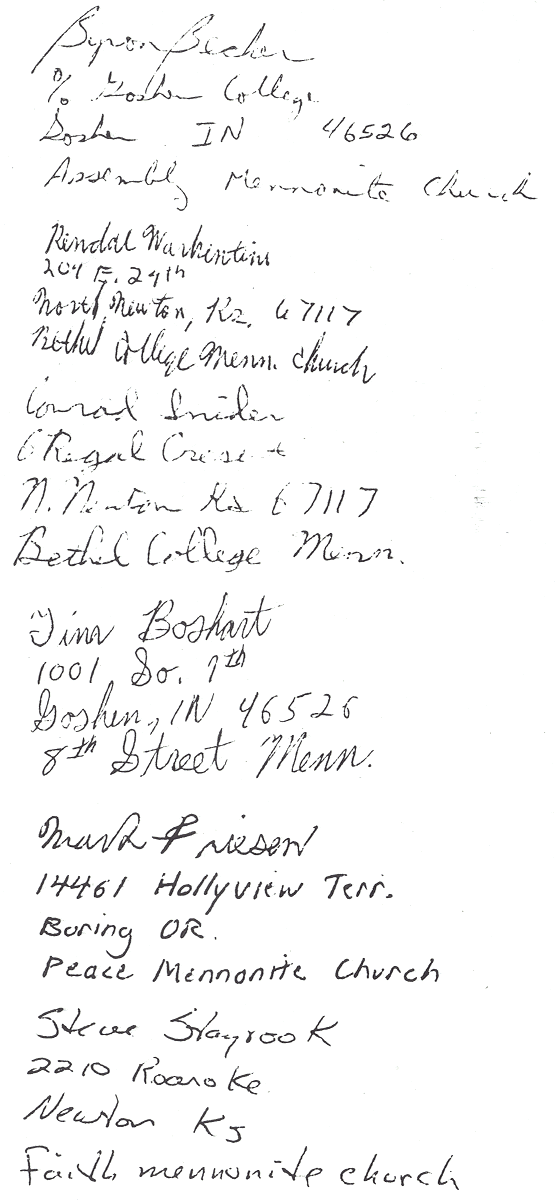
APPENDIX V
Bowling Green
As young men of the Mennonite Church we affirm the church's historic commitment to Jesus Christ and his way of peace and justice. In the past months we have been faced with a decision, which challenges our commitment to this way of life. The government has required that young men register for the military draft. In an effort to live out our peacemaking convictions we have chosen not to register.
As Christians seeking to follow the example of Jesus we must place our primary allegiance with God. Our allegiance to nation is only secondary. In a country committed to defending its interests by amassing stockpiles of weapons Christians will undoubtedly find themselves in direct conflict with the purposes of the state and at times with its laws.
Registration was initially posed as a military threat in response to Soviet intervention in Afghanistan. Registration increases the likelihood of a draft and is an important link in the chain, which ultimately leads to war. Much more subtly, registration psychologically prepares the nation for a draft and armed conflict. We cannot in good conscience participate in this step toward war.
We fear that conscientious objector status has all too often furthered the aims of conscription. Has the government succeeded in taking friction out of the war machine by giving privileged status to members of the Historic Peace Churches who are certain to oppose military service? Are we, by working within the conscription system, granting that system the legitimacy to draft others for war?
We wish to express our appreciation for the invaluable support from our home congregations and communities. We also gratefully acknowledge the support the Mennonite Church extended to non-registrants at Turner, Oregon in 1969. At that time a resolution was adopted stating in part: "We recognize the validity of noncooperation as a legitimate witness and pledge the offices of our brotherhood to minister to young men in any eventuality they incur in costly discipleship." This statement was reaffirmed at the General Assembly in Waterloo, Ontario two years ago. In the next months as the likelihood of prosecution increases your continued support will be very important, both to us and to those faced with this choice in the future.
In coming to this position as individuals and as a group we have spent much time in prayer, thought, and dialogue with brothers and sisters in the church. This is not a decision to be taken lightly.
As the Church faces the reality of militarism today, we are all challenged by the words from Deuteronomy:
I call heaven and earth to witness against you this day, that I have set before you life and death, blessing and curse; therefore choose life, that you and your descendants may live.
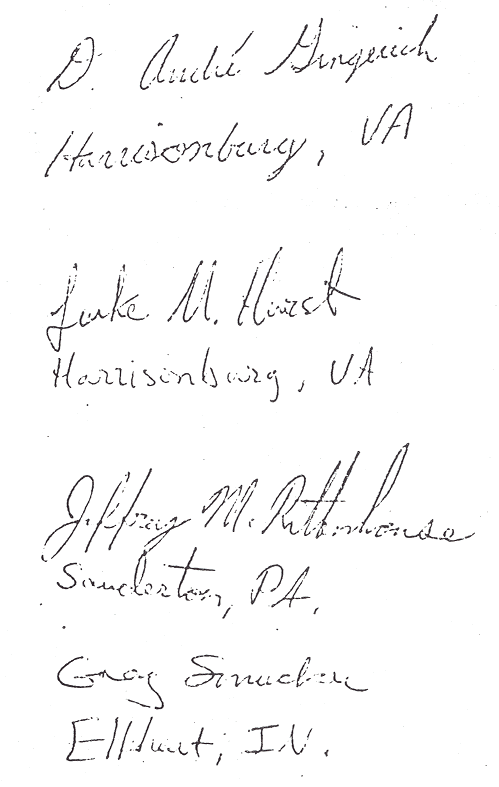
August 15, 1981
APPENDIX VI
ORAL HISTORY INTERVIEWS
The starting point for this paper on Mennonite resistance to draft registration was a series of oral history interviews. In preparation for these interviews, Mark Becker (the interviewer) developed the following list of questions to help guide him through the interviews:
Oral History Questionnaire for Non-registrants
1.) Name
2.) Date and place of birth
3.) Mother and Father-names and occupations
4.) Other residences (where were you raised?)
5.) Siblings-numbers & ages
6.) Church life-home church, present church, and level of involvement
7.) High School. College? where, years, major, minors, extra activities
8.) VS? Life outside US? Travels.
9.) Registered? where, when
10.) When did you first consider non-registration?
11.) Other options considered
12.) Influences: persons, experiences, readings
13.) Family response to your non-registration. Also active in this issue? Positions in past wars
14.) Presentation in church? reactions, pastor's response/role
15.) Other non-registrants in home church/community?
16.) Other conferences, experiences
17.) Goal or purpose in not registering
18.) What kind of issue is registration? Describe that belief in general, effects of registration on beliefs
19.) How public: letters, gov't, radio/TV, articles, demonstrations
20.) Legal action: warning letters, etc. Future of case? Future of registration/draft
21.) Register for financial aid
22.) Advocate non-registration for others?
23.) Future plans
24.) Comments
25.) (written materials)
Although these questions were orientated toward the situation of a man who had refused to register, this project also covered people who were not bona fide nonregistrants-people who opposed registration but registered for one reason or another or were not directly confronted with the registration requirement because of their age or sex. Numerous church leaders made very significant contributions to this issue and were therefore also included in this project.
Between April and October of 1984, Becker conducted fifty-seven of these interviews. About half of these were done in the vicinity of Bethel College, and the other half during a month long, four thousand mile, hitchhiking trip to the east coast during the summer of 1984. Upon returning to Bethel College, Becker wrote up a summary report on each interview. The summary report followed the pattern of:
Mark Becker (interviewer)
Interviewee__________________________________________________Date______________
Tape_______Side________Indicator________Place___________________________________
Date of Birth_________________Raised in__________________________________________
Home Church _______________________Occupation_________________________________
College_____________________________VS?_______________________________________
Registration Status_______________________Legal Action_____________________________
Outline of Beliefs and Experiences:
In addition, for each interview the interviewee and interviewer signed a "STATEMENT OF RELEASE" which stated that they donated the interview to Bethel College's Department of History "for the purposes of historical research and to further the cause of scholarship."
These materials, including thirty-six cassette tapes containing the interviews of the following people, are in the Oral History Collection in the Mennonite Library and Archives on the Bethel College campus in N. Newton, Kansas:
| Interviewee | Address | Date |
| Amstutz, Jim | MCC Akron | July 27, 1984 |
| Amstutz, Neil | Hesston College | April 28, 1984 |
| Becker, Ivan | Marion, SD | August 6, 1984 |
| Blosser, Don | Goshen College | July 26, 1984 |
| Bomberger, Irvin | NISBCO Washington | July 20, 1984 |
| Bonnet, Scott | Bethel College | May 7, 1984 |
| Dyck, Teresa | Goshen College | July 27, 1984 |
| Ebersole, Kevin | Bethel College | Oct. 4, 1984 |
| Engle, David | Bethel College | Oct. 27, 1984 |
| Epp, Tim | Bethel College | May 18, 1984 |
| Ewy, Ron | Bethel College | May 14, 1984 |
| Flickinger, Sue | Bethel College | May 14, 1984 |
| Franz, Delton | MCC Washington | July 23, 1984 |
| Friesen, Karl | Bethel College | Sept. 21, 1984 |
| Friesen, Mark D. | Bethel College | May 24, 1984 |
| Friesen, Mark G. | Bethel College | May 2, 1984 |
| Gabrielson, Nils | Wichita, KS | May 5, 1984 |
| Gehring, Richard | Bethel College | May 8, 1984 |
| Gingerich, André | Swarthmore | July 22, 1984 |
| Gingerich, Pierre | Swarthmore | July 21, 1984 |
| Gundy, Ron | Bethel College | May 17, 1984 |
| Harkin, Bernie | Chicago, Ill | July 4, 1984 |
| Hiebert, Jennifer | Bethel College | May 14, 1984 |
| Hochstetler, James | Hesston College | April 22, 1984 |
| Hull, Robert | GCMC Newton | May 29, 1984 |
| Hurst, Carol | EMC | July 22, 1984 |
| Isaak, Garth | Bethel College | May 18, 1984 |
| Jost, Scott | Bethel College | May 27, 1984 |
| Lehman, Karl | Bethel College | May 1, 1984 |
| Liechty, Jon | Goshen College | July 27, 1984 |
| Loganbill, Fred | GCMC Newton | August 10, 1984 |
| Lohrentz, David Yanada | Bethel College | August 14, 1984 |
| Lohrentz, Tim | Bethel College | August 13, 1984 |
| Metzler, Ed | Elkhart, IN | July 6, 1984 |
| McCall, Donovan | Wichita, KS | May 5, 1984 |
| Neufeld, Randy | Chicago, Ill | July 3, 1984 |
| Platt, Richard | Bethel College | May 1, 1984 |
| Schrag, Paul | Bethel College | Sept. 9, 1984 |
| Shearer, Jody | EMC | July 11, 1984 |
| Shenk, Steve | EMC | July 10, 1984 |
| Shirk, Juanita | EMC/Goshen College | July 6, 1984 |
| Shrock-Hurst, Luke | EMC | July 24, 1984 |
| Smucker, Joe | Bethel College | May 5, 1984 |
| Smucker, Nathan | Bethel College | May 11, 1984 |
| Speigle, Sam | Hesston College | April 22, 1984 |
| Stahl, Ramona | EMC | July 22, 1984 |
| Stayrook, Steve | Bethel College | June 24, 1984 |
| Stoltzfus, Philip | Goshen College | July 22, 1984 |
| Stoner, John | MCC Akron | July 10, 1984 |
| Stutzman, Jim | Bluffton College | July 6, 1984 |
| Waltner, Jerome | Bethel College | Sept. 17, 1984 |
| Warkentine, Kendal | Bethel College | June 28, 1984 |
| Weber, Monroe | EMC/Goshen College | July 5, 1984 |
| Weber-Becker, Ann | Goshen College | July 5, 1984 |
| Weber-Becker, Byron | Goshen College | July 7, 1984 |
| Wenger, Gordon | EMC | July 11, 1984 |
| Yoder, Micheal | EMC | July 24, 1984 |
A note on names: More and more nonregistrants are getting married, and therefore Luke Hurst has become Luke Shrock-Hurst and Byron Becker has become Byron Weber-Becker. In this list of interviews, they are alphabetized accordingly.
This project is not exhaustive. Becker was not able to track down everyone who should have been included in a project like this (a couple were in Europe during the summer of 1984 when he wanted to interview them), and time and distance separated him from others. Very few people declined the request to be interviewed about their experiences and beliefs. Becker is willing to lend his assistance to anyone who might be interested in carrying this project forward.
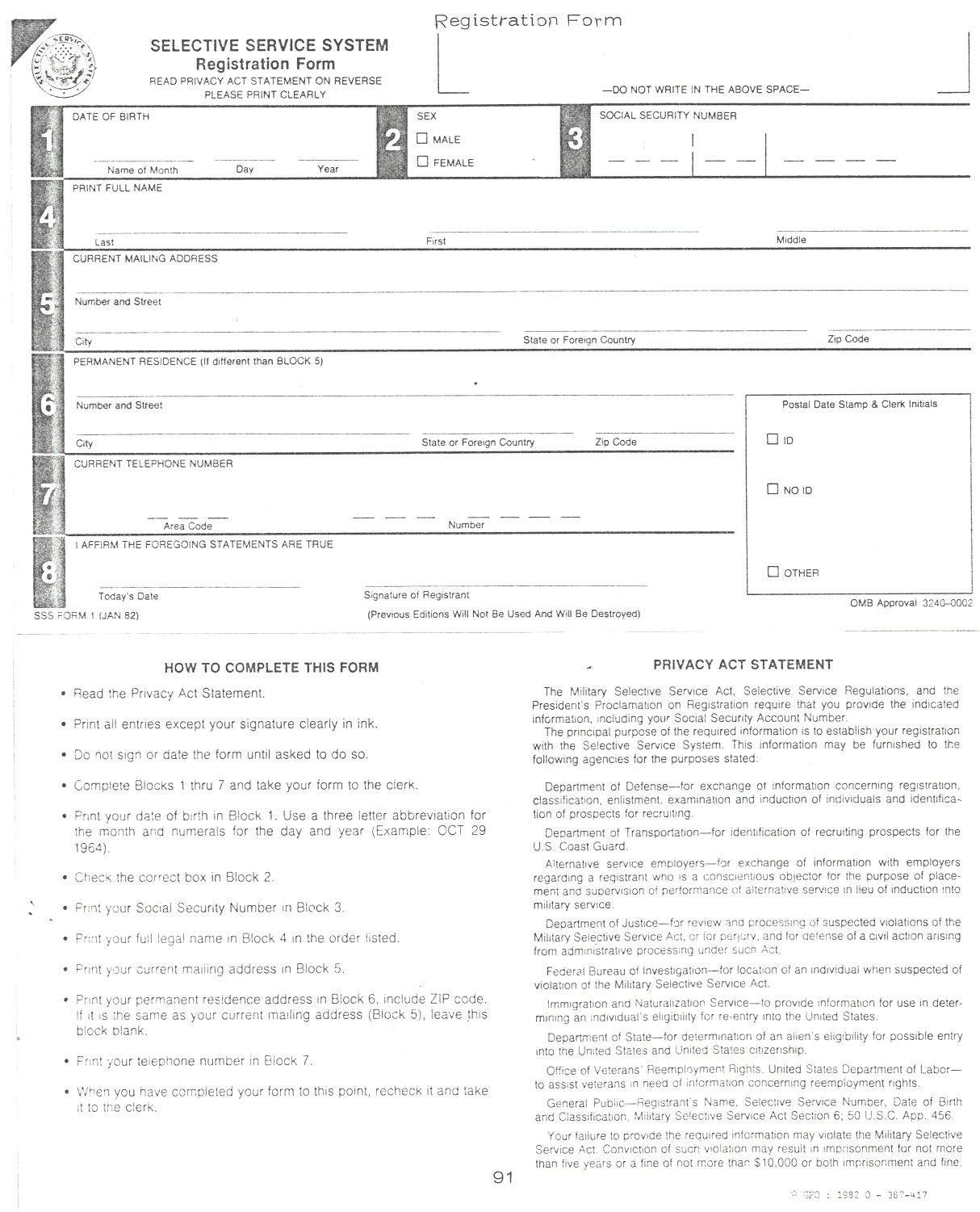
ENDNOTES
1. James C. Juhnke, "Mennonites and Military Conscription in the Twentieth Century," Mennonites and Conscientious Objection in 1980 (Akron, PA: Mennonite Central Committee (MCC) U.S. Peace Section, May 1980), p.19.
2. Robert Seeley, "Three Hundred Years: The Struggle for Conscience in America" (Philadelphia, PA: Central Committee for Conscientious Objectors (CCCO), 1976), p. 1.
3. Lillan Schlissel, ed., Conscience in America (New York: E.P. Dutton Co., 1968), p. 28.
4. Lt. Col. Neal M. Wherry, Conscientious Objection (Washington, DC: Government Printing Office, 1950), pp. 29-30.
5. Guy F. Hershberger, War Peace, and Nonresistance (Scottdale, PA: Herald Press, 1969), p. 100.
6. Wherry, ibid., p.34.
7. Ibid., p. 38.
8. Ibid., pp. 41, 45.
9. Howard Zinn, A People's History of the United States (New York: Harper & Row, 1), p. 187.
10. Hershberger, ibid., pp. 108-09.
11. Juhnke, ibid., pp. 20-21.
12. Kendal Warkentine, Military Justice in World War I: Court-Marital Trials of Mennonite Conscientious Objectors, Social Science Seminar, Bethel College, N. Newton, KS, February 1983, p. 25.
13. Hershberger, ibid., p. 114.
14. Seeley, Handbook for Conscientious Objectors (CCCO, April 1981), p. 153.
15. Allan Teichroew, "World War I and the Mennonite Migration to Canada to Avoid the Draft," Mennonite Quarterly Review, July 1971, p. 246.
16. Melvin Gingerich, Service for Peace (MCC, 1949), p. 1.
17. Juhnke, ibid., p. 23.
18. Seeley, Three Hundred Years, p.3.
19. Ibid., p. 5; Seeley, "The Vietnam Resistance," News Notes, Summer 1985, p.4.
20. Melissa Miller and Phil M. Shenk. The Path of Most Resistance (Scottdale, PA: Herald Press, 1982), p. 13.
21. Director of Selective Service, Semiannual Report of the Director of Selective Service: Jan 1, 1975 - June 30, 1975, (Washington: Government Printing Office, 1980), pp. 1-2.
22. Semiannual Report: Jan 1, 1976-June 30, 1976 (Washington: GPO, 1976), p. 9.
23. "Transcript of Presidents State of the Union Address to Joint Session of Congress," New York Times, January 24, 1980, p. A12.
24. "Congressional Watchdog," National Interreligious Service Board for Conscientious Objectors' Reporter for Conscience' Sake, December 1979, p. 4.
25. "Carter Calls for Registration of Women," Reporter, March 1980, pp. 1, 5.
26. Ibid., p. 1.
27. "Thirty Thousand March on Washington," Reporter, April 1980, p. 3.
28. "SSS Called Registration Unnecessary," Reporter, March 1980, p. 5.
29. "House Approves Summer Registration, Hatfield to Lead Filibuster in Senate," Reporter, May 1980, p. 1.
30. "Congress Approves Summer Registration," Reporter, July 1980, p. 1.
31. Semiannual Report: April 1, 1980 - Sept 30, 1980, p. 6.
32. "Congressional Watchdog," Reporter, p.4; Semiannual Report: April 1, 1980 - Sept 30, 1980, p. 19.
33. Carey Winfrey, "Prospect of the Draft Gets a Mixed Reaction From Feminists," New York Times, Jan 25, 1980, p. A16.
34. Emmett Lehman, A Statement of Position Regarding H.R. 6569 Amending the Selective Service Act-Submitted to the Subcommittee on Personnel of the House Committee on Armed Services-Presented at Public Hearings on March 5, 1980, in Washington, D.C., Mennonite central Committee (Akron, PA) collection.
35. Semiannual Report: April 1, 1980 - Sept 30, 1980, p. 19.
36. "Congressional Watchdog," Reporter, March 1980, p.6.
37. "Carter calls for Draft Registration of Women," Reporter, March 1980, p. 1.
38. Semiannual Report: April 1, 1980 - Sept 30, 1980, p. 19.
39. Semiannual Report: April 1, 1981-Sept 30, 1981 (Washington: GPO, 1981), p.14.
40. Semiannual Report: Oct 1, 1980- March 31, 1981 (Washington: GPO, 1981), p. 6.
41. Draft Agency Appeals 'Wolman,' Asks Stay," Reporter, Jan 81, p. 1.
42. Semiannual Report: Oct 1, 1980 - March 31, 1981, p. 6.
43. Semiannual Report: Oct 1, 1981-March 31, 1982 (Washington: GPO, 1982), p. 20.
44. Ibid., p. 5.
45. Ibid., p. 22.
46. Semiannual Report: April 1, 1982 - Sept 30, 1982 (Washington: GPO, 1982), p. 10.
47. "News," Mennonite Central Committee's U.S. Peace Section's Draft Counselor's Update, Oct 1980.
48. Semiannual Report: April 1, 1980 - Sept 30, 1980, p. 12.
49. Semiannual Report: Oct 1, 1980 - March 31, 1981, p. 3.
50. Ibid., p. 4
51. Compiled from Semiannual Report: April 1, 1980 - Sept 30, 1980, p. 3; Oct 1, 1980 - March 31, 1981, p. 4; Oct 1, 1981 - March 31, 1982, p. 2; Oct. 1, 1981-March 31, 1982, p. 2; April 1 - Sept 30, 1982, p. 3; Oct 1, 1982 - March 31, 1983, p. 3; April 1, 1983 - Sept 30, 1983, p. 2; Oct 1, 1983 - March 31, 1984, p. 2. Any discrepancies in figures are the Selective Service's. (i.e.- It is not a typo that 0.5% less people born in 1962 were registered as of September 30, 1983 as compared to half a year earlier. Apparently this is due to a shift in the estimate of the population figure.) The Selective Service did not release compliance figures for September 30, 1984 or March 31, 1985, but on February 21, 1985 Selective Service Director Turnage revealed that the overall compliance rate stood at 98.6% and that the lowest compliance was for 1965 (the primary call-up year if there was a draft) which stood at 95.8% (Chuck Epp, "Turnage Questioned on Booklets, Form 22," Reporter, March 1985, p. 3.).
52. Luke Hurst, "Prosecutions ... Soon?", Mennonite Conscientious Resisters' Newsletter (MCRN), July 30, 1981, p. 1.
53. Selective Service Law Panel Newsletter, Selective Service Law Panel of Los Angeles, Oct 21, 1981, p. 1.
54. "Nonregistration," Update, Nov 1981.
55. "Reagan Nominates Military Man for Selective Service," Reporter, Sept 1981, p. 1.
56. Semiannual Report: Oct 1, 1981 - March 31, 1982, p. 19.
57. "Bulletin on Nonregistration," CCCO, Nov 3, 1981.
58. George C. Wilson, "Draft Registration Violator Finds He's Signed Up, and Objects," Washington Post, Nov 25, 1981.
59. Tim Boshart, "Registration Continues," MCRN, March 1, 1982, p. l.
60. Paul Trudeau, "Resistance Road Trip," Resistance News, June 1982, p. 2.
61. "Reagan and the Draft," Update, Dec 1980.
62. Interview with Edgar Metzler, Elkhart, IN, July 6, 1984, Mennonite Library and Archives (MLA) Oral History Collection.
63. "Reagan's Wisdom," MCRN, March 1, 1982, p. 3.
64. "Sabo-Green Bill Cuts SS Funding," MCRN, Feb 8, 1983, p. 3.
65. Naomi Thiers, "Grace Period Passes with Little Fanfare," Reporter, March 1982, p. l.
66. "Third Supplement to Legal Defenses in Non-Registration cases under the Military Selective Service Act," Selective Service Law Panel Newsletter, March 18, 1982, pp. 1-2.
67. "Administration Weighed Draft Prosecution Policy," Wichita Eagle-Beacon, May 19, 1982.
68. Lori Linenberger, "Draft Officials to 'Get Tough' on Unregistered," Eagle-Beacon, August 3, 1980, p. lE.
69. Semiannual Report: April 1 - Sept 30, 1982, p. l.
70. Edward T. Pound, "Warning is Issued on Draft Signup," New York Times, March 26, 1982, p. 16A.
71. Charles Fishman, "One Draft Resister and His Dilemma," Washington Post, July 12, 1982, p. C3.
72. "Enten Eller: Statement of Position," MCRN, Sept 15, 1982, p. 3.
73. Adapted and updated from Semiannual Report: Oct 1, 1984 March 31, 1985, p. 10.
74. "Kendal Warkentine: Position," Stephanie Hiebert collection.
75. Interview with Kendal Warkentine, N. Newton, KS, June 28, 1984.
76. Ann Clark, "Prisoners Of Conscience," Reporter, Sept 1984, p. 2.
77. Edward Hasbrouck, "When the Indictment Comes," Resistance News, July 1984, p. 2.
78. Naomi Thiers, "POC," Reporter, Nov 1982, p. 3.
79. Ann Clark, "POC," Reporter, Dec 1982, p. 4.
80. "Justice Department May Find Successful Prosecutions Difficult," Draft Action, Nov 1981, p. 2.
81. "First Indictment Dismissed: David Wayte Victory," Draft Action, Dec 1982, pp. 1, 6.
82. "CCCO Hotline #22," CCCO, July 21, 1983.
83. Linda Greenhouse, "U.S. is Upheld in Prosecuting Avowed Resisters of Draft Registration Law," New York Times, March 20, 1985.
84. Ann Clark, "Status of Indicted Nonregistrants," NISBCO, April 12, 1985.
85. Jim Feldman, "A First Amendment Free Exercise of Religion Defense for Draft Non-Registrants," CCCO, July 1982.
86. "Continuing Duty," Selective Service Law Panel Newsletter, Oct 18, 1982, p. 2.
87. Thiers, "POC," Reporter, Dec 1982, p. 3.
88. Ibid., p. 3.
89. "Eight Circuit Rejects Continuing Duty and Selective Prosecution Arguments," CCCO Non-Registrant Bulletin, May 15, 1984.
90. "Comparison of Proposed Regulations and Final Regulation Published in the Federal Register," Selective Service Law Panel Newsletter, Vol. I, No 2.
91. "Justice Department May Find Successful Prosecution Difficult," Draft Action, Nov 81, p. 2.
92. Charles T. Bumer, "U.S. v. Wayte," On Watch, Aug-Oct, 1983, p. 6.
93. Mark Becker, "Finally: U.S. vs. Epp," MCRN, Oct 32, 1984, p. 1.
94. Chuck Epp, "Irk or Aid?", MCRN, Oct 32, 1984, p. 3.
95. "Legal News," Resistance News, Nov 18, 1981, p. 8.
96. "Legal Defenses in Non-Registration Cases Under the Military Selective Service Act," Selective Service Law Panel Newsletter, May 23, 1981, p. 9.
97. Clark, "Status."
98. Carol Leah Delton and Adrew Mazer, Everybody's Guide to Non-Registration (San Francisco, CA: EGNR, Nov 1980), p. 56.
99. Theirs, "House Resolution Threatens Action Against Nonregistrants," Reporter, March 1982, p. 2.
100. Theirs, "Congressional Watchdog," Reporter, June 1982, p. 4.
101. "Legislation," Update, August 1982.
102. "Solomon to be Enforced," Reporter, Aug 1983, p. 1.
103. Irvin Bomberger, "Congressional Watchdog," Reporter, Sept 1982, p. 3.
104. Harold Jordon, "Draft Agency Targets Low-Income Youth," Militarism Resource Project News, Spring 1985, p. 1.
105. "College Aid," Update, Feb 1983.
106. M. Becker and H. Shenk, "Loss of Aid," MCRN, Nov 20, 1984, p. 4.
107. "Supreme Court Upholds Solomon I," CCCO News Notes, Summer 1984, p. 8.
108. Bomberger, "Congressional Watchdog," Reporter, July 83, p. 4.
109. "Legislation," Update, May 1982.
110. "Legislation," Update, Feb 1982.
111. Bomberger, "Green, Sabo, Hatfield Start Anti-Registration Drive," Reporter, Feb 83, p. 1.
112. U.S. GAO Report to the Director of the Selective Service System, "Failure of Registrants to Report Address Changes Would Diminish Fairness of Induction Processing," Sept 24, 1982.
113. "Sabo-Green Bill Cuts SS Funding," MCRN, Feb 8, 1983, p. 3.
114. Dave Leaman, "National News," MCRN, April 5, 1983, p. 2.
115. Robert Kreider, "Statement for the NISBCO to the House Appropriations Subcommittee on HUD-Independent Agencies," Feb 24, 1983.
116. "News," MCRN, June 20, 1983, p. 6.
117. CCCO Draft Counselor's Hotline #27, March 25, 1985.
118. "Selective Service Penalties Increased," News Notes, Summer 1985, p. 1.
119. CCCO Hotline #29, June 3, 1985.
120. William Janzen, "Can Draft-Resisters go to Canada?", MCC Draft Counselor's Manual.
121. Richard Moore, "Canada is Still a Refuge for Draft Resisters," Mark Becker personal collection.
122. Interview with Garth Isaak, N. Newton, KS, May 18, 1984, MLA Oral History collection.
123. "Action by MCC Peace Section (U.S.) on Selective Service Annual Registration Plan, Taken November 15, 1975," MCC (Akron, PA) collection.
124. "Consensus Statement of the Consultation on the Draft and National Service," Nov 11, 12, 1977, MCC (Akron, PA), collection.
125. "MCC-US Peace Section to Support Non-Cooperators," Mennonite Non-Cooperators' Newsletter (MNN), April, 1980, p. 1.
126. "Lawyers Network Becoming a Reality," MNN, July 6, 1980, p. 2.
127. "Hello," MNN, April 1980, p. 1.
128. "Park View Responds," MNN, April 1980, p. 3.
129. Park View Congregation Supports Nonregistrants," MNN, July 6, 1980, pp. 1, 4.
130. Interview with André Gingerich, Harrisonburg, VA, July 22, 1984, MLA Oral History collection.
131. "General Conference Mennonites Support Nonregistrants," MNN, Aug 11, 1980, pp. 1-2.
132. "Mennonite Church General Assembly, Aug 11-16," MCRN, Sept 11, 1981, p. 1.
133. Interview with Jim Amstutz, Elkhart, IN, July 27, 1984, MLA Oral History collection.
134. Mark Schmucker, "Laurelville Provides Strong Sense of Unity," MCRN, March 1, 1982, p. 5.
135. André Gingerich and Greg Smucker, "Proposal for funding of a Mennonite Nonregistrants Coordinating Committee," David Lohrentz personal collection.
136. J. Roger Kuntz, "Non-registrants Weather Obstacles," Weather Vane, Feb 18, 1983, p. 4.
137. Greg Smucker, "Minutes: the Mennonite Nonregistrants Coordinating Committee," Initial Meeting-Feb 12-13, 1983, Lohrentz collection.
138. Dave Boshart, "Minutes: The Mennonite Nonregistrants Coordinating Committee," Second Meeting-May 27-29, 1983, Lohrentz collection.
139. G. Smucker, "Bethlehem '83," MCRN, Nov 20, 1983, p. 1.
140. Jeff Harkman, "Non-registrants' Financial Aid Cut," Weather Vane, Jan 21, 1983, p. 1.
141. "Solomon," Reporter, July 1983, p. 4.
142. Lisa Price, "Colleges Offer Alternative Student Aid," CCCO News Notes, Winter 1985, p. 13.
143. Matthew Gilmore, "Directors Approve Budget, Nonregistrants Fund," Collegian, March 3, 1983, p. 1.
144. Student Aid Fund for Nonregistrants," M. Becker collection.
145. Fred Loganbill and Jim Dunn, "General Conference Seeks Replacement Funds for Non-registrant Students," M. Becker collection.
146. M. Becker and H. Shenk, "Loss of Aid," MCRN, Nov 20, 1983, p. 4; "Student Aid," MCRN, Jan 24, 1984, p. 7; "12 Apply for Funds in MC Non-registrant Aid Program," Mennonite Weekly Review (MWR), Nov 8, 1984.
147. Luke Hurst, "Mennonite Nonregistrants meet a Laurelville," Intercollegiate Peace Fellowship Peace Notes, Feb 1982, p. 3.
148. Interview with Mark Friesen, Newton, KS, May 24, 1984, MLA Oral History collection.
149. Tina Stoltzfus, "Draft Forum Clarifies Issues," The Goshen College Record, Oct 19, 1979, p. 3.
150. For examples of such meetings, see: Chuck Regier, "Peace Teach-in Planned for March 5," The Bethel Collegian, Feb 22, 1980, p. 1; "Bethel College Peace Teach-in," Peace Notes, April 1980, pp. 6-7; "'Register or Not?' forum coming," Goshen College Record, Feb 8, 1980, p. 4; Marv Meck, "Forum Probes Options for Registration," Weather Vane, Feb 15, 1980, p. 4; Terri Grant, "The Draft: A Look at the options," The Witmarsum, Feb 22, 1980, p. 3; "Students Attend Draft Seminar," Freeman Junior College Star, Nov 7, 1980, p. 1.
151. For background information on the various Mennonite Colleges in the United States, see the following institutional histories that have been written on each school: Peter J. Wedel, The Story of Bethel College (N. Newton, KS: Bethel College, 1954); John Sylvanus Umble, Goshen College, 1894-1954 (Goshen, IN: Goshen College, 1955); Hubert R. Pellman, Eastern Mennonite College, 1917-1967 (Harrisonburg, VA: Eastern Mennonite College, 1967); Henry C. Smith and E.J. Hirschler, The Story of Bluffton College (Bluffton, OH: Bluffton College, June 1925); Von Hardesty, A Narrative of Bluffton College, Oct 1974; Mary Miller, A Pillar of Cloud: The Story of Hesston College, 1909-1959 (N. Newton, KS: Mennonite Press, 1959); Marie Waldner, For Half a Century: The Story of Freeman Junior College, 1900-1950 (Freeman, SD: Freeman Junior College, 1951); Wesley J. Prieb and Don Ratzlaff, To a Higher Plane of Vision (Hillsboro, KS: Tabor College, 1983).
152. Paul Trudeau, "Resistance Road Trip, Resistance News, June 1982, p. 1.
153. Interview with Sue Flickinger, N. Newton, KS, May 14, 1984; Interview with David Yanada Lohrentz, N. Newton, KS, Aug 14, 1984; Friesen interview, ibid.; Isaak interview, Ibid.; MLA Oral History collection.
154. "February Bethel Conference," MCRN, May 18, 1981, p. 5.
155. Interview with Jennifer Hiebert, N. Newton, KS, May 14, 1984; Flickinger interview, ibid.; MLA Oral History collection.
156. "February Bethel Conference," MCRN, May 18, 1981, pp. 5-6.
157. "Gaining Perspective: The State of the Newsletter," MNN, Jan 26, 1981, p. 7.
158. Mennonite Cooperators' Newsletter, Sept 2, 1980, p. 1.
159. Brian Suderman, "Registrants Resisters, Too," MCRN, April 12, 1982, p. 3.
160. Tim Lohrentz, "Non-registrants Face Prosecution," Collegian, Oct 2, 1981, p. 1.
161. MCRN, Nov 24, 1981, p. 6.
162. Carmen J. Epp, "Non-registrants Face Unsure Future," Collegian, Dec 9, 1981, p. 1.
163. Mark Unruh, "FBI at Bethel," Collegian, Nov 13, 1981, p. 1.
164. Scott Jost, "Why I Registered," MCRN, June 5, 1982, p. 7.
165. Interview with Scott Jost, N. Newton, KS, May 27, 1984, MLA Oral History collection.
166. Chuck Epp, "Traveling Peace Team," Peace Notes, Sept 82, p. 7.
167. D.Y. Lohrentz interview, ibid.
168. Stephanie Hiebert, "Meeting Notes 7-15-82," Stephanie Hiebert personal collection.
169. "Bethel Update," MCRN, Sept 15, 1982, p. 9.
170. Isaak interview, ibid.
171. "Nonregistration," Update, Oct 1982.
172. D.Y. Lohrentz interview, ibid.
173. "Press conference-Wichita 9-22-82," S. Hiebert collection.
174. "Religious Beliefs Prompt Refusal to Register for Draft," Newton Kansan, Sept 23, 1982, p. 12.
175. President Offers Statement of Position," Collegian, Oct 14, 1982, p. 2.
176. "Bethel Faculty Statement Supports Non-registrants," MWR, March 10, 1983, p. 4.
177. Interview with Kendal Warkentine, N. Newton, KS, June 28, 1984, MLA Oral History collection.
178. Chuck Epp and Dave Lohrentz, "Bethel Update," MCRN, April 5, 1983, p. 3.
179. "Judge Bars Tying College Loans to Selective Service Registration," Wichita Eagle-Beacon, March 11, 1983.
180. Warkentine interview, ibid.
181. Interview with Robert Hull, Newton, KS, May 29, 1984, MLA Oral History collection.
182. "Newton and Vicinity," MWR, Sept 20, 1984, p. 8.
183. Epp and Lohrentz, "Bethel Update," MCRN, April 5, 1983, p. 3.
184. "Mennonite Draft Prostester called victim of 'Selective Prosecution'," The Hutchinson News, May 24, 1983; Mark Friesen, "Bethel Update: Epp's Hearing," MCRN, June 20, 1983, p. 4.
185. Mark Becker, "Finally: U.S. vs. Epp," MCRN, Oct 32, 1984, pp. 1, 5.
186. Chuck Epp, "Irk or Aid?", MCRN, Oct 32, 1983, p. 3.
187. "Epp Feels Vindicated," Kansan, June 26, 1984, p. 5.
188. Mark Becker, "Finally" MCRN, Oct 32, 1984, p. 5.
189. John Gingerich, "Mennos Active in Goshen," MNN, Aug 11, 1980, p. 3.
190. Interview with Byron Weber-Becker, Goshen, IN, July 7, 1984, MLA Oral History collection.
191. "FBI Visits to Resisters Begin," MCRN, Nov 24, 1984, p. 1.
192. Interview with Don Blosser, Goshen, IN, July 26, 1984, MLA Oral History collection.
193. Weber-Becker interview, ibid.
194. Greg Smucker, "MCRN Moves to Goshen," MCRN, March 1, 1982, pp. 1-2.
195. Greg Smucker, "MCRN Moves to DC," MCRN, April 5, 1983, p. 1.
196. "Schmucker Trial Nears," Record, Sept 24, 1982, p. 3.
197. Blosser interview, ibid.
198. Jon Nafzinger, "United States vs. Mark Schmucker," MCRN, Oct 24, 1982, p. 3.
199. Blosser interview, ibid.
200. Melanie Zuercher, "Schmucker Trial Ends With 'Guilty' Verdict," Record, Oct 8, 1982, p. 2.
201. Melanie Zuercher, "Schmucker Begins Sentence," Record, Oct 29, 1982, p. 1.
202. "Scmucker Wins on Appeal," Update, Jan-Feb 1984.
203. Todd Friesen, "Nonregistrant explains 'Why I Chose to Register'," Record, March 11, 1983, p. 3.
204. Weber-Becker interview, ibid.
205. Terry Stutzman, "The Draft: A Former Resister Decided to Register," Record, May 31, 1985, p. 1.
206. Ibid., pp.1 ,4; Harold Shenk, "Menno-Brethern Update," MCRN, July 1985, p. 1.
207. Carl Good, "Nonregistration Receives Reduced Attention at GC," Record, May 31, 1985, p. 1.
208. Phil Stoltzfus, "Nonregistrant Denies His Cause is a "Dead Issue," Record, June 7, 1985, p. 2.
209. Marv Meck, "Forum Probes Options for Registration," Weather Vane, Feb 15, 1980, p. 4.
210. Linnie Good, "Marchers Voice Protest," Weather Vane, March 28, 1980, p. 1.
211. Greg Miller, "Virginia Conference Discusses Registration," MNN, June 3, 1980, pp. 6-7.
212. André Gingerich, "VA Conference to 'Recognize' and 'Respect' Nonregistrants," MNN, Aug 11, 1980, p. 5.
213. André Gingerich, "Presence Conducted at Harrisonburg Post Office," MNN, Aug 11, 1980, pp. 2-3.
214. "New Editorial Arrangement," MNN, Sept 2, 1980, p.8; Gingerich interview, ibid.
215. "Draft Non-registrants Support," Weather Vane, Nov 20, 1980, p. 1.
216. "Post Office Presence Conducted in Harrisonburg," MNN, Jan 26, 1981, p. 2.
217. Interview with Steve Shenk, Akron, PA, July 10, 1984, MLA Oral History collection.
218. Steve Shenk and Luke Hurst, "The Peace Fellowship is...." Weather Vane, Dec 11, 1981, p. 6.
219. Luke Hurst, "Non-registrants Meet to Strategize," Weather Vane, Feb 5, 1982, p. 7.
220. Shenk interview, ibid.
221. J. "Disk" Shearer, "EMC Takes a Step," MCRN, Nov 20, 1983, p. 1.
222. Katrina Eby, "Supporting the Nonregistrants," Weather Vane, Feb 15, 1985, p. 6.
223. "Student Aid Fund for Nonregistrants," M. Becker collection.
224. Interview with Micheal Yoder, Morgantown, W.VA, July 24, 1984, MLA Oral History collection.
225. "12 Apply for Funds in MC Non-Registrant Aid Program," MWR, Nov 8, 1984.
226. H. Shenk and Shearer, "Dear Readers," MCRN, Oct 32, 1984, p. 8.
227. "Draft Registration Couseling Available," Witmarsum, Dec 5, 1980, p. 5.
228. Glen Hasek, "Draft Registration Stirs Interest," Witmarsum, Jan 23, 1981, p. 1.
229. "For Your Information," Witmarsum, Jan 9, 1981, p. 2.
230. Luke Hurst, "Editorial," Peace Notes, Feb 82, p. 1.
231. "Policy on Christian Civil Responsibility," Freeman Junior College/Freeman Academy, M. Becker collection.
232. President Art DeHoogh to Mark Becker, Jan 13, 1981, M. Becker collection.
233. President Art DeHoogh to Mark Becker, Feb 3, 1981, M. Becker collection.
234. Interview with David Engle, N. Newton, KS, Oct 27, 1984, MLA Oral History collection.
235. Interview with Kevin Ebersole, N. Newton, KS, Oct 4, 1984, MLA Oral History collection.
236. David Boshart, "Student Perspective," Weather Vane, Feb 15, 1985, p. 5.
237. Interview with Irvin Bomberger, Washington, DC, July 20, 1984, MLA Oral History collection.
Newsletters and Newspapers
Bethel Collegian. Bethel College, KS. 1979 - present.
CCCO Draft Counselor's Hotline. Central Committee for Conscientious Objectors. Jan 20, 1982 - present.
CCCO News Notes. Central Committee for Conscientious Objectors. Fall 1981 - present.
Draft Action. Washington, DC. 1981 - present.
Draft Couselor's Update. Mennonite Central Committee U.S. Peace Section. Oct 1980 - present.
Goshen College Record. Goshen College, IN. 1979 - present.
Hutchinson News. Hutchinson, KS. 1980 - present.
Mennonite Conscientious Resisters Newsletter. March 18, 1981 present.
Mennonite Non-Cooperators' Newsletter. April 1980 - Jan 26, 1981.
Mennonite Weekly Review. Newton, KS. 1980 - present.
Newton Kansan. Newton, KS. 1980 - present.
On Watch. National Lawyers Guild Military Law Task Force, San Diego, CA. May 1983 - present.
Peace Notes. Intercollegiate Peace Fellowship. 1979 - present.
Reporter for Conscience' Sake. National Interreligious Service Board for Conscientious Objectors. 1975 - present.
Resistance News. National Resistance Committee, San Francisco, CA. Sept 8, 1981 - present.
Selective Service Law Panel Newsletter. Selective Service Law Panel of Los Angeles. Summer 1980 - March 9, 1983.
Star. Freeman Junior College, SD. 1979 - 1981.
Weather Vane. Eastern Mennonite College, VA. 1979 - 1983.
Wichita Eagle-Beacon. Wichita, KS. 1980 - present.
Wisconsin Resistance. Madison, Wisc. Oct 83 - Sept 84.
Witmarsum. Bluffton College, OH. 1979 - present.
Books
Delton, Carol and Andrew Mazer. Everybody's Guide to Non-Registration. San Francisco, CA: EGNR, November 1980.
Gingerich, Melvin. Service for Peace. Akron, PA: Mennonite Central Committee, 1949
Hershberger, Guy F. War, Peace, and Nonresistance. Scottdale, PA: Herald Press, 1969
Miller, Melissa, and Phil M. Shenk. The Path of Most Resistance. Scottdale, PA: Herald Press, 1982.
Schlissel, Lillan, ed. Conscience in America. New York: E.P. Dutton Co., 1968.
Seeley, Robert A. Handbook for Conscientious Objectors. Philadelphia: Central Committee for Conscientious Objectors, April 1981.
Wherry, Lt. Col. Neal M. Conscientious Objection. Washington: Government Printing Office, 1950.
Wittner, Lawrence S. Rebels Against War. New York: Columbia University Press, 1969.
Personal Collections
Becker, Mark, N. Newton, KS.
Flickinger, Susan, N. Newton, KS.
Hiebert, Stephanie, Newton, KS.
Isaak, Garth, N. Newton, KS.
Juhnke, James, N. Newton, KS.
Lohrentz, David Yanada, N. Newton, KS.
Mennonite Central Committee U.S. Peace Section, Akron, PA (compiled by Jim Amstutz).
Mennonite Central Committee U.S. Peace Section, Washington, DC (compiled by Delton Franz).
Warkentine, Kendal, N. Newton, KS.
Weber-Becker, Byron, Goshen, IN.
Miscellaneous
Director of Selective Service. Semiannual Report of the Director of Selective Service. 1975 - present.
Mennonite Central Committee U.S. Peace Section. Draft Counselor's Manual, 1980.
Mennonites and Conscientious Objection in 1980. Papers presented at MCC U.S. Peace Section Assembly on the Draft and National Service, March 27-29, 1980 in Goshen, Indiana.
U.S. General Accounting Office Report to the Director of the Selective Service System. Failure of Registrants to Report Address Changes Would Diminish Fairness of Induction Processing, Sept 24, 1982.