

Walking Through the New Nicaragua
Thoughts, journal entries, and other writings from a term with Witness for Peace in Nicaragua
Presented to the Peace Studies Department in partial fulfillment of the requirements for the course Peace Studies Internship
Mark Becker
Bethel College
August 1986
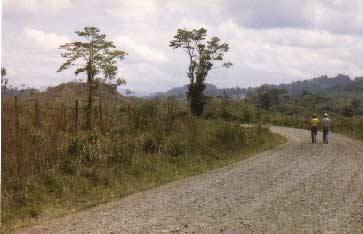
Nov 21, Pension, Yali
Julieta, James, and I walked most of the seventeen kilometers from San Rafael to Yali today. I love walking here in Nicaragua-it's almost like backpacking. I
thought of the book Now We Can Speak; A Journey Through the New Nicaragua. I turned to James and Julieta and said, "If we ever write a book about this, we
should call it Walking Through the New Nicaragua.
Table of Contents
- Bethel College Peace Studies Internship Contract
- Covenant and Purpose of Witness for Peace
- Introduction
- The Journal
- Appendix
Bethel College Peace Studies Internship Contract
for
Mark Becker
1985-1986
Mark Becker graduated in May, 1985 with a major in History. In 1985 he is a candidate for a Peace Studies major, having completed all requirements except the internship. Mark will do his internship during the 198-5-1986 school year with Witness for Peace in Nicaragua.
The following is our understanding of Mark's internship:
1.0 Mark will be responsible for raising his own support for language school costs and for Witness for Peace.
1.1 Mark will pay Bethel for eight hours of credit ($1248).
1.11 Since Mark has already graduated from Bethel College, he will only pay half tuition ($624).
1.12 In addition, since Mark will be working in a nonrenumerative position, policy guidelines state that one third of the collected fees ($208) will be retained by Bethel for administrative purposes aid the remaining two thirds will be reimbursed for subsidizing the nonrenumerative internship.
1.2 Mark will be financially responsible for his travel costs to Central America and back, two months of language study in Antigua Guatemala, and raising $1000 support for Witness for Peace.
2.0 Mark will receive eight hours of credit for his internship.
2.1 The first two months (September and October) will be spent in intensive language study in Antigua Guatemala.
2.2 A six month term with Witness for Peace will begin on November 2. 1985. As a long term volunteer, Mark will have three main responsibilities:
2.21 Hosting short term delegations, handling logistics, setting up interviews, acting as a translator, and accompanying the groups during their time in the country.
2.22 Gathering information and documenting effects of the contra war for dissemination to the North American public.
2.23 Standing with the Nicaraguan people as a part of a peaceful and nonviolent U.S. presence in that country.
3.0 Mark will keep a journal of his experiences in Central America. He will also make a report to the Peace Studies department upon his return to Bethel College. He will concentrate on the following areas:
3.1 First, while studying Spanish in Guatemala he will study the political, cultural, and social conditions in that country. This will give him some background against which to compare his later experiences in Nicaragua.
3.2 In Nicaragua, he will primarily be carrying out the goals and tasks of Witness for Peace. Within that context, he will be paying attention to the following points:
3.21 What does it mean to be a pacifist in a war torn country? Do his North American views have relevance in this situation? What (if any) is the connection between his recent involvement in the anti-draft movement with revolutionary movements in Latin America?
3.22 Coming to a clearer understanding of Liberation Theologies.
3.23 Acquiring an understanding of those who are disillusioned with the Sandinista Government.
3.24 Observing the role of indigenous populations (such as the Miskito Indians) in a revolutionary situation.
3.25 Learning about U.S. politics from "the other side of the tracks."
Covenant for Long and Short Term Delegations of Witness for Peace
Together, we make the following covenant:
- We commit ourselves to a prayerful, biblical approach and unity with one another as the foundations for this project.
- We commit ourselves to nonviolence in word and deed as the essential operating principle for Witness for Peace.
- We commit ourselves to honesty and openness in our relationships with one another.
- We commit ourselves to maintaining the political independence of Witness for Peace.
- We commit ourselves to act in solidarity and community with the Nicaraguan people, respecting their lives, their culture, and their decisions. We will respect the guidelines worked out with the Nicaraguan government in regard to our presence and mobility in the war zones.
- We commit significant time and financial resources on a regular basis to Witness for Peace.
- We commit ourselves to regular communications documenting our witness both within Witness for Peace and to the broader public.
Our Threefold Purpose
To develop an ever-broadening, prayerful, biblically based community of United States citizens who stand with the Nicaraguan people by acting in continuous nonviolent resistance to U.S. covert or overt intervention in their country. To mobilize public opinion and help change U.S. foreign policy to one which fosters justice, peace, and friendship. To welcome others in this endeavor who vary in spiritual approach but are one with us in purpose.
Introduction
The core of this paper is edited excerpts from the journal that I kept from the time of my acceptance as a part of Witness for Peace's long term team in August of 1985, through two months in language school in Antigua Guatemala, my six month term with Witness for Peace in Jinotega, Nicaragua, and my reentry to North American realities in May and June of 1986. Included as an appendix are reports that I wrote as part of my work with Witness for Peace, letters to elected representatives in Congress, and newspaper articles on my work in Nicaragua
The intent of this document is not to argue my political viewpoints, but to candidly present my thoughts and feelings on my experience. I tend to consider my journal a very personal document and I am only sharing it now with you, my personal friends, as a means of communicating what changes I went through while in Nicaragua. I am not attempting to tow any particular political line here and, therefore, do not intend for this journal to have a general circulation.
In writing about my experiences in a Latin culture, I found it necessary to occasionally use certain Spanish words that more fully describe a point than an English translation would. Hence, I present a brief vocabulary list:
acto - a religious or political event, rally, meeting, or action.
asentamiento-a Nicaraguan resettlement camp, usually inhabited by refugees from the war zone.
brigadista-a worker on a brigade.
campo-the countryside or mountains, a rural area.
campesinos-poor rural peasant farmers.
cedula-residency paper.
comedor-a cafeteria or inexpensive restaurant serving a simple meal.
compa-a Nicaraguan Army soldier.
companero-companion, comrade, coworker.
deslazado-one who has laid down his or her weapons in their struggle against the Sandinista Army.
desplazado-one who is displaced due to the war.
EPS-Popular Sandinista Army
Frente-the "Front;" the Sandinista National Liberation Front (FSLN), the present government of Nicaragua.
gringo-a North American or a foreigner.
padre-father, a Catholic priest.
pension-a cheap hotel.
refresco-a drink made from natural fruit juices.
responsable-a person in charge, the one "responsible."
WFP-Witness for Peace.
Lastly, I would like to thank you, Paul, for all the work you have done to make my peace studies internship a success. I really appreciate it. Thanks, Kevin, for proofreading this paper. (I really should have typed it on a word processor.) And thanks, Garth, for that quote that kept me going through times that I would have otherwise turned back from:
You can either chose to live your life and die;
or you can chose to not live your life and live.
Mark Becker
Bethel College
August 5, 1986
The Journal
Aug 9 South Dakota
Here I sit, a week after finding out that Witness for Peace accepted me for their long term team in Nicaragua for a term that begins in November, Despite the
language and financial barriers that I have to mount, I felt that I was left with no choice but to "go for it." If I didn't I would regret it immensely in the future. I
must meet this challenge and experience what lies ahead of me. This last week in South Dakota has been a rather difficult one. Life here is always hard for me; it
has only been complicated by my decision to go to Nicaragua. That is a decision that meets up with a lot of antagonism in these parts.
Aug 14 Bethel College
The past couple days I was at Ames ' 85, the Mennonite Church conference. I went there for the nonregistrants' meeting on Sunday. Nonregistration has been
such an important issue for me and now I feel like it's being ripped away from me because I'm too old to really be directly confronted with it. I feel very good
about the time and energy I've put into anti-registration issues, but now I need to find someplace else to put that time and energy.
Aug 19 Arvada, Colo.
I came here this weekend to climb Long's Peak. I wanted a break from life before going to Central America-and that's all that I got, no answers to life. When
we went to visit our relatives, the inevitable question eventually had to come up: "What are you going to do now?" When I said that I'm going to Nicaragua with
Witness for Peace, the relatives experienced a barely restrained blow-up. What can I do? I try to avoid topics of religion and politics, but there is so much
antagonism from my relatives to what I want to do with my life. Steve and Deb's pickup has a bumper sticker: "President Reagan: Bringing America Back."
People accuse me of being too political. Steve is studying to be a preacher, a person who is supposed to be concerned with spiritual matters. I get so pissed. I
just don't want to deal with people like that.
Aug 21 Bethel
Life can be such a hassle. I woke up this morning and realized that I only have five days left in which to get everything done before leaving for Central America,
I read through the Witness for Peace (WFP) propaganda and become somewhat unsettled over their seemingly strict and authoritarian administrative structures.
And I'm really feeling the pinch of financial dire straits. This is all getting to me.
Aug 24 Bethel
Trauma-today was the day, I felt as if I was going to my execution, "You better get your hair cut or you will be shot down there," I was told. It was one of the
most painful sacrifices that I've had to make. My long hair represents so much of what I am; I miss the freedom and thrill of the long hair dangling on my
shoulders and blowing in the wind.
Aug 26 Bethel
God-what a hectic day. I wanted to leave by noon. Now its 11:30 and I'm still here with many things to do. All the last minute things add up so much.
Tomorrow morning I'm gone-I promise. Paul's been great with the Peace Studies internship-he's really pulled through on that for me. Saying goodbye to
everyone. Weird how I'm so ready to be gone but yet not quite ready to leave.
Aug 29 Matamoras Bus Station, Mexico
I rush like crazy to get here early in the morning-only to find that the first bus leaves at 2:30. It's humid and I sweat while the chigger bites all over my body itch
like crazy. It's time for total immersion as I make my way to the bus station, making a total fool out of myself in the process. My comprehension is so low that I
can't even understand numbers.
I finally left Tuesday morning after an apple pancake breakfast with Nathan and Su. I made it to the south side of Fort Worth when I stopped for the night. After another whole day of riding (my motorcycle), I made it to Brownsville--over a thousand miles in two days. The heat, the wind, a thundershower, and a saddle sore butt complicated by a recently received gamma globulin shot all made it a trip that I am glad is behind me. I was quite exhausted-the sleep last night at the Brownsville VS unit (where I left my cycle) sure felt good.
Aug 30 Tapo Station, Mexico City
I spend my whole life waiting in bus stations. In Europe it was train stations. How worlds change.
Coming in on the bus, I was astounded by the level of poverty-a level that I don't remember seeing when I was here one and a half years ago. At first I thought I was in for an awful case of culture shock, but I am gaining my confidence back. Communication is going better. I really can't tell that I've lost anything that I really learned in Spanish Class two years ago. People have been real nice to me, struggling through language barriers with me and in directing me to the Guatemalan embassy where I got a visa. There are certain ironies, like Dutch keeps wanting to creep to the front of my mind, which really makes me miss The Netherlands.
On the Metro, shortly after I had been warned to watch my money, etc., closely, I noticed that over US$60 was missing from my right front pants pocket. Ouch, that hurt. Oh sheeze, I really could use that money. I feel real irresponsible now, as if I let down all the people whose financial contributions made this trip possible. But it was a very crowded Metro and I guess that that sort of thing happens. It makes me much more paranoid-I carefully watch all of my stuff but realize that if I didn't notice a hand in my front right pocket I probably won't notice when the next item loses me. I just hope that it isn't dad's camera--that wouldn't go over well at all.
Aug 31 Hotel Refugio, Antigua, Guate
The end of a long journey-finally, Day blends into day and who knows how long its been when most of my sleeping is done on a bus?
At the border a customs official took one look at my passport picture and exclaimed something to the affect of "Oh my!" I never felt that looking clean cut was important in Mexico, but it suddenly seems to become everything in Guatemala.
So I had my introduction to Guatemala. I found a bus to Guatemala City and it turned into a lesson on how to stretch a simple three hundred kilometer trip to a seven-hour journey by stopping in every little town and screaming out for passengers. I can get so impatient.
On the way to Guatemala City we came over a hill and there in the valley were about ten PMA soldiers, At first I didn't understand-were these military soldiers or guerrillas? Were they going to rob us or shoot us? But they let us go on after making all the men get out of the bus for an ID check. Then I asked another passenger who they were. They were the Guatemalan military looking for guerrillas or people who were helping them. It seems that on every street corner there is a National Police station. This is obviously a militarized country and I watch carefully what I do or say. It was a relief to know that these people were the military-it seemed to make them more predictable. I wonder if and when I will run into guerrillas.
Sept 1 Central Square, Antigua
Today I was in the market and a kid asked me if I wanted to change dollars, Sure-I needed to change some. He took me to a tourist trap where we met Terry
Kindle. Apparently, Terry had come here from the States as a missionary, but became disallusioned with trying to change the Indian's customs. He found that
by changing money on the black market and by exporting Indian weavings to the States he could live like a king here, and he seemed to be enjoying it immensely.
On his desk a Bible lay open to Psalms. He smoked an occasional North American cigarettes and he used rather rough language at points. He claimed that there
was a "99.9% chance" of a revolution here within two weeks. Oh crap-and here I am.
Later I met another man who told similar stories. He said the best idea would be for me to get out of Guatemala--maybe to Honduras. I came here for excitement and for an experience, I may be in for more then what I originally bargained for.
Sept 2 Central Park, Antigua
I started school today at Francisco Marroquino. They didn't seem any too happy about me wanting to transfer to Maya, But I need to spend a week here now
because I had made a reservation. My teacher Carmen is quite nice, but seems overly anxious to get to the breaks. All that we did was read over sentences. We
didn't spend much time practicing conversations, which is what I really need. My living situation (with a family) is rather straining also.
Sept 3 Bedroom, Antigua
I came home tonight for supper and a white haired missionary was here. Apparently he was caught in the student unrest in Guatemala City. Perhaps an actual
revolution-an actual liberation--is brewing here. Maybe I should forget about school and join the students in the street. Perhaps I don't need to go to Nicaragua
now-it could be happening right here in Guatemala!
Sept 6 The Park, Antigua
Here I sit in the park at about 6:30 pm. In the distance is the volcano that I hope to climb tomorrow. Further in the distance is another that I hope to climb on
another day. Somehow they seem so romantic, so intriguing. Climbing volcanoes-that is the life for me. And I feel the tension-am I here to enjoy life, or to
learn Spanish?
Sept 12 Antigua
Over supper I talked with the maid here in the house, She is getting paid twenty quetzales (about US$6) for a month of work-working every day from 6 am to 7
pm, seven days a week, thirty or thirty-one days a month. "How much are you paying a week here?" she asks. One hundred and ten quetzales (US$30) I humbly
answer rather embarrassed. Sometimes I think I'm so poor and live such a simple lifestyle. What can I say?
Sept 16 Antigua
I started classes with a new teacher today. His name is Abel and I think he will be good for me. He really drills me on my mistakes. It makes me realize how
lazy Carmen was. Right now I'm feeling rather optimistic about my classes. I feel quite exhausted-I'm not just floating along through with this teacher,
Sept 17 Antigua
Abel and I spent this whole afternoon discussing Guatemalan politics, Not only did the talk give me good practice with Spanish, it also gave me more insight into
Guatemalan politics. I'm trying my hardest not to get myself into trouble, but sometimes it's hard to keep my political opinions to myself.
Sept 18 Antigua
This afternoon I talked with Joan (the owner of the bookstore "Un Poco de Todo") about her observations of Nicaragua. She had just come back from a trip
there and painted a rather dismal picture of the situation there. She said that the excitement of right after the revolution was gone, that everything was in short
supply, and that the Sandinistas were becoming more totalitarian. It left me feeling very lost. What role do I play? Perhaps the Sandinista government no longer
is worth protecting. But does that mean I should drop out of WFP? At this point I would say no-I still need to work to stop a war. The situation is still very
tense and I want to help prevent a war with Honduras or an invasion by the U.S. But I was hoping that this time I could stand for something instead of just
working against what I oppose.
Sept 21 Antigua
Today someone got a USA Today paper to read about the earthquake in Mexico. In it there was a short blurb saying that Benjamin Sasway was getting out of
prison after serving six months of a thirty month sentence for not registering for the draft. Suddenly it brings back a whole era of my life that I had basically left
behind. This seems to be a different world here, far removed from the one that I once knew.
Sept 24 Antigua
Tonight I discussed Central American politics with Julio, the son in the family with which I'm staying. He saw Nicaragua as a real threat to this region.
Sometimes it really shocks me how naive people here are and how much they buy the propaganda that they are fed. It is difficult for me to say what I think
because I need to survive here for another month and I'm trying my best to stay out of trouble. I really hate it when the topic of my life and reasons for being
here comes up. What can I say? I can't help but think that it would be a great mistake to tell many of these people that I'm going to Nicaragua to work with
WFP.
Sept 25 Antigua
Sometimes I stop and think about getting killed. Life here is so cheap. Two weeks ago when I was walking back from San Antonio Agua Caliente, I passed a
guy laying in the ditch. I couldn't tell if he was just asleep or dead, but he looked very stiff and there were flies around his mouth. So many deaths seem so
meaningless. I hate like crazy the thought of dying all for nothing. I'm not ready to go yet…
Oct 1 Antigua
A month from tomorrow I need to be in Managua Only a month left and I have so much left to learn. I wonder if I can cut it. Sometimes I get so incredibly
frustrated.
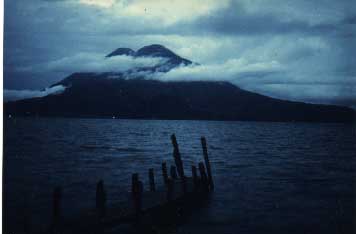 Oct 5 Lake Atitlan, Panajachel
Two friends and I came out here for the weekend. On the bus out here I finally ran into the other WFPers who are studying Spanish here in Guatemala. It felt
great to be surrounded by that type of person. They said that WFP needed all of the help that they can get, so I guess I can quit worrying about being rejected
for whatever reason at the last minute.
On the way out here we caught a ride with a guy from Israel, I wonder how safe it was riding with him. With all of the military aid that Israel supplies to Guatemala, I imagine that he would be quite the target for a guerrilla attack.
Oct 8 Antigua
Sometimes I think about death. Last summer I had these dreams in which I was being executed for my involvement in subversive activities. I would wake up
screaming, "No! I don't want to die!" There was always one more thing I wanted to do, one more sunset to watch. Whenever a helicopter appears in the sky, I
can't help but think of death and destruction. But when I think of the possibility of my demise, it's Garth's quote that pushes me onward and I would choose to
leave it as a tribute to my life and death:
"You can either choose to live your life and die;
or you can choose to not live your life and live."
Oct 15 Antigua
I started writing this story in which I take all these risks and do all sorts of fun, exciting things and then go home and drown in my bathtub. It kinda expresses
how I feel.
Oct 24 Antigua
In a couple days it will be time for me to leave Guatemala for Nicaragua. Why does leaving need to be so difficult? I've really enjoyed my time here. Antigua
feels like home. You don't know how tempting it is to forget about Nicaragua and stay here in Guatemala.
Oct 28 Guatemala
Sitting (at least) on a crowded bus to San Salvador. Why do they always have to pack people in like this? What a hectic morning. I ran all over trying to get my
visa for Honduras. I hate trying to get around in a city where I'm not familiar with the public transit system and I'm dragging all of my worldly belongings with
me. Such a pain.
Pension, San Salvador
Well, the bus ride was OK, if you don't mind getting off too many times for military checks. People are surprisingly friendly and the borders have been easy-so
far I wouldn't have gotten into trouble for carrying anything. I met a guy who took me to a cheap pension close to the bus terminal. It's a different side of life
here. There are hordes of prostitutes in windows like I haven't seen since the Red Light District of Amsterdam.
Oct 29 Choluteca, Honduras
Another long day on the bus. I got up at 5:30 this morning but ended up missing the first class bus that left at 6:00, so I spent the whole day crowded into third
class buses. But otherwise things went OK. It seemed like all the bridges this side of San Salvador have been blown up but only one rather large one was still
out. That stretch was supposed to be the most dangerous, but the roads were full of people and I guess it really wasn't that big of a risk. I've never seen so
many soldiers lining a road before. I guess it's more of a war zone, but except for the bridges I didn't see much damage. I feel more relaxed now that I'm in
Honduras. I begin telling people that I'm going to Estelí to visit a friend-even the immigration officer at the border. Hopefully, tomorrow night I will be with
Tim-Blob in Estelí, Nicaragua.
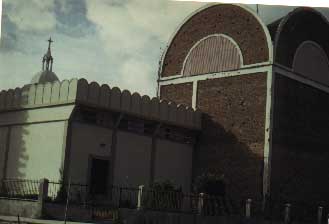
Oct 31 Hotel Moderno, Estelí, Nicaragua
"Greetings from Free Nicaragua." I got here without too many problems. When we were leaving Honduras a soldier stopped us, asked for our passports and
asked where we were going, "Duh-I don't know. Where does this road go?" We walked past the old bombed-out border station to a waiting pickup that took
us to Nicaraguan customs five kilometers away. Now that I'm here I feel pretty free to say what I'm doing and where I'm going. Crossing the border really
wasn't that much of a problem, even though I had to change $60 US for the rate of 28 Cordobas to $1 US (the going rate is 750 Cords to the dollar). We
caught another pickup to Somoto where we waited for about three hours for a bus to Estelí. I hate waiting for buses and here it was worse. There aren't
enough buses and these "really nice people" become quite pushy and nasty in an attempt to get on the few buses that there are. It was quite a rude introduction
to a country that is supposed to be so kind, humane, and helpful to each other.
Anyway, after we got on the bus to Estelí we started talking to some soldiers and they were more friendly and helpful. They told me where to get off for the school where Tim is working. Tim's been great in cluing me in on what is happening here. He really has helped in interpreting the news stories I was reading in Guatemala over the "protests" of the Catholic Church here in Estelí.
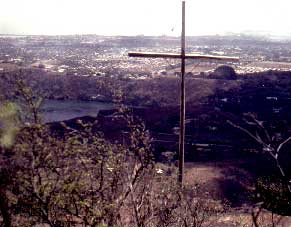
Nov 1 WFP Little House, Managua, Nicaragua
We left Estelí this morning and stood on a packed bus all the way to Managua. We took a taxi to change money and then I caught a bus to the WFP house.
We're starting in heavy duty tomorrow night on our orientation. In ways this group really pulls together-good people to be with.
Nov 5 Short Term Team House (STTH), Managua
Walt and Sali (two new long-termers) just kinda drop out of WFP and our lives. I wonder how well thought-out some people's coming here was. But I become
more and more comfortable with WFP and life here. WFP seems more open and less authoritarian from this angle. Now I wonder if my original impressions
come from the Durham office. When I ask about an unpopular policy it always seems to have come from the Durham office. Or maybe that's just their way of
dealing with such things. I've become quite lazy amongst these gringos--I'm not using my Spanish much in conversations, writings, studying, or writing papers.
I hope that I don't begin to lose it. It was easier in language school when I was always using my Spanish.
We run role plays here. We're on a bus attacked by contras. I begin realizing more and more that I don't want to die here- that Nicaragua's freedom doesn't mean that much to me. I said that last night in our personal reflection: "I don't want to die in Nicaragua." Today more and more people repeated that same line- "I don't want to die in Nicaragua." I guess that expresses what a lot of us are feeling.
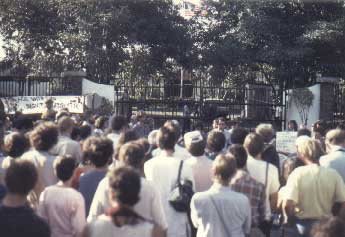
Nov 7 STTH
Statement by WFP new long term team at the U.S. Embassy vigil on November 7, 1985:
"We are twelve Christians from North America joining with those (the Witness for Peace team) already here in opposing the war of the United States government against Nicaragua.
We will be here for at least six months living and working non-violently in the war zones, standing in solidarity with the Nicaraguan people in their suffering.
We are here this morning because each of us considers the U.S. policy of terrorist war against Nicaragua to be intolerable, immoral, and an impediment to peace, justices and freedom in this country. These vigils have been going on for two years and still we await every day as do the Nicaraguan people and the people of the world, some concrete actions for peace by the U.S. government instead of the insincere rhetoric for peace which is regularly disseminated from Washington, DC.
We come here insistent, we come here urgent, and we come here citizens of the U.S. demanding an end to this war.
Joining us in similar vigils every week in their hometowns are our compatriots in Charleston, W.V.; Colville, WA; and Debuke, Iowa, among others.
We hope this circle of peace and love will spread until the positions of our government change."
We went to the lake again this afternoon. I started walking around it. It was so peaceful and beautiful-it was hard to believe that a war was going on in this country. I just wanted life to stop and stay there. Why can't we always be like that?
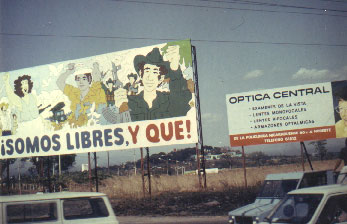
Nov 11 Little House
I got discerned this morning by Ed and Sharon (the WFP coordinators). I guess it went OK and I guess I'm probably in for sure now. I keep trying to think,
"Why am I here?" To experience a different culture and to try to affect a positive change in U.S. foreign policy. How are you going to affect that change?
Sheeze, I don't know. I really don't know.
Nov 12 Little House
Today was the last day of our orientation. We had our commissioning service and signing of the covenant tonight. Before I signed it, I thought, "Maybe I don't
want to sign this" and decided that at least I should read what it said. It's kinda funny-they never asked us if we wanted to sign. Becoming part of WFP has
been such a gradual process, this was just another small step. But I feel good here-this is where I should be.
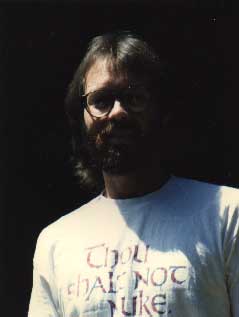
Nov 14 Pensión La Colonia, Matagalpa
We finally left Managua for the campo today. Julieta, James, Julio, Mary, and I hitchhiked here on the backs of dump trucks (one full of dirt) and on a semi. It
feels good to be out of Managua and closer to the "real Nicaragua."
Nov 15 Hotel Tito, Jinotega
Today we arrived in Jinotega, where I will be working with WFP. I begin giving up on ever talking much Spanish here. I'm working with Gringos in a Gringo
organization and of course we'll speak English. I'm never going to start thinking in Spanish here like I did in Antigua, and therefore I'm never going to learn any.
That's really too bad, but what can I do about it? I realized this morning that this job really needs self-motivating people. And it's time to get to work, eh?
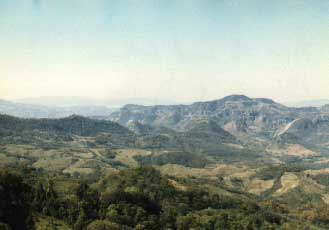
Nov 16 Jinotega
I started reading Ayn Rand's We The Living. I suppose Ayn Randists would want me to see the parallels between her view of Soviet Russia and Nicaragua. She
seemed to have quite an elitist view of the world.
I begin to feel a bit of the effect of this experience in Nicaragua on me. "Simple lifestyle" comes to mean something else. How Garth, Tim, and I lived last year in our trailer at Bethel is really quite rich compared to many people's lives here. It all becomes relative and I realize that I just want to live on a level that I'm comfortable with.
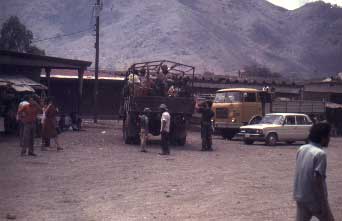
Nov 20 Pensión, San Rafael del Norte
We finally got out of the city of Jinotega and into the campo. James, Julieta, and I went with Ed to Sisley where we talked with some people who had been
attacked by the contras on August 15. Then we went to La Pradera where the attack occurred. We took pictures of three houses they had burned down; they
also had killed one guy there.
Then we continued on to San Rafael. James fell in with some kids who play basketball, he seems to fit in here. Julieta can't wait to get to Yali-that's like her home away from home. But where do I fit in? It seems nowhere, I really want to get away and speak and live only Spanish.
Nov 22 Yali
Yali-the end of the line. You can tell we're getting out there. Of the three newspapers, only the Barricada makes it here and that doesn't arrive until the 6:00pm
bus pulls in. What is there to do in Yali? Go to the comedor for supper and that's about it. I suppose it'd be OK if I had friends here though. This Pensión is like
an old barn-including the sound of pigs. Last night, a rat helped itself to a banana in my pack. James and I woke up in the middle of the night to machine gun
fire. It was from only one gun and I suppose some compa just got bored.
Nov 24 Yali
I read a little piece in the paper today about Nelson Mandela. I realized how isolated and "Nica-centric" this place is. All that's important is Nicaragua and that
the Sandinistas survive. I want to view this situation with a bit more historical objectivity. I think Julieta is getting pissed at me. I make cynical comments about
these green people here killing people, She says that they are protecting the people. So much for nonviolence and political independence.
Nov 25 Pensión, San Rafael
"I love the smell of napalm in the morning. It smells like...victory." That's a quote from Apocalypse Now. I'm not sure why it keeps coming back to me.
Walking from Yali to here I really felt the need to say it. But it was dusk and therefore didn't seem appropriate. Finally here in San Rafael it came out. Julieta
and James just kinda laughed at me.
The walk from Yali to San Rafael is about seventeen kilometers, or so they say. We left Yali at 2:30 and walked for four or four and a half hours. I think only three vehicles passed us, but that's OK. I really don't mind walking. We walked the last hour or so after sunset, but that was OK because the moon was almost full. An IFA (army truck) roared by with a spotlight shining into the roadside. The realization that "there's contras in them hills" jumped to mind and we begin talking of contingency plans in case of an attack. I really wasn't scared, I just don't care to be out in the country after sunset, that's all.
Nov 27 Hotel Tito, Jinotega
You learn all sorts of interesting things living in a war zone-like, did you know that if you're about to be hit by a shell you should open your mouth or you'll
explode?
Today we went out to Tamalaque by Pantasma with Padre Douglas and two doctors. Padre holds a mass while the doctors check out people. Julieta and James fill prescriptions and I try to help for awhile but decide that I'm just getting in the way so I take off down the road. We were in a valley--it was really quiet, except for the sounds of birds and locusts. How peaceful it could be to live there. About ten days ago, there was a contra attack there. "Deje apoya a la contra no más muertos," the writing on the wall said. ("Stop support to the contras, no more deaths"). I wouldn't mind participating in more concrete actions like this. But still, this was mostly just a political action. One of the doctors (who is from Basque) admitted this. Pushing medicine isn't the answer. Some of the people's customs need to change--they need to pay more attention to their diet and sanitary conditions. This would help them a lot more then the medicine will. I start thinking about what I would be like if I had been raised there. How would being raised in a traditional culture affect me? But then I looked around me and I wondered what the difference between this place and rural, isolated South Dakota would be. I looked at some of the people and it seemed as if they were the same as my friends from High School-just reflecting the values and norms and views of their surroundings. Then I wondered how much of my politics came from my education and how much comes from within and I decided that I probably would have turned out the same with similar values and concerns.
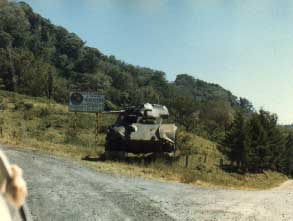
Nov 28 Selva Negra
And so here we are at Selva Negra ("Black Forest"-an old German coffee plantation converted into a hotel) for a WFP retreat. We caught a ride here with two Soviet journalists, which was really interesting. They joked that there were three Soviets in Nicaragua-the two of them and the ambassador. They said that Nicaragua will have to learn how to fight and what to fight for.
Nov 30 Selva Negra
I feel that I have a personality filled with ironies. I hate this war and what its effects are, but I thrive on the excitement that it produces. If I wasn't a pacifist, I would join the army for the adventure- here, I can be a pacifist and experience war also. But still, while other people around me become militant supporters of the Sandinista Army, I back off and become more critical and objective of the situation. I read in the Barricada of contra attacks, amnesties, and draft evaders coming back and it all sounds like propaganda. To me, this army seems just like any other army with similar goals, methods and objectives. "There must be a better way," my mind keeps thinking. "All of this killing can't be necessary." And the Anabaptist theme of a third way keeps resurfacing. I want my life to be a force for a third way.
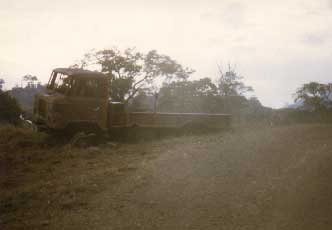
Dec 6 Jinotega
Yesterday we walked most of the twenty kilometers to the coop Hector Flores in Namanji to get affidavits of a contra attack and kidnaping in which they killed
the president of the coup. The wife of the president seemed scared and didn't want to talk much about her experiences. People in general seemed to be
suspicious of us being there. But we did talk with some men who were working on a well that they were building with materials donated by Switzerland. Later I
was talking with another guy about life in that community. He had a dismal view of things. The government isn't doing much in that community, and most
everything is in short supply. He knew that the much needed materials come from the states and it's only in the last couple years that it has been a crisis situation
like this. But if he knew why this situation existed, he didn't indicate that to me. They have trouble getting a hold of food, clothing, and anything for the Chevy
pickup which is their transportation link to the outside world. This was the first cooperative that I'd visited, but Julieta said that it was a badly organized one.
They sure could use some political education and exposure to how these world forces that are affecting them so directly operate.
Dec 9 Bocas de Vilan
Well, I got here yesterday without getting sick on the long ride out here, although I was still feeling a bit weak from being sick a couple days ago.
This morning Tim and Terry (WFP coworkers who brought me out here) continued on to Wiwili and just kinda left me here all alone. I wasn't really sure if I really felt up to this, but what choice did I have? At least I'm getting more Spanish now and, to my satisfaction, I'm holding my own. I smile when I realize that I can now understand "Padre Douglas" without the "s" when I couldn't have a month ago. Now I'm waiting to go with a woman to Flor del Pino de Vilan to help her pick coffee.
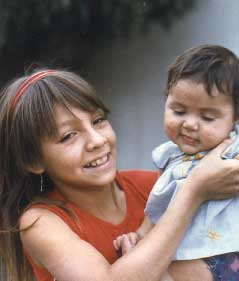
Dec 10 Manuel's farm, Bocas de Vilan
Well, I ended up staying here in Bocas de Vilan for the night and I'm still here. Yesterday and today I've been helping Manuel- mostly with cleaning bad beans
out of the coffee. That woman decided that it was too late for me to risk going with her last night, so she sent her boys to get me today along with some beans.
Now it's getting about as late as it was yesterday when she wouldn't take me.
I'm quite apprehensive about my health here. Hogs and chickens wander freely about everywhere-I feel like I'm in a pig pen back home and the house seems like that red cabin in the trees (in which we kept pigs) that I always wondered if people once lived in. The dirt floors don't bother me (actually, there is a fair amount of concrete) and the food is great (although I probably shouldn't be drinking the refrescos, but I'm not getting enough liquids in my diet); I just feel like I'm compromising some basic sanitary measures, I hope that it doesn't catch up with me.
These kids sure seem curious about my bags. When I begin to open it up they jump and are right there to watch, So last night I went through everything and showed them everything that I had. I hope that they were satisfied. One of them said something about a "regalo" (a present)-I hope they weren't expecting one. Sorry, I'm not Santa Claus. Manuel asked how much my sleeping bag cost. I always get embarrassed when someone asks that. But everything is on such a different level here. Twenty dollars for my backpack is too expensive here. Sometimes it gets to me how people stare at me here, but I guess I stare at them too.
Dec 12 Doña Carmen, Flor del Pino de Vilan
This place is set kinda back in the woods-almost an hour on a muddy trail from the road. Coming here, we passed over a ridge and at the top there was this
house overlooking an awesomely beautiful valley. My thoughts on this place were crossing-my contempt for the isolation and ignorance of these people was
changing for my romantic desire to live in a log cabin in the mountains. Here I could do it. "How much would it cost to rent-or even buy-that place?" I
wondered. I could move out here and live my life the way I want to. Their school needs a teacher-I might even have a job.
We live on a dirt floor here. That's OK, but when the kid craps on it they go outside the front door to where the pigs hang out and bring in some dirt to clean it up. They pee and throw all sorts of trash out of the kitchen door and I then walk through it all the time. They eat beans and corn tortillas all the time, but I begin to realize that this land is relatively rich with fruits and veggies and they could be eating a diet a lot better and varied. Really, it's surprising that they don't seem to have more problems with sickness. It's surprising that I'm not having more problems then I am. Life here doesn't have to be this way-it could be a lot better. Maybe I could come here and live and show them a better way.
Anyway, so I spent my first day picking coffee-five and a half medias of it, if that means anything to you. Suzana (Carmen's fifteen year old daughter) picked ten. If I had come here as a brigadista to pick coffee for two or three months, I think I would be quite depressed at this moment. It's quite tedious and meaningless work, but at least I'm getting a lot of time to think. It's easier then walking beans, and I probably could stand it if I was getting paid five dollars an hour. That's quite a capitalistic admission, isn't it? As it is, though, a crew of about six of us didn't even pick five dollars worth of coffee all day yesterday. Sometimes I wonder how these people can make ends meet.
Dec 13 A creek someplace in Nicaragua
I really love this area. It's so quiet and so beautiful. I think if I had my own house and my own little group of friends I could live here. Why does there have to
be this war going on?
Anyway, these people are always so curious about my bags. Once I saw three or four of them watching me stuff my sleeping bag in its storage sack. Argentina, the little girl, saw my frisbee and asked what that purple plate was. So I showed it to them. I threw it and promptly lost it. When I found it, Doña Carmen said it was just a plastic plate and so she washed it for me. I guess she'd think it stupid to pay five dollars for something like that.
Dec 14 Jinotega
I got back to Jinotega today and found fourteen letters waiting for me. It's a bit of an overdose, I guess, especially since I had received about three letters in the
last two months. Anyway, the biggest surprise was the letter from my old friend Cheryl. She said that she was coming to Nicaragua with the WFP student
delegation in January. One letter informed me that my paper on draft resistance finished third in the John Horst Contribution contest. That's quite disappointing.
I really thought that I was going to win it. Mom and Dad sent news of the explosion in the grain elevator in Marion. Death-three of them. Nicaragua doesn't
have a corner on pain and dying, and death for whatever reason isn't easy for me to deal with. Sheeze-it's just so hard to imagine. Gone, gone forever…
Anyway, I came back from Bocas de Vilan this afternoon. I spent the morning picking coffee at Epifanio's. I really like that family-it's so much more fun then the heavy atmosphere that hangs over Manuel's. Manuel told me that the night that the contras kidnaped three of his sons he ran after them imploring them in the name of Jesus Christ to leave them go. They didn't listen. When I asked if it would be a bother to have me spend the night in his house he said that there was lots of room-his house was empty now. Just feel the pain.
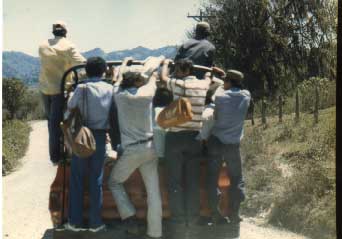
Dec 15 Jinotega
A Frente vehicle was ambushed on the road to Las Colinas yesterday. Two people were killed and two injured. Julieta and James had been on that same vehicle just a couple hours earlier. The thought that he could have been on it really is shaking up James. He knew those people, including the thirteen year-old kid who got shrapnel in his arm. I start thinking-next time it could be someone I know and love. Suddenly it seems a lot more dangerous.
Dec 18 Bocas de Vilan
Here I sit in front of the house that I suppose is more of a "home" than I'll find anyplace in Nicaragua. I just spent a hot, sun-baked day in the field clearing corn
stalks into piles, which we burned, thereby clearing the way for plowing. Wouldn't it be better to plow it under? After all, it's good mulch for the soil. But
what can I say? I'm not here as a development worker and know nothing about their agricultural practices.
James and I were talking about the ambushed Frente vehicle. I told him about Marion's grain elevator and that Nicaragua doesn't have a corner on pain and suffering. Yeh, he said, but that was an accident-the Frente vehicle wasn't. I guess a more proper analogy would be the South Church-both that and the Frente vehicle were the result of an evil and malicious intent.
Anyway, I went back to Jinotega this weekend to meet Peter and we came back here together on Monday to begin setting up for the Seminary Delegation that is coming in January. The fear of getting blown up, especially while on the road, becomes wearing after awhile. How can I live with this day after day? Even worse is the realization that when I go, this journal will probably go with me and all the work of leaving behind a tribute to myself will have been for nothing.
Dec 20 Hotel Tito Jinotega
I'm back in Jinotega for the weekend. It's not even 8:00pm and I feel incredibly tired, but there's so much stuff I want to do-reading and writing. I spent all of
yesterday in the field again. I heard shelling all day and occasional machine gun fire. God-this is a war zone. What the heck am I doing here? The kids in
Bocas de Vilan really take to my Frisbee. We throw it around for hours. It's so weird thinking of playing frisbee (basically a middle class college pastime) in this
cultural backwash.
Dec 22 WFP house, Estelí
So I'm back in Estelí once again, this time trying to find Tim and the Central American Peace March. Apparently they are at a coop north of town. The march
seems to be screwed up-there's dissension in the ranks, they're busing it almost all the way instead of walking, and a lot of Central American governments are
resisting allowing them to come into their countries. It's really too bad that a march for peace has to result in so much discord. It seems so characteristic of the
peace movement- it reminds me so much of Dave Lohrentz's stories of the peace march he was on in 1982. I wonder how much of it is due to infiltration by
antagonistic elements with the intent to sabotage the march.
Telcor (the communications office) can be a bit strange. They never seem to have change, so they give you stamps as change instead. It would be interesting to start a Nicaraguan stamp collection-what do their stamps say about the revolution? They gave me red Lenin stamps for my letter to Barb in the Philippians. I wonder what the government there will think of that.
Dec 24 Poneloya beach
What better place to be on Christmas? It sure doesn't seem like Christmas, but that's OK with me. The waves are crashing on the beach and it sounds so
beautiful. The peace march left without me. Maybe that's just as well. I took Jonathan and Lauren (who had just gotten off of a WFP delegation) to the WFP
house and then followed them to Leon where we stayed with Andrew from their delegation. Leon is hot with a lot of bombed out buildings, but I kinda liked it
there. Sometime I should go back.
Dec 27 Little House, Managua
I get assaulted from both sides and I feel so confused. I made a remark to Mary D. about maybe we are just trying to find evidence to fit our already foregone
conclusions about the situation here and she jumps all over me. At Poneloya I was talking with two Political Science students from San Diego who claimed to be
neutral and "seeing for themselves" here, but were obviously quite conservative. I didn't talk much-most people never seem to have much interest in listening to
anybody but themselves-but they remarked how I was the most reasonable "leftist" they had met. Why don't people ever stop and listen to criticism? They just
scream at each other. No one ever listens. Maybe the problem just is that I have different goals in being here. I would describe myself as being very much a
socialist- I make no qualms about that. But it doesn't start and stop with Nicaragua and the Sandinistas. There are much deeper and broader reaching issues at
stake here. Do revolutions always follow the same pattern? Can they succeed without violence? Or are they victimized by human nature? I begin to wonder if
the most positive contribution I could give would be as a school teacher-in education.
Dec 29 Little House, Managua
I heard three shots while walking by the lake Xiloa and almost just zoned them out. Sheeze that's scary. Am I becoming numb to the sounds of war and
violence?
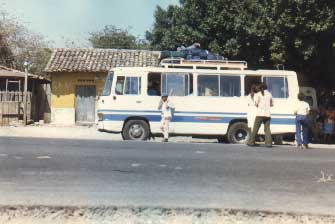
Jan 1 STTH, Managua
Sitting here listening to Jack Nelson Palmier speak to our student delegation that came in last night. I forgot my backpack at the airport last night when we
picked them up. I got it back this morning, but it was unnerving to think of facing life without this journal and my dictionary, which I had left in the backpack.
Jan 3 Hotel Tito, Jinotega
So here I am back here. Four people from the student delegation are sick here and two more are down at our doctor friends Justin and Mag. I'm beginning to
feel quite tired. I really hadn't imagined that I would be doing this. I don't enjoy playing doctor. But I do enjoy being with this student group. I feel as if I'm
back with my peers.
Jan 5 Mag & Justin's, Jinotega
We passed the evening with our sick delegation at Mag and Justin's place. Justin said that he and Jack Nelson Palmier heard this song on the contra radio
station:
J.J. & the Contras
We arm the world
We starve the children
We arm the ones that steal the people's land
So let's keep on giving
There's a choice we're making
We're taking all their lives
So that we can have a brighter day
Just you and me.
We arm the world
Kill women and children
We are the freedom fighting, founding fathers, Reagan's brothers
There's some laws we're breaking
But hell we know we're right
So as long as Congress foots the bill
We'll keep up the fight.
We've armed the world
We've nuked the children
We've maimed and killed to save our world from Commie sympathizers
There's a chance we've taken
Some people say we're wrong
But we know that God is on our side
That's why we're strong,
We'll arm the world
We'll bomb the children
We'll terrorize until their miserable lives just ain't worth living
It's democracy we're making
All around the world
It's freedom for the privileged few
That's me and you.
It's freedom for the privileged few
That's us not you.
It's freedom for the privileged few
That's me not you.
Jan 6 Museum San Rafael
Now we finally have the whole delegation back together and everybody is feeling better. It's the five year anniversary of my Revolution. Maybe it's kinda ironic
to pass the date of when the statute of limitations would normally expire for my not registering outside of the U.S. and in Nicaragua, of all places. Almost half of
my time since I was supposed to have registered has been spent outside of the U.S. Originally, I didn't register because of U.S. policies in places like Nicaragua,
but the cart has almost come before the horse-registration remains the primary issue in my life.
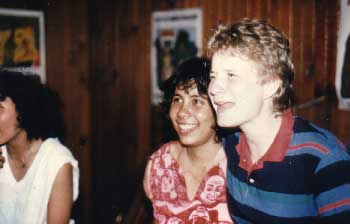
Jan 9 Julieta's Ranch
Song written especially for the vigil at the U.S. Embassy on January 9, 1986, and sung by the WFP student delegation:
Burn It Bright!
(Set Nicaragua Free)
Words and Music by Jeff Dixon
1.) Sweet, sweet, sweet Jesus Christ
Gave, gave, gave his precious life
To break the captives chains
To end the prisoner's pain
And set them free
Set them free
Then why do you refrain (from breaking)
Nicaragua' s chain
To set them free?
Set them free?
2.) Blood, blood, blood is on the land
Dark, dark, dark is Reagan's hand
Gunfire in the night
Is taking precious lives
Endlessly
Endlessly
Mothers and their babes are being
Sent to early graves
Are you proud? Is Reagan proud?
(chorus)
Burn it bright, burn it bright, burn it bright, burn it bright!
Freedom's light, freedom's lights freedom's light freedoms light!
End the night, end the night, end the night, end the night!
C'mon, c'mon, c'mon c'mon c'mon c'mon!
Set Nicaragua Free!
3.) Peace, peace, peace, there's no peace
No. no, no, there's no release
When thirteen year old boys
Play with guns like they were toys!
And fight grown men
Fight grown men
They must take up arms
To save their families and their farms
And grow up too soon!
Grow up too soon!
4.) Just, just, just, is it just?
To burn, burn, burn this land to dust?
What morality
Burns everything it sees
In the name of truth?
The name of truth?
The mercenary hides
In freedom fighter guise
And kills for pay!
Kills for pay!
5.) Peace, peace, peace, we want peace!
Please, please, please, please release
Let Nicaragua go
To heal its wounds on its own
And live in peace
Live in peace
Our own freedom cannot last
If you stab freedom in the back
And let it die
Let it die
6.) Love, love, love is the light
If, if, I if you let it shine
The darkness of your night
Will fade away from sight
Just open up your eyes
And realize
We never have to fear
Weeping joyful tears
In freedom's light
Burning bright!
Jan 13 Little House, Managua
Well, the student delegation left two days ago and I'm still feeling somewhat wasted, both physically and emotionally. But it's time to move on. I feel like soon
I'm going to be heading toward some unknown fate. It's only a matter of time till it catches up with me. I'm not ready to go yet. Oh, spiritually and maybe
emotionally I am, but it's just the lingering presence of things left undone. But then, when will I ever be ready to go? There will always be one more sunset that
I need to watch, one more full moon to walk under. I suppose most people are never really ready to go. That's really too bad, I guess. Right now, it just all
seems so meaningless to go. But what would I have done if I didn't go? That's an unanswered question too.
Jan 16 Jinotega
Here I sit in "our" new house waiting for the house warming party to begin. After many months of searching, we finally found a house to rent. It will be OK
here, I think.
I finally left Managua this morning. It would have been just as easy not to. I felt incredibly apprehensive and nervous. I came with the Kansas delegation as far as Sebaco and then started hitching. I just wasn't in that mind frame. Going to San José de Bocay really scares me, I feel like a dreadful fate lies out on that long road to nowhere. But still I have to go-to not go would be cheating life. I can't turn back now. There's only one way to go-and that's onward, I wonder if I'll still feel that way when I reach the end.
Jan 18 Jinotega
James and I lay here talking about life, death, and love. Peter and I leave tomorrow for our long trip to nowhere. I'm ready to go now. There comes a point
where you just have to go on-to turn back would be to deny life. Remember that quote? "You can either choose to live your life and die; or you can choose to
not live your life and live." I want so much to leave something behind that says something about life, but I keep coming up blank. Two hundred pages in a
journal and I still haven't been able to say it. I've tried, and maybe that's why it's so rough and weird at points. I really feel bad for making you have to try to
read all this-with my bad handwriting (typing?) and all the crap I've had to say. I don't want to die-I have no death wish. Any death I can imagine at this point
seems so meaningless. I'd much rather "live humbly" than to die bravely for my cause. "This is the end…" that's from Apocolypse Now too-it starts out with
that song by The Doors. I want life to go on-not just for me, but for everybody and everything. What more can I say? Maybe I've said it all, but I've said
nothing...
Jan 19 Coop Ernesto Acuña
Well, we left Jinotega today. Really, it was time to be on our way. We caught a bus (well, really a truck) to La Colonia and walked most of the rest of the way
(about ten kilometers) to Ernesto Acuña. I feel a lot better now-the fear is gone. Fate may come if it wishes, but I don't feel as if I'm going to meet my destiny.
Ernesto Acuña-it's a cooperative of campesinos with a high level of political consciousness who asked the Sandinistas to organize them into a CAS (Cooperativa Agricultura Sandinista) where they would farm all the land together. I guess it's a bit unusual to find campesinos like this. Peter and the other WFPers who've been here really seem to love this place. I'm doing OK. We'll just be here for a short time (we're leaving early tomorrow morning already) so I really don't have a good feel yet for the place. I've talked some with the brigadistas who are here picking coffee and the Germans who are working on the water project, but I feel that language is still being a barrier. I'm finding that I can understand quite well, but that I have problems getting people to understand me.
Jan 20 El Cua
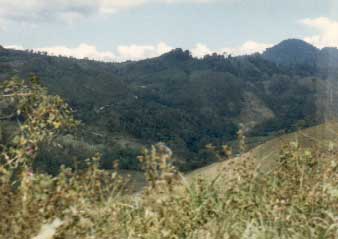
Well, we made it this far, Tomorrow we'll try for Bocay. The road was quite beautiful between La Colonia and here. I probably wouldn't have thought much
about it if Peter hadn't made occasional references to ambushes and contra attacks along the road. But it sounds like this zone is fairly quiet and I doubt that
we'll have any problems. El Cua seems like a nice place to be. There are comedors, a river that is nice both for bathing and for just hanging out by, and the
Pensión is OK. We spent a couple hours at the Frente office this afternoon, but really didn't find out much useful info.
Jan 21 El Cua
Waiting-just sitting here in the Pensión waiting for a ride to San José de Bocay. So much of life is just spent waiting. Right now I'd just as soon be on the road
again-on my way. My ears perk up at every sound in the distance that could possibly be a vehicle that would carry us away. I'm feeling OK, for the most part,
being out here. It's rougher on Peter. He would just as soon go home and be with Maria. I guess relationships like that do it to you.
San José de Bocay
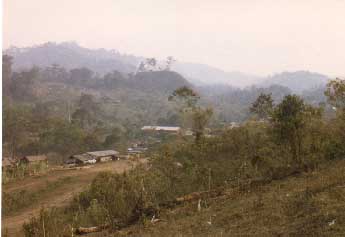
Well, I took up my Post watching for a vehicle heading out while I read Howard Zinn. After a couple false alerts, along came a truck that took us to Bocay. It
sure felt good to be on the road again. The military presence on the road seemed less pronounced, but the signs were there-numerous ambushed IFA army
trucks along the road and helicopters in the sky. We're getting closer to the rain forest so it's raining continuously and the vegetation is becoming more lush.
The road kept crossing stream beds and Jinotega seems to become more beautiful the further we get away from the city. It reminded me so much of
backpacking and the type of environments I've backpacked in and it begins to surprise me that someone would actually live like that for fun.
But we got here-the end of the road. There's two kids from the city of Matagalpa here. They kinda seem out of place. Victor had trouble guessing where we're from-he could only come up with Russia. I wonder where he got that from. Well, tomorrow we can start in on such things as our work might be.
Jan 23 Frente Office, Bocay
Now I know what they meant when they said that we will spend a lot of time in the Frente office. We spent like half of yesterday here waiting for Louis Fischer,
the Frente representative here in San José de Bocay. At about 9:00am he promised us that he'd meet us here in half an hour, but he never showed. I guess he
must have gotten busy because last night he found us in the comedor when we were eating and he invited us to come visit him after supper, which we did. I was
quite impressed with him. I don't think he's any older then I am- maybe twenty-one years old. He's not from here; he's from Leon. But he's had this job for a
year and has been in the zone for one and a half years. He was rather apologetic for the mistakes of the Sandinistas, but was also very proud of the of the
revolution. "What was the first thing that the revolution brought?" he asked rhetorically. "It wasn't guns and the war, it was pens and notebooks. That was the
first thing, and the people are going to remember it. The guns came only after the revolution was being attacked and we needed to defend it." We were sitting in
the midst of the accomplishments of the revolution-in front of the Banco de Desarrollo, which is a government sponsored bank which gives loans to people to
help plant crops, start projects, and get on their feet economically; behind the health center which provides free health care; and beside the warehouse through
which passes the basic elements (food, soap, etc.) for the people of this zone. In a way, it was a quite sad situation.
The Sandinistas don't want this war-they only want to defend their revolution. Just think of the possibilities if it wasn't for the war! Louis admitted to having problems in learning to deal with the poor campesinos of this zone. He's not alone in his frustration-we feel it too. Some of it is a cultural gap, but it's also a development gap. I'm too cynical to believe that technology will save us all, but I'm beginning to see the importance and power of education. Yesterday afternoon we went to visit an asentamiento on the north side of town. At the first house, we dropped in on we found a woman with eight children ranging from two months to sixteen years of age. All of them (including her husband) lived in a house with a dirt floor and plastic sheets for a roof.
The floor space was about nine feet by twelve feet. Peter and I could not imagine where everyone slept. It is raining all the time, even now in the dry season. During the rainy season, the floor must turn into a sea of mud. Yet, they've been there for eight months. None of them could read or write-not even as much as signing their names. Someone needs to teach them about birth control. In the next house we visited, a mother held her kid (maybe about one year old) as he peed on the floor. Someone needs to teach them about basic health and sanitation measures. Their diet probably consists wholly of beans and cornmeal tortillas. They miss entirely the minerals and vitamins gained from fruits and veggies. Someone needs to teach them basic nutrition.
The asentamiento we visited yesterday is called Ramiro Cruz Luna and in general consists of the displaced families who live now on the outskirts of Bocay. Twenty-three families came here about a year ago, but since December seventeen more families have come-all voluntarily. Every day more and more people come in from the surrounding mountains to escape the fighting that's going one. This morning Ramón Torrez, who is in charge of the asentamientos here, took us to the Héroes y Mártires (Heroes and Martyrs) asentamiento, several kilometers north of Bocay. This asentamiento has two parts to it-the first fifteen families or so came in 1981 and have since formed what they call the colectivo (the collective)-a CAB similar to Ernesto Acuña. They farm about one hundred manzanas (about one hundred seventy acres) of land. In the last couple weeks, about fifteen more families have also come here from the mountains and settled there. About one half of them lived in houses, the rest were in tents or under plastic tarps.
Jan 25 Pensión, El Cua
I just got into one of those arguments that leaves me feeling lousy. Peter says all he cares about is Nicaragua here and now; for me, life doesn't start and stop
with what happens to the Sandinista revolution. I want to learn from history in order to construct a more sound, more just, and more sustainable system. We're
here to share in the plight of the Nicaraguan people, but still we can't handle the rice and beans for more than a couple days at a time. My whole thinking has
been orientated toward a liberation theology, pro-justice, pro-poor and oppressed framework. Now I'm feeling more and more like a middle-class elitist and it's
making me rethink my whole system of thought. If I can't live without my culture then I'm not doing a very good job of standing in solidarity with the
downtrodden. I really liked the areas of Bocay. I really want to go back. But I also got the feeling that if I had stayed there another day I would really have
gotten burned out on being there. I'm not at all sure what my role in life should be. I just have a lot of figuring out to do.
Anyway, the Frente told us that sixty-three families-367 people-had come voluntarily out of the mountains to San José de Bocay this year. We got a different perspective when we actually talked to the desplazados (the displaced). First of all, we didn't actually find sixty-three families-we weren't sure where all of those people were at. Second, the families claimed the army had brought them there-apparently with the two helicopters that flew over all day long. We asked them why the army had moved them, "Because they were taking everybody," they would answer. We asked if the contras had bothered them, "No one bothered us, neither the contras nor the compas (Nicaraguan soldiers)," they told us. What? There they were, living in the middle of the war zone with combat going on all around them and they didn't have any stories of contra attacks or atrocities to relate to us? That's why sometimes I have a bit of a problem buying fully into the WFP line that the Sandinistas are good and God-like and the contras represent the epitome of evil and all things bad and would rape and kill their own mothers if given half the chance. But there are shades of gray. Although I remain very committed to my socialistic principles, I wonder if there's anything to be gained by distorting reality in order to more forcefully make our point.
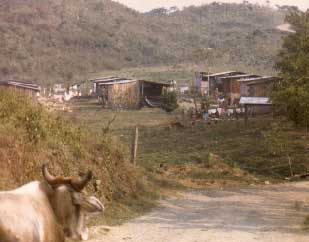
Yesterday morning we caught one of those 5:00am transports out of Bocay. We stopped in El Cedro--an asentamiento about an hour south of Bocay. El Cedro (which is also a CAS) has been there since March of 1983, but it was totally destroyed in a June 9, 1985 contra attack. They are still rebuilding the houses, but haven't started yet on the school. Peter got a series of testimonies there-from people who had been kidnaped, raped, or had their husbands or other relatives kidnaped and/or killed by the contras. In the afternoon we continued on to Bocaycito (another asentamiento and CAS) where we talked with a woman whose husband has been killed by the contras one and a half years ago on the road between El Cua and Bocaycito, and three kids seventeen to nineteen years old who had been taken by the contras and forced to fight with them this fall. Now we are waiting for a ride back there (after coming to El Cua to spend the night) to try to find a woman whose husband was killed by the contras about ten days ago.
There's really a difference between the campesinos of asentamientos such as El Cedro and Bocaycito and those arriving in San José de Bocay from the mountains during the last several weeks. The campesinos in El Cedro and Bocaycito were more pro-process, are green and carry AK-47 machine guns, and (to use the terminology of my friends) have a higher level of political consciousness. One friendly compa at El Cedro was rambling on and on about the revolution, as all of these people are apt to do, but he made a couple points that I thought were worth noting. He gave three reasons for campesinos being with the contras-either they had been fooled by the contras, were scared of what might happen to them if they didn't help the contras, or they had been kidnaped. He also noted that many of the desplazados who hadn't been bothered by the contras probably had been left alone because they had family members fighting with the contras. This may actually be an accurate observation and a valid explanation for why they didn't have stories of contra abuses to tell us.
Feb 1 Peñas Blancas Border station, Costa Rica
Now I am on my way to Panama for a week vacation to visit my parents who are working there with the Gospel Missionary Union. Just before 1:00pm while we
(Hazel, a woman from the Kansas WFP delegation and I) were waiting on the border between Nicaragua and Costa Rica we heard a plane flying over.
Unfortunately, I did not see the plane myself, but according to the Costa Ricans around me it was a Nicaraguan "avioneta" (a little plane). Suddenly there was
machine gun fire from the border region and the Costa Rican soldiers gripped their guns and ran onto the road and ordered a group of Nicaraguan women who
were waiting by the road to go behind the immigration "caseta" (guard house). The women and Hazel appeared rather frightened and the soldiers had nervous
grins on their faces. A bit later we talked with an immigration official. He said that Nicaragua has been intentionally violating Costa Rican airspace-flying a plane
over Costa Rica every five days or so. About a month ago, the Costa Rican government gave orders to fire on these unauthorized violations of their airspace.
As in El Espiño on the Honduran side of Nicaragua, here the Nicaraguan border station is set several kilometers back from the actual border. Just on the Nicaraguan side of the border, they have dug a trench with rifle portholes, have tank traps along the road, and a rather heavily armed presence on the border. It definitely appears as if they are expecting (or at least preparing for) an invasion from the Costa Rican side of the border. And the airplane overflight makes a person wonder if they are trying to provoke such an incident.
Costa Rica, for not having an army, sure seems well armed. The soldiers here do not have the old beat up AKs I grew accustomed to seeing in Nicaragua. I don't know enough about weapons to know what type they are carrying, but they are definitely nice, new machine guns. Already I miss Nicaragua, especially its affordable standard of living (life is expensive here). Maybe this trip will be good for me and help me appreciate Nicaragua more. "So you live here, Marcos," the Nicaraguan immigration officer said as I left. Yeah, I'll be back in a week. I feel at home there.
Feb 2 Mom & Dad's, El Amanecer, Panama
Well, I made it all the way here-really without any problems. It looks like I'm going to be in for lots of stories about repression in Nicaragua from the
conservative missionary folk that hang out here, stories that just aren't going to match up with the reality that I've experienced. It will probably be a good dry
run for my return to the States. I'm already beginning to feel what Tom said--I'm here hasta el fin ("until the end"). The way things are, I just can't handle
living back there.
There was a guy on the bus who was Nicaraguan but had been studying in Costa Rica for two years. He didn't like the Sandinista government and didn't want to do his military service. Yeah, I guess maybe I'm out of my country for the same purpose (different reaons though, perhaps). yeah.
A footnote to my story on the Nicaraguan-Costa Rican border incident yesterday-a Costa Rican civilian there said it might have been a contra plane that flew over trying to create an international incident that would make the Nicaraguan government look bad. Although this explanation has various problems (like, why wouldn't the Sandinistas shoot it down then, or at least follow it to where it landed and capture it?) it demonstrates to me the danger in jumping to obvious conclusions.
Feb 3 Panama
We went to Panama City today. Dad made a wrong turn at an intersection and a cop stopped us. After arguing about it for about an hour, the cop offered to
forget it for twenty dollars. Dad paid it, but the only thing I could think of was that this wouldn't happen in Nicaragua. You know how moralistic these
Commies are, corruption such as bribing just isn't possible there. And I miss "repressive" Nicaragua.
Feb 12 Jinotega
On the way back from Panama, I got pulled out of the Costa Rican customs line at the Costa Rican-Panama border. The customs official briefly unzipped my
backpack, put his chalk mark on it, and then an immigration officer indicated that I needed to go with him. We went to a bare office-two desks, three chairs,
you know--one of those places where it looks like they shoot people. The immigration officer told me to sit down. He pulled out a notebook and took down the
basic information from my passport. Then he had me sign it. He asked where I was going-I said Nicaragua, I wanted to meet up with some friends there. "Why
would you want to go there?'' was his reaction. He asked me how much money I had-I showed him. He took a twenty, for a moment I feared he would keep it.
But he only rubbed it on a sheet of paper-apparently to test if it was genuine. He went over to the other desk where he had instructed me to put my backpack.
He zipped it open and asked why I was traveling without any clothes. I explained that I had all of my clothes rolled up with my sleeping bag and strapped on the
bottom of the pack; in the backpack I only had assorted items such as my shoes, camera, frisbee, and this journal. Then he let me go, as another person from the
bus came into the room. What do you make of it? Did he see all the Nicaraguan stamps in my passport? Did I look a bit too shaggy? Or was it just a random
control? I don't know.
Feb 14 Jinotega
Today I went out to the asentamiento Loma Alto and its accompanying CAB cooperative- Carlos Fonseca. Everything was pretty quiet there-fourteen families
in the cooperative, all they had was coffee, and no history of contra attacks. The asentamiento was small-only eight families, all of them having arrived in the
last three months. Really no stories of kidnapings, rapes, or tortures. More a story of people looking for work and a more secure place to live.
There is a West German water project that has been going on there for a year. I talked with eight of them for a couple hours. We talked a bit about revolution and nonviolence. In a way, I really felt akin to them. The Green Party, for them, was too conservative-it works within a system that needs to be overthrown. Several of them had done some sort of draft resistance in Germany, but here they were in Nicaragua carrying AK machine guns. They really felt a need to defend themselves. If the contras attacked, they would get killed, they said, regardless of the fact that they were Germans. They were helping the Sandinistas and this would be sufficient reason for the contras to kill them. They mentioned the story of the two German women who had been working on that same water project several months before whom the contras had taken off of a public transit pickup on the road from Jinotega to Loma Alta and raped them. It seemed to be very much on their minds. They also told me the story of a German doctor who was stopped and killed by the contras on the road between Pantasma and Wiwili in 1983 (I believe), even though they knew who he was and what he was doing. They laughed at me for thinking that my gringo blood could save me; they thought that I was being naïve.
When I first thought about heading out there today, it was the story of the two women, ironically, that flashed through my mind. That had happened on that supposedly safe and free of contra stretch of road I had traveled out on. These Germans don't ride on the public transit anymore-"you don't know who you are riding with." They thought I was crazy for traveling alone and unarmed. "You could disappear and no one would know it." Now they only ride on Frente or army vehicles. My mind jumped to James and how he and Julieta almost were on an ambushed Frente vehicle and how he thought we should stay off of them. I felt trapped. Choose your way to die. But when it came time for me to go back to town, I was on a Frente vehicle-they had me too apprehensive to get on a public transit pickup. I am well aware that most of the drivers of those pickups are contra-sympathizers.
One of my main personal agenda items in coming here was to work through my feelings on nonviolence and my position on pacifism. I'm still very much at the same point where I was before-it's an irrelevant issue. I'm not at a point where I really have a choice. Like my German friends, I resisted the draft, and militarism in the US because it's unjust, oppressive, and exploitive-not because of its violence. They face the irony of now fighting for justice. For me, I do not see picking up a weapon here as having any constructive results--the struggle is Nicaraguan. I have not even been asked to pick up a gun, they ask us to go back to the States and change U.S. policy against Nicaragua. Another irony-I mention that unlike them, WFP is not trying to improve the Nicaraguans' lives, but to change US policy so that they can improve their own lives. But the Germans disagreed with me-their work was only a medium for changing German policy, to give them experience here and legitimacy for going back to Europe and trying to affect change there. The fruits of their labor here they saw as being quite minute.

Feb 19 Little House, Managua
I went out for pizza last night with Bruce. I had a real good talk with him. Turns out that he's a non-registrant too, although a more quiet one. Somehow, that
world seems far removed from this reality, but in my mind they are still closely intertwined. Resisting the draft is one way I have of (hopefully) stopping U.S.
aggression in Nicaragua.
On Sunday, February 16, the contras attacked a pickup by Somotillo. Four Nicaraguan women and Maurice Demierre, a Swiss agronomist who had been working for over two years in that area with the organization Brothers without Borders, were killed. Several people in WFP knew Maurice. The papers are full of news about these murders, the vigil at the U.S.Embassy tomorrow is in memory of Maurice, and there will be a mass for him at UCA (Universidad Centroamericana) tomorrow nights. Several things run through my head:
1.) If Maurice hadn't been injured, if it was only the four Nicaraguan women, this incident wouldn't be receiving near the news coverage that it is. Somehow internationalistas' lives have a worth higher then those of Nicaraguans, especially Nicaraguan women. I wonder if this worldview will ever change.
2.) The thought that this might be a "good" thing--Today at a press conference in DC, Mary Dutcher released the WOLA report that we've been working on. This appears to be a clear-cut case of a contra atrocity-it should add considerable weight to the report. The irony of going out of our way to locate clear-cut examples of what we are trying to stop.
3.) We had just pulled out of Somotillo at our December retreat-the zone was so quiet we didn't think we needed personnel there. I think this attack caught us by surprise. Julio noted that when the FOR delegation was in Nueva Guinea there wasn't much contra activity there; when they left it suddenly increased again. Maybe our presence in a place is more effective then we generally give it credit for being. We've been thinking about pulling some people out of Jinotega because it's so quiet there, maybe they should be sent to where the war really is. Now I'm really hesitating over whether that would really be such a good idea.
4.) How long will it be before it's one of us? I'm getting deep into Howard Zinn's & People's History of the United States. It leaves me feeling frustrated and exasperated. Zinn outlines so well where I'm at-not really a communist, more of a socialistic-orientated program for improving people's lives-not only in the U.S. but all around the world. But we are fighting against a deeply entrenched capitalistic system that creates a coalition of liberals and conservatives that oppose true social change. How can we really make change? And at what cost? Pacifism becomes more and more of a non-issue; the struggle is for justice.
Feb 20 Managua
We went to the mass and acto for Maurice tonight. There was a poster on the wall that said: "Reagan: assassinating Christians is religious persecution and is
terrorism." Yes, there is religious persecution here in Nicaragua. Guess where it comes from?
I'm reading in Zinn about the Vietnam war. That must have been a lot worse then Nicaragua is now. I guess we still have it easy-we need to do our work while the going is easy. Maybe the best thing we can do is to speak truth--to continue to uncover Reagan's lies. Maybe that's all we can do.
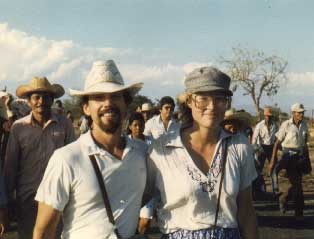
Feb 22 Managua
Warren came back from Nueva Guinea. He had been with the ARDE forces the past several days. The Sandinistas had tried to clear a free fire zone, but the
campesinos that they had taken to the asentamientos went back to their homes. Now the Sandinista army goes in and blows everybody away (including civilians)
in an attempt to destroy the social base for the contras. Warren brought back affidavits of Sandinista human rights abuses, and these can't be dismissed as
isolated activities that are subsequently punished. They are a result of the Sandinista policy in that situation. Things would be a lot easier if they came in black
and white. My mind jumps to San José de Bocay and how people told us that the army had removed them from their homes. I begin to wonder what we would
find if we traveled up to those areas, if we would find the same things. I really want to go and find out.

Feb 27 Tipitapa
Tired and sore, with shin splints and sunburns, but I'm glad to be on it, I must say. It's Miguel D'Escoto's Via Crucis por la Paz y la Vida (Way of the Cross for
Peace and Life). Yesterday morning, I hitched out with Mark and Michelle to Puerto Viejo where we met up with the March. Spent last night sleeping in a
school in Las Maderas. We set out a 5:00 this morning. It was awesome starting out before dawn-nice and cool too. The middle of the day gets blistering hot.
Today we made it to Tipitapa. We've come fifty kilometers now, and have twenty more to go tomorrow to get to the Plaza de la Revolución for the final
celebration. I'm really enjoying walking. I always do. I feel like I could keep on going forever. Too bad it has to end tomorrow. I wish I could have walked the
whole way from Jalapa (on the Honduras border, where the March started from). Walking is such a meditative experience.

March 1 Managua
We walked from Tipitapa to Managua yesterday. In a way it was anti-climatic. The March seemed to become more of a religious procession and Managua just
kinda drug on and on under the hot sun. I enjoyed walking out on the open roads. The final mass in front of the old cathedral was pretty neat though-kinda
powerful. Padre Miguel D'Escoto said some pretty powerful things--like the U.S. is an expert in the manufacture of death but not in God's justice; and how
Cardinal Obando y Bravo stands with the wealthy in Miami but not with the people of Nicaragua--and how he shouldn't celebrate any more masses until he gets
right with God and the people. I suppose that antagonistic people would argue that he was not very peace-loving and reconciling, but I know from my
experiences at Marion High School that these other things cannot happen until justice is established.
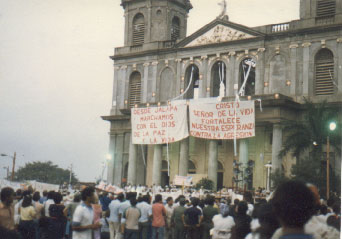
March 5 Jinotega
I'm reading Marge Piercy's Vida. It's about a radical from the sixties and her life underground in the late seventies. After reading Zinn and now this, I feel more
and more drawn to the Weather Underground. That's where I should be. Why? The marxist philosophies and insquabbling of leftist groups over ideology
doesn't really appeal to me. It's more just a simple-minded commitment to an idea and a vision. How would you describe it? It's idealistic orientated, but not
really idea orientated. I drift away from my pacifistic start, but don't really disavow it. I can't see myself pipebombing people and buildings. That's just not in
myself. But to be there on the radical cutting edge, that's where I need to be.
March 7 Managua
Rubén Zamora from the FDR-FMLN in El Salvador spoke to us tonight. My overriding reaction was how unradical he was. He just seemed to want a peaceful
settlement that allowed for social change. The hardline rhetoric that I'm drifting more and more into would say that such a settlement with exploitative forces
would co-op any real-changes they want to make. After all, why will Cuba and Nicaragua survive where Allende's Chile and Arbenz's Guatemala didn't? It says
something for a complete, thorough-going revolution instead of a reformist movement that leaves the basic corrupt structures intact. I guess in my militancy I
am drifting further and further away from my pacifistic beginnings. It becomes clearer and clearer that the Sandinistas are really whipping the contras and it
seems like good news. I'm really looking for a way to become involved in radical change. A hardline critique of the present anti-interventionalist movement
would state that it doesn't go far enough--doesn't seek to change and overthrow the system that results in this type of unjust imperialism. Maybe it's missing
the anger, urgency, and passionate commitment of a similar movement fifteen years ago. But I see in history movements tearing themselves apart by bitter
infighting over such philosophical points and I'm not quite willing to become involved in such divisions. It's best to work together against our enemies, eh?
March 11 Managua
Early evening on another Managua day. What useful reflections can I make on life on this planet?
Yes, I'm becoming more militant-placing the need for justice over the need for peace. But how does this play itself out in reality? I guess I am a de facto pacifist. But I look at the world around me-what kind of world do I envision creating? Can I hope for anything better then Nicaragua? I feel real hurt when I read of alleged Sandinista abuses. I expect them to be perfect-it shatters my world when they're not. A lot of what is reported is lies--I have to keep reminding myself of that. Events are misinterpreted or taken out of context. Today I came across a pile of censured material from La Prensa (the opposition newspaper) from several days in February. I was surprised how much--and what sort of material was cut. Couldn't the Sandinistas go ahead and let them print their lies and slanted propaganda? Won't truth win out in the end? It really destroys my idealism to begin to realize that this may not be reality, that the world is not black and white and that we may have to compromise on our ideals to achieve our ends. But this flies smack in the face of my earlier beliefs that an end is not worth achieving if we have to sacrifice our methods in the process. So…Life isn't always quite that easy, is it?
March 14 Jinotega
I finished reading Vida. The book used a phrase I never recall seeing before--violent direct action. Again, in this book pacifism was not a real issue. They
bombed buildings and other symbols of corporate profit from oppression and injustice. But they were careful never to hurt people or to hold them captive--they
always called in bomb threats and gave people time to evacuate. It makes me wonder how far I could go. If this is violent direct action, isn't it a fine line
between that and nonviolent direct action that could still be accepted by my pacifist friends? But it makes me direct my actions a bit more. For example, I doubt
I would be willing to serve a several year sentence for a Civil Disobedience action at Rocky Flats. But what would I be willing to do to prevent a U.S. invasion
of Nicaragua? A lot more, that's for sure, because that would be war and I know which side I would have to be fighting on. An invasion would be a lot easier
to fight against than the nuclear threats because it would be some thing a lot more concrete to organize against.
I spent all day yesterday in Matagalpa trying to get a letter of introduction from the asentamiento office for our trip next week. The director of the office, Carlos Paladino Murillo, asked me what my impressions of the asentamientos were. He made no attempt to hide the fact that the Sandinistas had made mistakes. He readily admitted that the EPS (the army) had forcefully removed campesinos from the mountains in the region north of San José de Bocay (as opposed to them coming voluntarily, as we had first been told). He felt caught in a bind-would they leave these campesinos in the isolated regions of Jinotega where they would be used, abused, and fooled by "La guardia," as he kept referring to the contras? Or would they pull them back into a zone where the army could protect them, even if this would not be what the campesinos wanted? He kept asking me rhetorically, "What would you do?" I kept wanting to tell him of Warren's recent experiences in Nueva Guinea. I told him of my desire to visit that area north of San José de Bocay. He had just returned from an eight-day trip through that area. He didn't laugh at me for wanting to go there, but said that if I got permission he would be willing to take me. I'd have to wear a uniform--camouflage to keep me from being spotted by the contras and shot at. I'm sure that Ed and Sharon (our WFP co-coordinators) would love that idea. I was surprised at his willingness to take me on such a trip-I'm sure that that area is not exactly a showcase of the possibilities of the Sandinista revolution.
March 17 Jinotega
'Twas one of those awful Managua days in which nothing ever quite gets done. Anyway, I went back to Managua two days ago (on Saturday). The pickup that
I hitched a ride on between Matagalpa and Sebaco had the left rear tire blow out. The truck was weaving all over the road. I kinda screamed and ducked into
the bed. It was one of those experiences in which I thought it was all over. I suppose if I have to go that's the way it'll probably be. The spare they put on
wasn't in any better shape than the tire that had blown out. We were almost to Sebaco, and I was glad to get off of that ride when we got there.
The next day (March 16), I went up to Somotillo for the acto commemorating the one month anniversary of Mauricio's and the four mothers' deaths in the ambush. We started out with a mass at Jiñocuao, where the four mothers were from. Then we stopped at the cemetery where the four women were buried, and walked the twelve kilometers to where the ambush took place. There we planted five crosses. It was almost dark when we planted them. Ria Reasoner sang her song "Gracias a los Nicas." I got so pissed-thinking about how the U.S.-supported contras deliberately killed them. I had to wonder when we'd have to plant one for our own-I hope never. Anyway, then we walked to Mauricio's grave in Somotillo. After finally eating we left at 9:15 for Managua. I wonder how good of an idea it was to go back at night-we were close to the border and I hadn't seen anyplace in Nicaragua with such heavy security. The bridges were heavily guarded and surrounded with mine fields. At night they were lighted underneath and they made us turn off the truck lights when we crossed-we never really understood why. At one point on the way to Somotillo, they made us get out of the bus and they searched it-I'm just not used to that sort of activity here in Nicaragua.
March 19 Jinotega
Yesterday and today Julieta, Sue (visiting from the Durham WFP office) and I visited a string of asentamientos in the Asturias and Pantasma zones. The stories
all are pretty much the same-the war's overt but the effects linger on. I read in the paper about Reagan's lies, and I get so pissed, I wanna do something to stop
it. Maybe we're back to the sixties and time for some good guerrilla theatre and other such antics.
March 21 Little House, Managua
Tried to get to Yali yesterday with Julieta and Sue, but the road past San Rafael was closed because of contras in the area. It's the first time I've run into that, I
wonder what's up.
March 23 Managua
I talked with Julieta by phone today. It sounds like all of Jinotega is on alert. I guess a group of about one thousand contras have been fighting in the area of
Yali, La Concordia, and San Rafael del Norte. And here I sit in Managua. I should be up there with the people. My political independence and nonviolence
suffer-I see Sandinista victories over the contras as a "good thing," feel encouraged by the realization that the Sandinistas are militarily defeating the contras.

March 26 STTH, Managua
Reports come in on the tense Nicaraguan-Honduran border situation. Reagan says that Nicaraguan soldiers have crossed into Honduras and that Honduras
asked for twenty million dollars in logistical support. No one else seems to support this version of the story-including Honduras. Most of the story seems to
come from the contras. At the same time, Reagan is making attacks against Libya. The newspapers draw parallels to the Gulf of Tonkin. Somehow it all seems
to be a deliberate staged introduction to an invasion again. I wonder how much of our concern is paranoia or if we really are that close to an invasion. Maybe I
won't be going home in a month. We are talking about responses-maybe even an acto on the border.
March 27 Little House, Managua
Tonight we celebrated the Passover supper and then the last supper. Daniel talked about a country under siege-a country being attacked by the world's
strongest power while groups inside the country collaborated with the invaders, others turned to violence to defeat the aggressors and religious sects arose,
which turned their minds to another world to take them off of the misery at hand. The irony and parallels between first century Judah and twentieth century
Nicaragua were striking.
We have taken up posts at the phone and are taking turns monitoring the radio during these Easter holidays so that we are prepared to respond if the present crisis should worsen. Now, the crisis seems to be blowing over. We still do not have a clear picture of what happened on the border between Nicaragua and Honduras. In Jalapa, Julio reports that all is "tranquilo" ("quiet"). But in Jinotega, Julieta said the contra had ambushed and killed six policemen by Pueblo Nuevo-an area that I had considered to be quite safe. I feel like I really should be in Jinotega and that I'm not carrying through on my WFP responsibilities. The Senate just passed the $100 million aid bill for the contras. It is a disappointment, but as we didn't celebrate when the House defeated the aid bill we won't mourn when the Senate passes it. After all, they do not bring us salvation and life, but they only talk of death and destruction.
I worry about my return to the States-how I will react to the continual bombardment of lies and how my recent turn toward a more militant nature will affect my ability to communicate my concerns. I can't see myself becoming involved in legislative work-I don't see that avenue resulting in the needed changes. In a way, it would be much easier if they would just get on with it and invade instead of leaving us in the uncertainty of this low level war. Then we would have an organizing advantage, something concrete to fight against.
And pacifism-I still won't register for the draft because that would be for aggression and exploitation. I won't pick up an AK here because we are not here to fight the war for them. The U.S. needs to be overthrown because it is an obstacle to any real change, but at this point it would be hopeless and self defeating to try to do it with guns. I, therefore, remain de facto a pacifist (I guess) although I still have to be confronted with the issues that would allow me to process the point and a situation that would present me with the options that would make it a real choice as opposed to simply a given.
April 8 Jinotega
I got a letter from Mom and Dad with a clipping about religious repression in Nicaragua from the Evangelical Press. I get incredibly pissed when I try to read
something like that. It's so biased and so full of lies and so much against people. I get so burning mad-but what good does it do? I just don't want to have to
deal with that sort of thing. I just don't deal well at all with it.
Carrie started changing my vocabulary this weekend. It's not "if I come back," but "when I come back" to Nicaragua. I don't know when it'll be-maybe a couple years, maybe this summer (if I have a good enough excuse). A couple days ago I had a dream in which I was leaving and I was just bawling my eyes out. I feel so privileged to live in a country like this-that actually tries to be for people instead of for more profits for the wealthy. It makes me sad to think of leaving and it blows me away to try to imagine that in three weeks I'll be gone. Why am I leaving? I don't really understand. It's as if it's just something that must be.
April 10 Yali
Waiting by the side of the road in Yali for a ride to San Rafael. We spent yesterday afternoon and this morning trying to find out some information about people
who were kidnaped during the combats in the last couple weeks. We're sure that something worth documenting did happen, but we can't seem to find out any
accurate information. So we're heading back to San Rafael-(WFPers) James, Cathy, Joe, me, Steph (a gringo teacher in Yali), and an English woman named
Diane that's kinda tagging along.
Pensión, San Rafael
I was thinking about going out with a polio vaccination campaign this weekend, but I guess they're going out with arms. Oh. Maybe I can't go then. Why?
Because of respect for WFP's guidelines against accepting armed escort. But then I stop and think-that's a pretty low principled reason for not doing
something-just because I was told not to. Then I try to think-what would I do if it wasn't for WFP? Would I go then? The issue seems so muddled and my
own ideas on nonviolence so-undefined. What does it mean to be a pacifist in this situation? And what happens when our goal of changing U.S. policy comes
into conflict with our nonviolence?
Alejandro was showing us some pictures tonight. James and I first met him playing basketball here five months ago. At that time he was in the SMP (the draft)- and a month later was demobilized. He won an award for his fighting, plus a trip to the Soviet Union. I remember him showing us how much he liked fighting. Then I had a flash of him shooting other people-other people who probably were fighting for the same reasons he was-probably (to a certain degree) involuntarily. It was a flash that made me cringe. The idea of people killing people just like them-that's the basic reason why I'm a pacifist. It just flies right in the face of my gut reactions and who I am.
April 11 Jinotega
Sitting here at home after a rather intense discussion at the Oriental Restaurant about nonviolence and the overthrow of the U.S. government. Cathy said that
overthrow of the U.S. government wasn't at all on her agenda. Joe and I went around and around until we ended up arguing the other's original point. For me,
I am still experiencing a reaction against the nonresistance of my religious upbringing, but have no desire to kill anyone (rather, I experience a quite deep moral
revulsion against the idea), but still strongly feel that in order for exploitation and oppression to stop here the U.S. government has to fall first. And then there's
the question of how to bring that about, and I guess that practically necessitates means which are more and more violent and perhaps more traditionally Marxist
in nature. It may be hard to understand the ambiguities and uncertainties that I'm dealing with unless you've dealt with them yourself.
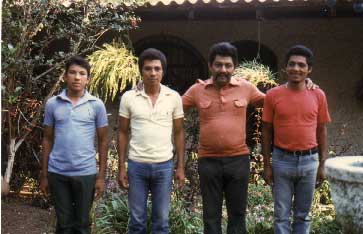
April 13 Jinotega
Yesterday I received the best news that I have gotten in my six months here. Peter and Alma returned from Bocas de Vilan with four of the fifteen people that had been kidnaped on October 25, 1985. The four-including Manuel's three sons-had just escaped a couple days earlier. Now they are going through the amnesty process. But this good news isn't without it's negative aspects: Manuel is afraid that the contras will return and kill his whole family in revenge for the escape of his three sons. He is afraid to spend the night in Bocas de Vilan and is planning on leaving his farm. The government would like for him to go to an asentamiento; he wants to move here to Jinotega. We are going to go back with him to his farm in Padre Douglas' pickup to get his family and things. Also, it looks like two of the three sons will be drafted now too. But after seeing Manuel so downcast over the loss of his sons, it is so exciting to see their release.
Last night Tim (Lohrentz) and I talked on the phone. We both had the same message-neither one of us is at all ready to leave Nicaragua. Right now we are tentatively looking at staying another two weeks or possibly a month more. It just doesn't seem possible that I could be leaving two weeks from tomorrow.
April 15 Tax Day
My head's feeling a bit messed up, so I'm not sure how much of this I'll get straight. Let's see-we left yesterday morning for Bocas de Vilan with Manuel and his three sons. Joe and I took them out in Padre Douglas' pickup. Manuel wanted to leave early in the morning, but we were trying to arrange getting a truck through the Frente to take out his corn and beans so it was 9:00 or so by the time we left.
On the way to Bocas de Vilan we stopped in at the Zonal Frente office in Pantasma because the Zonal Delegate there, Antonio Zamora, was supposed to have arranged the truck for us. When we got to his office he wasn't there. There just had been, at 9:00 that morning, an ambush in Bocas de Vilan and he had gone out to it. Manuel was real worried-he was sure that the contras had come and burned down his house and killed his family in an act of retaliation against his sons for their having escaped. Imagine the relief when Zamora came back and said that everyone was OK, Manuel responded, "That's it. That's the last night we're spending in Bocas de Vilan." We had heard that the road might be mined, but Zamora said it was clear. He returned to the sight of the ambush and we followed him to Manuel's house a couple minutes later.
For a family traumatized by all the fighting, they sure didn't move very quickly to get out of there. It was already noon and we still didn't have a truck, so Manuel decided to have his family spend the night in Malecon, back up the road in the Pantasma valley. Because of the size of his family, we had to make two trips with the pickup. On the way back from the first trip we had an empty pickup so we picked up people walking back to their houses in Bocas de Vilan. One of these riders talked Manuel into getting us to give her a ride to her place on the other side of Bocas de Vilan. I kinda jumped at the chance to take her because I hadn't been down the road yet to the sight of the ambush.
When I got to the ambush I suddenly became rather frightened. It was the first time that I had been anywhere in Nicaragua that I just as soon would not have been there. The ambush had been at the bridge just below Epifanio's place. A Ministry of Construction water truck had just crossed the bridge when it was attacked. A pickup coming from the other way was also hit. Both were burned, the driver of the truck and two drivers in the pickup killed, and a woman in the pickup wounded. The truck was still smoldering in the middle of the road, the pickup had gone off the side into the ditch. About fifty soldiers surrounded the scene. I asked a compa (a soldier) if we could go around the truck-sure, no problem. As we went on I became more and more scared. What did Manuel think he was doing sending us into this kind of a scene? I had Joe ask another compa, if it was sure that the road was not mined, I felt like I was losing my stability. Just above where the ambush had taken places we stopped to let the woman off, Mario, one of Manuel's sons who had just escaped from the contras, walked her home. We waited about half an hour while the sun was setting and we were in sight of this ambush scene while Mario, who had just left the contrast had to say goodbye to a girlfriend. He definitely didn't have the fear that some of the rest of us did. When we left to go back to Manuel's place, a compa yelled, "I hope the guardia doesn't get you." Sheeze, thanks a lot.
We finally got the second half of Manuel's family loaded up. They had been sitting rather tranquilo in their house all day, but when they got on the road they immediately were on pins. Joe, who was riding in back with them, said they were watching on hilltops and behind trees. "Early in the morning and late in the afternoon is the worse time for ambushes," they were saying. Great. Thanks. We could have gotten this whole show on the road hours ago, you know.
Meanwhile, I was driving naively not thinking that we might be the victim of an ambush, but thinking that the contra war had created yet another refugee family and that, but for a different turn of the cards, we could have been in the middle of the ambush that morning. That thought was unsettling. I started to cry. I felt like I was losing my head. No, when you're driving on these roads you can't let your vision blur-you won't see the potholes and land mines. So I turned my mind to other things, started singing Dire Straits "walking hand in hand like lovers are supposed to be" and thought of friends far away. My mind slipped back to matters at hand and I began to cry again. No, you can't let your vision blur…
I woke up in the middle of the night after a series of the worst war dreams that I've had here. As after a nightmare, I couldn't fall back asleep. My mind turned to the situation at hand and I began to cry. Several hours later I finally fell back asleep after finally shifting my thinking to friends far away…
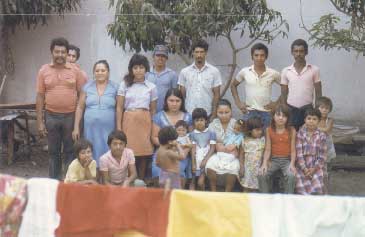
We came back to Jinotega this morning. We still hadn't gotten the truck and Manuel was not interested in going back into Bocas de Vilan without any army protection. So we loaded up part of the family up for the trip to Jinotega-three infants, nine kids, four bigger kids, and their grandmother. Later, the Padre sent his driver out with the pickup to pick up Manuel, his wife, and two sons. Mario, of all people, stayed in Bocas de Vilan. Now the whole family (except for Mario), twenty-one persons in all, is staying in Padre's church until they find a house.
Antonio Zamora told us the women hurt in the ambush was at the military hospital Apanas, so when I got back to Jinotega I continued on to Matagalpa to get permission from the EPS (army) public relations office to enter the hospital. I got a ride on a cattle truck and rode up on top of the rack in the wind. I alternatively thought of reality and began to cry, and then started to sing Dire Straits and think of friends far away in order to stop. We met a truck coming from the other way with Julieta in it. We waved like crazy for as long as the stretch of road allowed us to see each other.
At the public relations office I talked with the director, Daniel Soza. He was great-carefully getting all of the data on the nature of our visit to the hospital, complete and accurate so that we wouldn't have any troubles getting in. It's people like him and Zamora who care so much about Nicaragua, the revolution, and people that makes working here such a blast that I wish I didn't have to leave.
Speaking of leaving, Tim and I talked again tonight on the phone. We pushed back our departure date till May 11. That feels good-it will give me more time to finish up some things I'm not quite done working on. But the events of these last few days just proved to fully remind me why I'm not interested in another term right now. I just don't have the maturity to deal with the sorts of things I'm being put through.
April 19 Jinotega
We were going to leave for San José de Bocay this morning, but the situation got muddled up yesterday evening when I tried to pick up a letter of introduction
from Juan Tercero at the Frente office here in Jinotega to the zonal rep in the El Cua-Bocay area. It was the first time that we tried to get such a letter from Juan
Tercero, though we normally get such letters to go into distant zones like El Cua. Apparently Juan had contacted State Security to see how he should handle
what we intend just to be a routine request. State Security told Juan to ask to see our credentials. Well, we don't have such credentials-our work is based on
agreements on freedom of movement in the war zones that we worked out with the government two and a half years ago at the beginning of our work here.
Well, State Security said we should come over and meet with them. So we cancelled our travel plans for today and, at 8:00 this morning, went to the State
Security office here in Jinotega. They were too busy to see us and therefore, two hours later, told us that we would need to go to the Regional office in
Matagalpa. We called Juan back and he said he would see what he could do. He gave us a letter and let us continue with our travel plans, but we still need to
have a meeting with State Security. I just get really exasperated when having to deal with this bureaucracy. It's such a run around. It wouldn't bother me if I
thought it had a worthwhile end, if I thought it'd end the war. But it just seems like a waste.
April 22 Pensión San José de Bocay
After several fruitless days of attempting to secure transportation out here, we finally made it yesterday. This morning we went and talked with Ramón (Moncho)
Torrez who is in charge of the asentamientos here. Since our last visit here in January the army has stopped the forced evacuation of campesinos from the
mountains, apparently because of the expense. So in the last three months only seven new families have arrived here in Bocay and three in Tapaskún up the road.
Ramón is an "old timer" who fought with the Sandinistas before the revolution and is really pro-process. But he seems to want to use us for his political ends. Ramón took us to a UNAG (Union of small farmers) meeting where they discussed getting credit from the bank for the next year. In a way, it was just a propaganda meeting in which Ramón talked about the importance of production. The meeting began and ended with everyone standing, taking off their hats, and singing the Sandinista Hymn (although Ramón did most of the singing). The second time, one person didn't stand up. Ramón insisted that he stand, and the scene caused me to flash on my behavior in the states. There I wouldn't stand or sing the national hymn. It would be nice if things were different here. I wish they wouldn't have to engage in such blatant propaganda- I can't get used to it, no matter what its political ends are.
April 23 Rio El Cedro
"Down by the river..." is becoming a bit of a theme song for this trip. Just kinda hanging out here by the river, bathing, washing clothes, writing-kinda feeling
like I was backpacking and how much of the life that is.
Yesterday afternoon we went to talk with some of the new families at the asentamiento in Bocay. It just really bummed me out-just bounce in, "Hi! I'm from the States and why don't you tell me all about how it feels being abused by the contras?" It seems so shallow and fly-by-night. Talking with Manuel and his sons was so much more meaningful because we actually had a relationship with them and knew them. I agree more and more with Julieta and her feelings of the need to do permanent presence as opposed to documentation. I do recognize the importance of documentation, it's just... The permanent presence can be pretty paternalistic too, for that matter. I remember Peter at one point asking the question if a place felt the need to be "accompanied (by a WFP delegation) through their time of suffering," What do we know about life and death to really help a people like this?
Anyway, we blew into El Cedro early this morning. We found Paulo Ramos, the responsable, right away. We had a good but short talk with him, I kinda like him-he seems to have his act together. There has been recent combat in the area- two weeks ago a band of six hundred contras passed by here and two or three days ago there had been another combat. But the BLIs (the army's rapid deployment force) do a pretty good job of handling the contras and they didn't do any damage to the coop. It seems to be in a pretty static state of being-no new families, no new stories. So we spent an hour or so this morning talking with Antonio, a desalzado who left the contras and is on his way to El Cua to turn himself in to the Ministry of Interior in order to take advantage of the amnesty law.
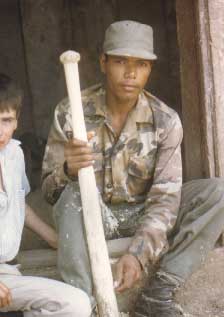
April 26 Jinotega
So now we are back home already. It seems unfair that reality can change so fast--it should take a while to get from the backward reality of the campo to the
modern reality of the city.
We finally left El Cedro on the evening of April 24 on a truck to Bocaycito carrying medicine for the Ministry of Health. The late afternoon isn't the safest time to travel, but we really did need to be moving on.
In Bocaycito they had just finished celebrating the fourth anniversary of their founding. The combat in the area is military-the civilian population is pretty much being left alone. We found out that they were starting a new co-op in San Benito, a couple kilometers outside of Bocaycito, so we began walking there.
On the way there, we found out that apparently the contra had killed a man by La Chata, close to El Cua. We finished walking to the coop, talked a bit with a couple leaders, and left to try to get to La Chata. Again, we ran into transportation difficulties and spent the rest of the day waiting for a ride to La Chata. Early this morning we started walking there. We stopped in La Chata, just long enough to get the basic story on this guy who had been killed, and then we continued on into Cua. There we immediately got pulled into the State Security office where they proceeded to basically chew us out for being in the zone without their permission. Then a vehicle was leaving for Jinotega so we got on it (because we really wanted to get back here) without doing anything else in El Cua.
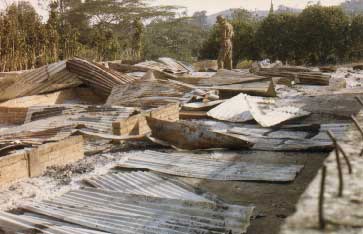
April 28 Jinotega
We found out this afternoon that early this morning a group of contras had attacked El Diamante, an asentamiento that I had visited about one and a half months
ago with Sue McKinney and Julieta. Cathy and I went out there with Maj and Justin Stormogibson in their jeep. Fortunately, no one was killed in the attack, but
two militia and one little girl were hurt, and one nineteen year-old man was kidnaped. The contras burned the houses of these "desplazados" ("displaced
people"). I took picture after picture of the smoldering ashes of the remains of the houses, and of the people who used to live in them. The army was painting
over the graffiti that the contras had left behind. On one wall it said "Cachorros de Reagan"-these freedom fighting brethren of his do such fine work here.
What more can I say?
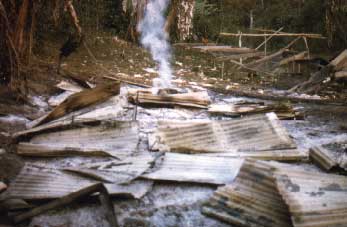
May 2 Managua
Kinda left Jinotega-kinda feels kinda weird to kinda leave for good, eh? Leaving and knowing I'm not going back in a couple days...I had to come to Managua
to apply for my exit visa. I wanna say that I'm coming back so they don't take my cédula (my residency papers) away, but they won't let me. They say
immigration would keep looking for me if I left with my cédula. That's not fair-they can't take my cédula away, they can't deprive me of my Nicaraguan
residency.
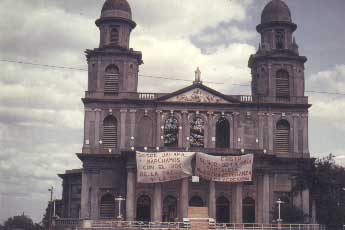
May 6 Managua
My passport came back from immigration today. In it there was a stamp that said "residencia cancelada" ("residency canceled"). I feel like I lost a part of
myself-they took my Nicaraguan residency away. Just doesn't seem fair to do it. Even though I still am here in Nicaragua, I'm no longer a resident. Pout-pout.

May 11 Hospedaje Familiar, Tegucigalpa- U.S. occupied Honduras
It's been a long haul today. We left Estelí early this morning. At the border, Nicaraguan immigration wanted to see our cédulas-the one Sharon made me turn
in. They noted "no es residente" ("isn't a resident") as if to rub it in. Customs charged C$300 to look through my luggage-claimed they charged it because it
was Sunday.
We got to Honduras. They charged us two limpira apiece to look through our luggage. They did us the favor of confiscating all of our communist propaganda so that we wouldn't be shot as communists further up the road. Took my Omar Cabezas book (which I hadn't finished reading) and my communist Nicaraguan tourist map. But they wouldn't take my communist La Prensa though-they claimed that it was just toilet paper. They told us how bad Nicaragua was. Immigration only gave us four-day transit visas (we were planning on staying about a week). No, they didn't give them to us-they charged us five limpira apiece. They told us four days was long enough to see what we would want to see in Honduras. By this time I was rather pissed and didn't care to have anything else to do with Honduras customs/immigration, or Honduras itself for that matter. On the taxi ride to San Marcos de Colon I just started thinking about how much I missed Nicaragua--the atmosphere and friendly officials. That's really worth a lot to me. I really don't understand why I left. I told people that I was coming back in a year or two, but even as I leave I know that once I'm gone it's forever. The world's big and I have to be moving on.
We caught a bus to Tegucigalpa. Elias Sanchez, Doris' old boss here in Honduras, was nice enough to pick us up from the bus station. He took us to this hospedaje (hotel) and bought us supper. We had a great discussion with him about the political situation here. I was quite impressed with him, really. Wonder how many people like him there are here. He told us that if Paul McKay can't find a job in the U.S. he should come back and work here.
We went out walking the streets. I walked into a store-there were eggs and soap and toilet paper on the shelf. Culture shock. Powdered milk, too. Five limpiras. I bought the same thing in Nicaragua for 400 cords. Broke me up-these guys are really being taken for a ride. Maybe there is more here, but can people (the real people) afford it?
May 12 Hotel San Pedro Sula, Honduras
We've come this far already-seems incredible that we were in Nicaragua only yesterday. They say Honduras is supposed to be so poor but we are living so
luxuriously here. I went to take a shower and there were two knobs. "Which one's for the water?" I wondered. But one was hot and one was cold! I couldn't
believe it! A hot shower! It's been like eight months since I've had that. Culture shock. But it's a hot day-why would anyone want to take a steaming hot
shower on a hot day? So I took a cold shower anyway. And there was TP in the bathroom. I had to resist the temptation to take a bit of it. Guess days of being
short on TP are over. Just not used to this sort of thing.
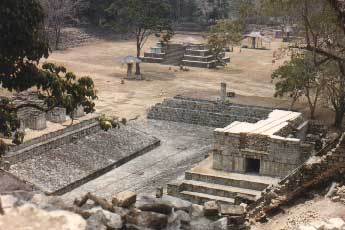
May 14 Linda Shelly's, San Marcos, Honduras
Yesterday we went to the Mayan ruins at Copan. Today we arrived at San Marcos, met Linda Shelly, and got our permission to get into the Mesa Grande
refugee camp tomorrow. We talked with Luis Flores, the coordinator for the Honduran Mennonite Church work in the refugee camps. Generally I think of the
Mennonite church here as being rather conservative and inward looking. It's nice to meet people with a social concern.
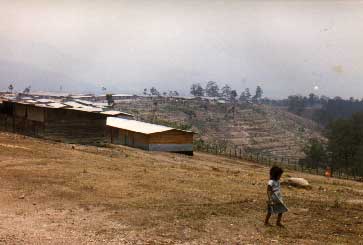
May 15 Pensión Nazereno, Esquipuias, Guatemala
We made it to Guatemala. Somehow I like this country, even if it is a police state. At least it's cheaper here. Rigoberto, a director of construction at the
Salvadorean refugee camp "Mesa Grande" in Honduras, took us to two of the camps there today. There are five agencies working at the camps and the
Mennonites are in charge of construction. We just spent the morning there because our visas ran out today and we had to leave the country. Rigoberto took us
to the different "Talleres" (workshops) set up at the camp. Not only is there the one for construction (where they were making latrine doors and chicken nests),
but one for carpentry (tables, chairs, beds, a cabinet and a coffin), another for shoes, for hammocks, for clothes (including men making their own pants), and for
hats. I was quite impressed. Here were refugees working for nothing, but working hard to make products for their communities. A lot of them were doing
work that they had never done before-they were teaching each other and learning skills through experience.
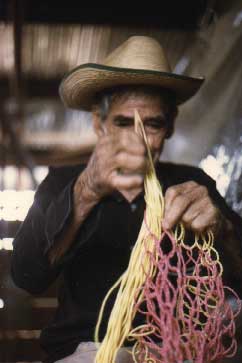
Salvadoreans have been called the Germans of Central America and watching them work really brought out the Protestant work ethic in me. But they are also learning a lot about working together and raising themselves ("levantarse"). They will have a lot to add to the New El Salvador after the revolution. In addition to the workshops, we also saw their agricultural project (but 11,000 people will never achieve self-sufficiency on 300 manzanas of land) and the schools (with their own Salvadorean teachers). These people aren't just kicking back and taking a vacation-they're working hard to make something out of their lives.
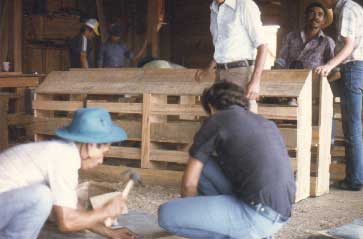
Tim asked me how these camps compared to asentamientos in Nicaragua. All asentamientos aren't the same, but generally they lack males of my age bracket, or if such males are there, they are in the militia and dressed in green and carry AKs. This population is unarmed and males my age are dressed in civilian clothes. I was surprised how high the morale was in the camps-seemed to be higher then in the asentamientos. These people seemed to be working together better. The Nicaraguan asentamientos have more room--houses aren't built one right on top of the other (though these houses were better constructed then those in Nicaragua-often in Nicaragua there is a lack of material to properly finish the houses) and land is more plentiful for distribution for farming. But really, my experiences (on both levels, really) are much too limited to really draw much of comparisons.
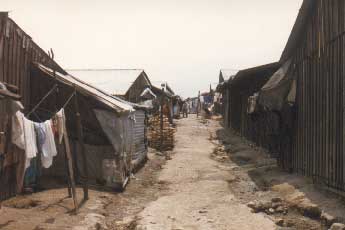
And so we left Honduras, a land which really didn't want us anyway and charges outrageous rates for its buses. And we came to Guatemala where they didn't have any customs check at the border but, instead, two military roadblocks in the short distance (maybe ten kilometers) from the border to Esquipulas.
May 19 Finca Ixobel, Guatemala
Anyway, we left Esquipulas and continued on a long, hot, dusty ride to Flores, a ride not unlike that to San José de Bocay. The bus was full so we got to ride on
top, which was fun, but I got thoroughly sunburned. The next morning we went out to Tikal and spent the whole day climbing around on the temples-the ancient
Mayans would probably have been really pissed to have pagans violating their sacred grounds like that. We spent the night at a campground there. When we
came out of the showers we met a bunch of soldiers waiting to get in. They were horsing around and the first thing I thought when I saw that sea of green was
that these were the Nicaraguan compas I used to always run into. How different an army looks close up-these are just people.
I read in the paper today that eight Germans who were working on a construction project in Nicaragua were kidnaped by the contras. Guess their AK's didn't save them, eh? Really hope they're OK. Dreading the day when I pick up a paper and read that some of my compañeros have been shot…
May 23 San Salvador
We spent an extra day at the Finca Ixobel, a gringo-run campground that is a real good place for just kicking back. We went caving-two of them. It's the sort
of thing you do out of loyalty to friends like Barb Johnson. (Can't you just hear her? "What? You went to the only place in all of Guatemala with decent caves
and you didn't even go into them?") Then we got on the bus and rode for two days, stopping over in Guatemala City for the night. We got into San Salvador
and tried to look up the MCCers but got hooked up with the Beachy Mennonite Mission that Carol Miller was here with.
May 25 San Salvador
El Salvador-a mixture of religion, tourism, and politics. We went to a church service with the Beachy Mennonites. We saw the national cathedral, the national
palace, and the national theatre.
But more then anything our purpose was political. In the cathedral we visited Oscar Romero's tomb and met a group of about fifteen people who had sought refuge there from the army's bombardments in the campo. They had only come in the last week or two. Then we went to the University. We walked around and read the graffiti-slogans celebrating the struggle of the FMLN against the oppression in the country. It felt great to be back on a college campus, and it made me wonder why I was in such a big hurry to graduate in the first place anyway.
Then we met Blake Ortman, the MCC country rep in Salvador. He drew a completely different picture of the nature of the struggle here in El Salvador than one is normally apt to gather. He also opened doors for us to visit victims of the oppression.
The next morning (Saturday) we went with Nathan, a Beachy Mennonite worker, to Guazapa where he works. Guazapa is at the base of the Guazapa Mountain which is famous as rebel headquarters-only thirty kilometers or so from San Salvador. He showed us a bit of his work-a water project and a clinic.
And then, in the afternoon, we went to the Domus Marie Refugio where about five hundred people were living, afraid to leave because of the oppression of the Army. They had been there for years-since about 1980. A group of people crowded on a hilltop, surrounded by a wire fence-never able to leave, always having to be there. In a way it was like the Mesa Grande camp in Honduras-they cooked together, had a carpenter shop and a sewing shop. They were in this together. Just when we were leaving we started playing with some kids. They piled all over us-fascinated by these gringos, by my glasses and by Tim's camera. They were just bubbling over with energy, being cramped up in that tight area. It had been a long time since I had had so much fun with kids.
Then we went to the mother's committee of the disappeared. We listened to them tell of their stories of oppression and terror. They told us to go tell Reagan what the situation was like there. It seemed like an awfully big task they laid out for us to carry out. I'm not sure I'm up for it-I'm not sure I'm capable. By the end of the day we felt wasted.
May 28 Hotel Central, Huehuetenengo, Guatemala
Lying on my bed here in this hotel feeling none too hot. Ever since Saturday in San Salvador (five days ago) I've been sick, which makes bus travel none too much fun.
We came back from San Salvador to Antigua Guatemala. We went to Doña Luisa's for supper, which is what I really wanted to do in Antigua anyway. We spent the next day in Antigua and then continued on to Panajachel. Now we are in Huehuetenengo. I mostly wanted to come here because this is where my brother Wiren was ten years ago with Team Missions. Tomorrow we leave for Mexico.
May 31 Terminal Autobuses del Norte, Mexico, DF
Sitting here on the bus that will take us through the night to Matamoras and when morning dawns it will be June and we'll be crossing back to that great monster
in the north.
I found Omar Cabazes book La montaña es algo más que una inmensa estepa verde in a bookstore here. I just had to buy it to spite Honduras and powers who make situations like Honduras possible whose customs we may still have to pass through. They can't beat the truth that easy. If they take it away there, I'll just buy another copy in the States.
June 1 VS Unit Brownsville, Texas, U.S. occupied U.S.
Here I am in another place that kinda almost feels like home. I spent all afternoon working on my cycle. I think it's ready to go now.
It was a long terrible bus ride last night. Somehow we missed Mexican customs-still not sure where they were supposed to be. U.S. customs-just gets me really nervous and feeling bad about it. First, immigration: The man takes my passport and asks, "Where were you born?" South Dakota. "What's South Dakota famous for?" The Black Hills, I guess. "Which Indians lived in South Dakota?" Well, Sioux, where I'm from. Then he puts Tim to the same interrogation. I guess we passed the test because he gave us back our passports and sent us to customs: "Where are you coming from?" they asked. Mexico City, "How long were you there?" A couple of days. "Are you bringing anything from there?" Yeah, some souvenirs." Are you carrying any medication?" No. They look at our passports and see Tim's Guatemalan stamps. They dwell on this point. "How far have you been?" Well, I've been to Panama. He turns to Tim, "And you?" Almost as far, Tim answers. I could have hit him. It sounded like a lie. They let it slide. If he would have said Nicaragua, we probably would have been detained for further questioning. They gave us back our passports, finished searching our bags, and one asked me, "Have you ever lived in Virginia?" Ah...no. Why? "Just wondering." I couldn't wait to get out of there. Tim seemed to take forever in getting his bags closed up.
June 5 little bro Ivan's, Arvada, Colorado
So here I am-feeling a bit lost and lethargic, not sure just where to go from here. Two long days on the bike-1250 miles in two days. Two long days and my
butt is sore and my nose is sunburned.
Really not too much culture shock. I went through most of the cultural adjustment gradually by traveling back overland. Still, I'm not used to the wealth. Ivan sends me to the store for milk. Well, where I come from, if you're lucky enough to even find milk it comes in only one size and shape and form- a liter in a plastic bag. I stared dumbfoundedly at the cooler with about ten different kinds of milk, trying to figure out which one Ivan might have meant. Otherwise, it's some of the typical stuff- like not used to addressing strangers in English, and not used to being completely functionally literate in a society.
But the biggest thing is people's attitudes. Like the guys running the Honda shop in Brownsville-they told me I needed a new battery for my cycle and that it cost $42.95 and, well, if I only had $41.73 it wasn't their problem and there was nothing they could do about it. That place was just such a full expression of everything I despise about the U.S. capitalistic system. Or when the mechanic of whom I asked to borrow a wrench to change my spark plus and he refused. Oh. Sorry. I forgot. People aren't supposed to trust people here. Lock the doors and pull the curtains and hide in your house. I wonder why this world has to be such a mean, cold, cruel place, until I realize that the world isn't like that- it's only the system here in this country. So I vow that I'll do something about it. I'll be the one who goes around being nice to people, doing nice things for them. Down with cold prickles. Three cheers for warm Fuzzies!!!
June 15 South Dakota
I just got done with what I thought to be the ultimate test of my WFP experience- bringing it back home. I gave a presentation in church tonight, showed my
slides and talked about my experiences. For years, I had wanted to shake these people up and talk to them about Truth and Reality. Now, I finally had my big
opportunity and I found that I no longer really care what the Marion EMB church thinks or does. Let them go off on their own. I was really surprised at how
easy it was, considering their political antagonisms to what I'm trying to do in the world and the theological distance between me and them. Everything was
low-key and they seemed to listen. I was even surprised at how many people came-mom said she counted about twenty.
I don't consider myself a public speaker at all, but at least this was good practice for situations that I may take a little bit more serious. Yeah, Life?
Appendix
- Fundraising letter for Mark and Tim's service in Nicaragua.
- Map of the Department of Jinotega where Mark worked.
- Report on the February 14, 1986 trip to the cooperative Carlos Fonseca and the asentamiento Loma Alta.
- Report on the March 18 and 19, 1986 trip to asentamientos in the zones of Asturias and Pantasma.
- Report on the April 14, 1986 ambush of two vehicles in Bocas de Vilan.
- Report on the April 28, 1986 attack on the asentamiento at El Diamante.
- Summary of Contra and WFP activity in the Department of Jinotega, January to March, 1986.
- Testimony for the Kansas Network on Central America's Kansas Citizens' Hearing on Central America, March 21, 1986.
- Text of letter sent to Representatives Tom Daschle (D-SD) and Bob Whittaker (R-KS), February 24, 1986.
- Whittaker's response to this letter, March 3. 1986.
- Daschle's response, May 2, 1986.
- Daschle's response, June 30, 1986.
- Letter to Senator Nancy Kassebaum (R-KS), June 26, 1986.
- "Local Man Returns from Service in Nicaragua," The Marion Record, Marion, South Dakota, June 19, 1986.
- Letter to the Editor, Mountain News, Denver, Colorado, July 6, 1986.
- "Bethel grads spend time in Nicaragua." Matt Bartell, The Newton Kansan, July 10, 1986.
Fundraising letter for Mark and Tim's service in Nicaragua
Two recent Bethel College grads (Tim Lohrentz and Mark Becker) are going to Nicaragua this fall to work, live, and stand in solidarity with the Nicaraguan people. They need your financial, emotional, and spiritual support as they go to a war-torn country. In exchange, they will be your contacts and communication link with the situation in Nicaragua. Upon their return, they will be willing to discuss and give talks on their experiences. Please pass this request for support on to other interested persons.
Tim Lohrentz
I will be leaving on September 5 for Nicaragua. I will be working for up to a year (on a voluntary-service basis) at a school sixteen kilometers north of Estelí after completing language studies in Estelí. It is an agricultural school, and was visited by the Paul McKay-led Bethel trip in June, 1983. A Radio Shack TRS, paid for by the Save The Children Foundation of Canada, will be used for the school's accounting and a number of agricultural applications. I will implement the programs and teach the staff how to use it.
About $500 is needed for additional computer software, language school, and return-travel costs (overland). Send tax-deductible contributions to Box 252, N. Newton, KS 67117. Please make checks payable to "Jubilee Mennonite Church," with "Nicaragua Fund'' written on the memo. May we all learn to live together before we all die together.
Mark Becker
I am going with Witness for Peace as a part of their long-term delegation in Nicaragua. Witness for Peace is a faith-based movement dedicated to changing United States' foreign policy toward Nicaragua from one of covert and overt intervention to one that fosters justice, peace, and friendship. As a long term volunteer, my responsibilities will include:
- Hosting short-term delegations, handling logistics, setting up interviews, acting as a translator, and accompanying the groups during their time in the country.
- Gathering information and documenting effects of the contra war for dissemination to the North American public.
- Standing with the Nicaraguan people as a part of a peaceful and nonviolent U.S. presence in that country.
I will leave an August 26 for two months of language study in Guatemala. My six-month term with Witness for Peace in Nicaragua will begin on November 2. Financially, I need $1000 support for my Witness for Peace expenses and $600 for language study. Tax deductible contributions can be sent directly to Witness for Peace, 1414 Woodland Dr., Durham, NC 27701. Checks should be made out to the Eschaton Foundation with "WFP-Mark Becker" noted on the memo.
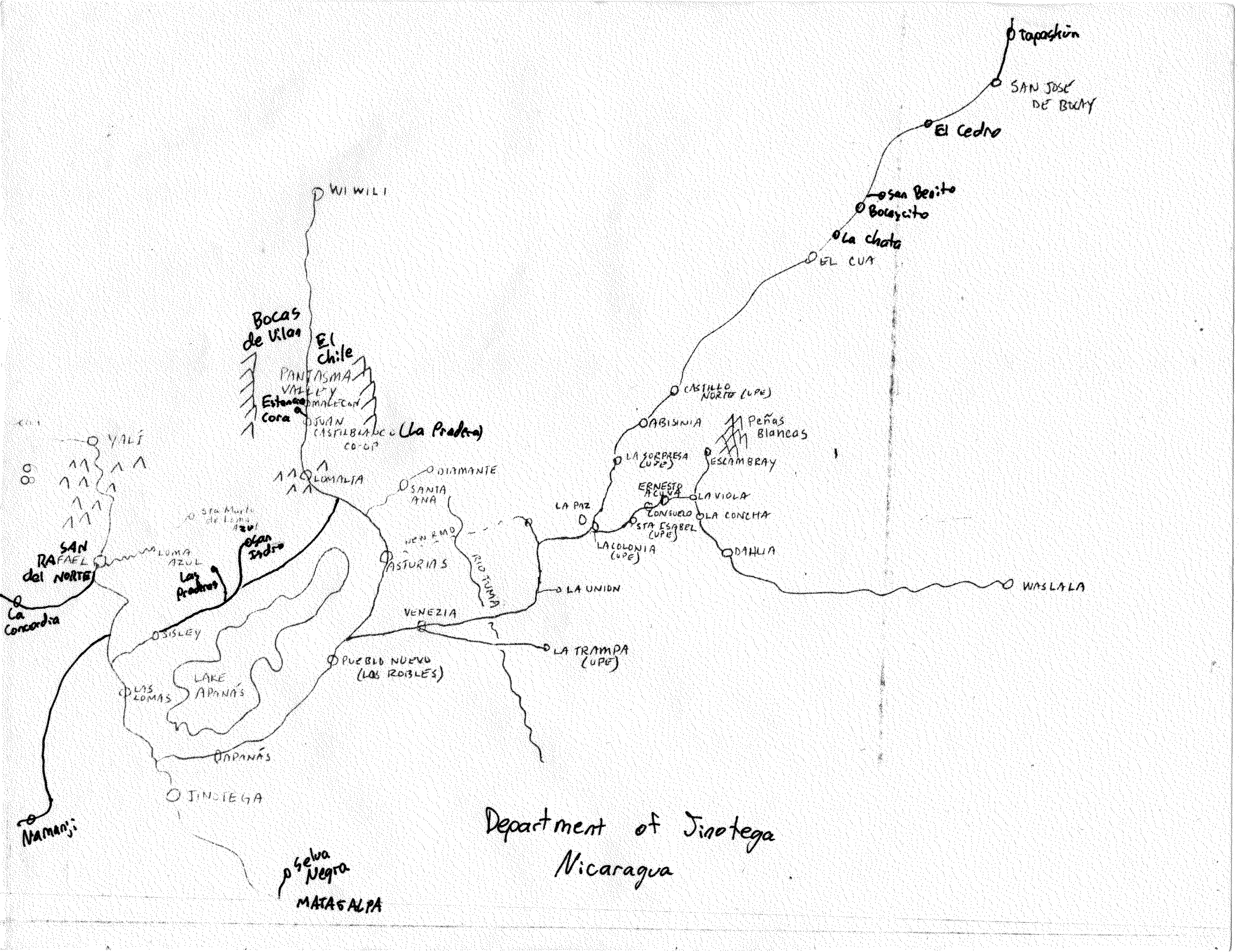
REPORT: Cooperative Carlos Fonseca; asentamiento Loma Alta
On February 14, 1986, I, Mark Becker, traveled to the cooperative Carlos Fonseca and the asentamiento Loma Alta in the Zone of Pantasma in the Department of Jinotega.
Carlos Fonseca is a CAS, a cooperative that shares a common means of production and in the defense of the cooperative. The cooperative was formed twenty months ago (June 1984) by displaced families from Ventaron, a cooperative in the Zone of Pantasma that was destroyed by the contras. Fourteen families (about 120 people, including children) now live there. They are organized under a directorate of four people. The cooperative is comprised of twenty-nine well-built houses. Of the fifteen houses not used to accommodate families, one is used as living quarters for a West German Brigade, and the others are used to store supplies and other materials. Thirty Brigadistas from Managua were also there working on the coffee harvest. The cooperative has fifty manzanas of coffee and planned to finish the harvest the next day (February 15). They had harvested nine hundred quintales of coffee-a good harvest. Besides coffee, the cooperative has a bit of corn, but nothing more. I asked one member of the cooperative what the food situation was like; he responded, "We aren't lacking much." Although on occasion groups of contras have been known to move through this area, this cooperative has never been attacked. Things seemed to be well under control and running smoothly.
Loma Alta is a recently constructed asentamiento next to the cooperative Carlos Fonseca. As with many other new asentamientos in the region, the twenty-nine "houses" are simply tin roofs supported by concrete poles with leveled off dirt floors. Slowly work is progressing on the latrines. Eight families now live here, most of them came from the surrounding areas. The first family arrived three months ago (November 1985) from La Cruz. This family is comprised of a mother with five children, the father died fighting with the Sandinistas three years ago. The family was looking for a more secure place to live. Two months ago (December 1985) a family arrived from Dewale. Three boys from this family are in the Sandinista Army and the rest of the family felt that it was too dangerous living close to the mountains where the contras are. Although most of the houses in the asentamiento were unoccupied, this family chose a house on the far edge of the settlement--away from the other families. This house was the closest to Dewale-they still have their farm there and every day the father walks there to get the coffee harvest in. Presently they are trying to sell the farm.
The last families to arrive in Loma Alta came a month or two ago from Oscar Tursio because of fear of the many contras that moved through that area. Another family had come to Loma Alta simply because of the work. There are close connections between this asentamiento and the cooperative Carlos Fonseca and many people from the asentamiento work with the cooperative on the coffee harvest. In one house I encountered a woman from La Cruz who was taking care of a friend's house in the asentamiento while she was away for a month. This woman from La Cruz expressed a great interest in moving to the asentamiento also. She saw it as a haven, a secure place with sufficient food. At present it is doubtful that many more people will come to Loma Alta; but most of those that do come will probably, like this woman, come for convenience's sake.
About a year ago a group of West Germans started work on a project to bring clean drinking water to the cooperative and asentamiento. Now a brigade of eight Germans is working on this project that the Germans hope to complete within two months time. A man in the cooperative told me that they welcomed the Germans as "a force, a help to improve our lives."
Within the last year the cooperative has built a new school building and classes should be starting within a month when the two teachers come. This school is just one more example of how together this cooperative is.
Visits to Asentamientos in the Zones of Asturias and Pantasma
On March 18 & 19, 1986, Witness for Peace Long Termers Mark Becker and Julieta Martinez, along with Sue McKinney from the Durham office staff, visited the asentamientos of Loma Alta and El Diamante/Santa Ana in the zone of Asturias; and Estancia Cora and La Pradera in the zone of Pantasma. This is a report (written by Mark Becker) on those visits.
March 18, Loma Alta
We made our first stop at the cooperative Carlos Fonseca, which is comprised mainly of people who have been in the asentamiento of Loma Alta for almost two years. Since Mark Becker had recently visited this asentamiento (see February 14 report), and since there were no new members, we did not spend much time here.
About five days earlier (March 13??), a group of about one hundred contras had passed through that area but did not attack. The cooperative/asentamiento has a new school building, but they were still waiting for the teachers to arrive for classes to begin. They do not have a health center. The German brigade working on the water project had just left, although due to a lack of material the project was not completed.
El Diamante/Santa Ana
Next we visited the asentamiento El Diamante/Santa Ana. Here we spoke with the responsable Jacinto Perez Palacio.
This asentamiento was begun on February 16 to 18, 1985 after continual intense fighting (the last combat had been on February 5, 1985) had made it impossible to work it that area. The land for the asentamiento had been acquired from three haciendas (El Diamante, Santa Ana, and La Estrella). The government paid 42 million cordabas to the former owner, Francisco Casco, for the land. The people were moved here from Ventarron, La Cruz, and Los Cedros (all settlements within a couple kilometers of the asentamiento) and the other three asentamientos in the zones of Asturias and Pantasma (Loma Alta, La Pradera, and Estancia Cora).
Originally, one hundred houses had been planned in this asentamiento. A number of people have left the asentamiento and now only seventy-five houses are planned. Seven houses are finished, but all of the seven or eight families that we spoke with lived in the small, dark type of building used to house workers on an hacienda. Although work on the asentamiento was progressing, we did not receive clear data on the make-up of it. Everyone in the area seemed to be treated as part of the asentamiento, and there seemed to be a goal of filling up the houses whether they were needed or not.
Last year the school had two teachers and about fifty-two students. They were waiting for the teachers to arrive for this school year while we were there. At one point, they had started an Adult Education program with fifteen people, but it lasted only a month-mostly because of the war. They have a Health Center with a resident nurse and a doctor that visits once a week. Thirty-five to forty people visit the Health Center every day.
The government is in the process of distributing land to members of the asentamiento. Coffee, corn, beans, and vegetables (cabbage, potatoes, and tomatoes) are grown in that area, and people are getting loans from the bank.
El Chile/Bocas de Vilan
We spent the night here. They reported that the area had been calm with less combat. There still is no word from the fifteen people kidnaped on the night of October 25, 1985.
March 19, Estancia Cora
At the asentamiento Estancia Cora we briefly spoke with the responsable, Francisco Aguilar. This asentamiento was begun in February, 1985 of people from Prisionero, La Rica, Santa Cruz, La Vigia, and Wiwili. Originally, Estancia Cora was a hacienda before becoming an UPE (state farm) and now an asentamiento. It consists of 1400 manzanas of land on which is raised cattle, coffee, beans, and corn.
At present, there are one hundred houses in the asentamiento. Sixty-eight families (a total of 384 persons) live there, and plans are to bring in thirty-six more families. There is a school (the teacher was to arrive the following week), an adult education program, and a health center. Forty-nine of the people are organized into a credit and service cooperative (CCS) known as Daniel Teller P. Members of the asentamiento are also organized into a militia for defense purposes, although the asentamiento has never been attacked.
After this introduction, we visited several of the families that had arrived within the last week. The families had been displaced from their homes for about a year, but had spent the intervening time in Wiwili or Tamalaque. They were not receiving food from the government because they had been displaced more then three months ago. Several people complained of the unequal distribution of land. Some people received as little as one manzana of land, others as much as eight. Also, some received land ready for planting and others had to clear theirs.
La Pradera
Next we visited the asentamiento La Pradera. Here we spoke with Alejandro Huerta who was filling in as the responsible while Anthony Zamora, the responsable for this asentamiento and of the zone of Pantasma, was on vacation.
La Pradera consists of the asentamiento and the cooperative Juan Castilblanco, which is a CAS. It was formed in mid-1984 from the remnants of two cooperatives that the contras had attacked an October 18, 1983. These were the cooperative Juan Castle in Malecon and Jacinto Ernante in Carcon. At present, there are fifty-eight families (a total of 310 people) at La Pradera/Juan Castilblanco. Twenty-four families are recent desplazados, which are part of the asentamiento, the other thirty-four families are part of the cooperative. The desplazados came from Corozal, Cuartos Esquinas, San Sabu, and Ventarron. Most of them were moved here because they have family members in the army and therefore were targets of contra attacks.
One hundred houses are planned for this asentamiento. At present, seventy are finished. A German brigade was helping build the houses, and there appeared to be sufficient building supplies. There is a school with four teachers, and a health center-although a nurse makes only monthly visits. In addition to cows, people raise coffee, corn, and some beans. Land is distributed on the basis of one manzana for every male over ten years old. Much of the work is mechanized (they can hire people with tractors to plow their fields). A militia provides the defense. The contras attacked the cooperative in October of 1985, but they did not hurt anyone or damage any materials.
Because we were in a hurry to return to Jinotega, we did not have much time to talk with people in the asentamiento. We did, however, talk with two families.
The first one had left San Sabu six months previously. There were twelve people in their family, and they were busy constructing the three houses that they would be living in with materials they had received from the Ministry of Housing. They were raising corn, beans and cabbage on their one and a half manzanas of land. They had been brought here because of the threat of the war. The contras had kidnaped a brother eight months ago; three months later he was found dead after a combat. In 1982 the contras had killed another brother who was an adult education coordinator. In 1983, an uncle and a cousin had also been killed, supposedly by the contras.
The second family had been in La Pradera for seven months after leaving their home in Flor del Pino de Vilan. They had to leave after a son had been kidnaped by the contras more then a year ago. Another son had been killed on July 30, 1985 while in the SMP (the draft). Now only one son remained, and the mother was afraid of losing him also. There were eighteen members of their family, and they were building the three houses that they would live in. They were trying to grow corn on their one-and-a-half manzanas of land, but because of the heat they had had a bad harvest. Even so, they were planning on remaining in their new home.
March 20, San Isdro
The following day we visited several of Julieta's friends in the asentamiento of San Isdro. This group of twenty-two families had been moved several times-first to Las Praderas which was attacked on August 15, 1985, then to Sisle, and now to San Isdro, a former hacienda. They were finishing up the coffee harvest and beginning to rebuild their lives in their new homes.
Contras Ambush Two Vehicles in Bocas de Vilan
On April 14, 1986, on the road to Wiwili about five kilometers north of Pantasma, a band of contras ambushed and burned a civilian pickup of the FSLN and a Ministry of Construction water truck. Three people were killed and two injured. Information for this report is from Antonio Zamora, the FSLN zonal delegate of Pantasma; and Maria Teresa Yubankz Morales and Julio Cesear Barahona, both passengers on the pickup. Mark Becker, Mary Dutcher, Peter Kemmerle, Julieta Martinez, Joséph Regotti, and Cathy Thomas collected information for this report. Mark Becker wrote the report.
Bocas de Vilan, Jinotega, May 5, 1986, (WFP). At about 9:00 am on April 14, 1986 a group of contras ambushed and burned a civilian pickup truck form the FSLN in Wiwili and a Ministry of Construction water truck in the district of Bocas de Vilan, about five kilometers north of Pantasma on the road to Wiwili. Three people were killed and two were injured.
According to Julio César Barahona, a worker for CORCONO (Corporación Comercial del Norte) and a passenger on the pickup which was heading south to Jinotega, the contras attacked the pickup with a RP-7 grenade and gunfire. Two drivers for the FSLN, Silvio Palacio and Byron Benerio, were killed.
Enrique, a worker for BICOCA, was seriously wounded, and a woman, María Teresa Yubankz Morales, recieved a bullet wound in her right leg. Both were taken to the Military Hospital Apanas, north of Jinotega.
Four other passengers, Barahona, Marvin (from the Juventud Sandinista), and Carlos Aguilar and Cristobál (both from the FSLN) managed to escape in the dust and smoke. The seven men in the pickup were armed civilians.
According to Yubankz, an unarmed civilian who had hitched a ride in the pickup, the contras found her laying injured by the side of the road. "Look at the old woman. We should kill her," they said. But no one wanted to carry out the act. Yubankz, a thirty-eight year old mother of eight and a worker in a fish factory in San Juan del Sur, was returning from Wiwili where she was visiting a son who is completing his military service, to Jinotega where she had another son in the Military Hospital Apanas.
After the picup was ambushed, the contras ambushed and burned a Ministry of Construction water truck which was on the same road heading north. Carlos Aguilar, a passenger on the pickup, tried to warn the driver of the truck of the ambush, but the driver failed to hear him. The driver, Francisco Eleo Centeno, an unarmed civilian who was alone in the truck, was killed by a bullet wound in his head.
Contras Burn Asentamiento at El Diamante
On April 28, 1986, counterrevolutionary forces attacked and burned the asentamiento at El Diamante, about six kilometers north of Asturias in the Department of Jinotega. The contras kidnaped one man. and injured two militia and a little girl. Witness for Peace volunteers Cathy Thomas and Mark Becker, along with Doctors Maj and Justin Stormogipson, visited El Diamante the afternoon of the attack. Mark Becker wrote the report.
EL DIAMANTE, JINOTEGA. May 1, 1986, (WFP). In the early morning hours of April 28, 1986, a group of about two hundred contras attacked and burned the asentamiento of El Diamante.
El Diamante, a former hacienda, is about forty kilometers northeast of Jinotega, just off the road to Pantasma. Because of contra activity in the zone, about thirty families have moved to El Diamante from the surrounding area since the asentamiento was formed in February of 1985. Most of the families lived in the small row houses of the former hacienda, although seventy-five new houses are being constructed.
In the battle between the contras and eleven militia members attempting to defend the asentamiento, two militia were slightly injured, one was kidnaped, and a young girl received a bullet wound in her leg. The contras also burned the living quarters of twenty families. The residents of El Diamante and the asentamiento of Santa Ana were evacuated to Asturias for the duration of the attack, which lasted from about 5:00 am to 7:00 am.
According to Anastacia Urrutia, a resident at El Diamante, the contras kidnaped her son, Leones Urrutia Benavida, age 19, tying his hands behind his back and taking him with them. A five year-old girl, Jamalet Hernandez Obando, received a bullet wound in her thigh. Hernandez and the two wounded militia, Emilio Centeno and Victor Zamora, were taken to the Apenas Military Hospital north of Jinotega.
Summary of Both Contra and Wfp Activity in the Department of Jinotega
January - March 1986
(Marcos' version of the story)January
The month began with a double delegation, both of which came on December 31 and stayed until January 11. Julieta, James, and Marcos took the student
delegation to Las Colinas, San Rafael, and Yali. We moved several pipes used to construct houses at the asentamiento at Las Colinas, and also watched a short
combat several kilometers away. Thirteen of seventeen short-termers got sick, and Marcos stayed in Jinotega with six of the sickest.
Marilyn Gordon, Paul Allen, Sue Severen, and Peter took the seminary delegation to Bocas de Vilan to work with families who have lost members to the contras in the October 25, 1985 kidnapping. The delegation stayed at Epifanio Tinoco's houses, and twelve of thirteen short-termers (plus Marilyn) got sick.
Jan. 19-29
Peter and Marcos went on a reporting trip to the zone of El Cua and San José de Bocay, stopping in to visit the folks at Ernesto Acuña on the way out.
Together they visited asentamientos at Tapakun, El Cedro, and Bocaycito. On Jan 26, Marcos returned to Managua with documentation for the WOLA study
while Peter continued to document activity at asentamientos at Bocaycito, La Chata, El Trebol, and Santa Rosa. (See Peter's detailed report or this trip for more
information.)
James and Julieta picked coffee with desplazados at San Isidro. This group of families has been the victim of several contra attacks, being moved to La Pradera, Sisle, and now San Isidro.
February
Marcos went on vacation to Panama, while Peter, James, and Julieta set up for the Alaska delegation.
Feb. 14. Marcos visited Loma Alta (see report).
Feb. 20-25. Retreat
Feb. 26-28. Marcos on Miguel D'Escoto's Via Cruces.
March
James, Julieta, and Peter work the Alaska delegation from Feb. 26 to March 11. The delegation spends a night at the Sumu asentamiento La Paz del Tuma has a
meeting with the folks at Ernesto Acuña. and works on the coffee harvest at Escambray. The "Crosses of Sorrow, Crosses of Hope" campaign is initiated in
Nicaragua at Escambray. Also, a priest with the delegation performs numerous baptisms and weddings at Escambray. Liz G-N rides out on the bus to Ernesto
Acuña (with her leg in a cast and all!!!) to visit there for the first time in God knows how long.
March 12-21. Peter on vacation.
March 16. James and Marcos at Somotillo Acto for Mauricio Demierre.
March 18-20. Julieta, Marcos, and Sue McKinney (from the Durham office) on a reporting trip to asentamientos in the zones of Pantasma and Asturias (Loma
Alta, Santa Ana/El Diamante, Estancia Cora, and La Pradera). Marcos becomes disallusioned with such "hit-and-run" reporting trips. Visit folks in Bocas de
Vilan and San Isidro. Road to Yali closed because of combat. (See report Marcos wrote.)
March 18-29. James goes on vacation to Panama and proceeds to get mugged. Returns quickly to Nicaragua.
March 25. James becomes yet another year older.
March 21-29. Marcos and Peter in Managua for orientation of March Team. Julieta stuck in Jinotega due to Semana Santa and heavy combat in the zone.
Summary
As you can probably tell by reading this, the first quarter of 1986 was a very quiet one in Jinotega. In the beginning of March, I visited with Carlos Paladino, the
director of asentamientos in Region VI. He said that the EPS had pushed the contras up to the Honduran border and would kill them as they tried to enter
Nicaragua. The war was far removed from where we were working.
This all changed in the middle of March when, in an apparent attempt to prove to the U.S. Congress that they were still a viable fighting force, the contras pushed deep into the country. We first realized this when on March 20, we tried to go to Yali and found the road closed. We since have heard rumors of kidnappings in this zone, but nave not been able to document any. Since this incursion there has been a lot more activity, especially in the zones of Yali and Pantasma. But this has been happening since March and hence will have to be saved for the next quarterly report.
Sincerely yours,
Marcos
Managua, Nicaragua
May 09, 1986
Testimony
Mark Alan Becker
Bethel College
N. Newton, KS 67117
(316) 283-2500
Student
De donde fue el hospital OCON, 1 c. abajo, ½ c. al N
Managua, Nicaragua
02-51933
I am a student at Bethel College. Presently I am living in Central America for nine months doing a Peace Studies Internship. For six of these months I am working in Nicaragua with Witness for Peace. We are a faith- based organization and work closely with the churches both here in Nicaragua and in the United States. We have people stationed all over the country in order to talk with people affected by the war with the purpose of disseminating this information to the North American public.
Most of my work takes place in the Department of Jinotega, in the northern part of Nicaragua. In December, I spent several days working in Bocas de Vilan with Manuel, a local religious leader. On October 25, 1985, three of his sons, along with twelve other religious leaders in the community, were kidnaped by the contras. Since then nothing has been heard from these fifteen people. Without his sons Manuel's house seems empty and sad; some of his crops go unharvested.
In January, Peter Kemmerle (a co-worker) and I traveled to the area of El Cua and San José de Bocay in the eastern part of Jinotega. There we talked with people who, because of the war, had been uprooted from their homes and moved to "asentamientos" or resettlement villages. We talked with people who had been kidnaped, raped, or had family members killed by the counterrevolutionary forces.
In Bocaycito, an asentamiento about twenty kilometers south of San José de Bocay, we met three teenage boys who had been kidnaped last September by the contras and taken to Honduras for training. In December they were sent back to Nicaragua with orders to kidnap more civilians to fight with the contras. In January they escaped, but are afraid to return to their homes in the mountains for fear that the contras may return and kill them.
Repeatedly, I encounter stories of the contras' use of terror and violence. School teachers, health care workers, religious leaders-in general anyone who tries to improve the life of the Nicaraguan people, are targets of attack for the contras. The contras are not bringing freedom to Nicaragua, but rather pain and suffering. The United States' support and funding for the contras only increases this terror. Left alone, the Nicaraguans could get back to the tremendous task of rebuilding their country after decades of Somoza's brutal dictatorial rule.
February 24, 1985
Rep. Tom Daschle
House Office Building
Washington, DC 20515
Rep. Daschle;
At present I am working with Witness for Peace in the Department of Jinotega in Nicaragua. My co-workers and I live and travel in the war zones of Nicaragua and gather first-hand information on the situation here.
President Reagan is planning on asking Congress for aid for the counterrevolutionary forces which are attempting to overthrow the Nicaraguan government. The disastrous affects that passage of this aid would have on the general population of Nicaragua is very apparent to those of us who live with the Nicaraguan people. I strongly encourage you to oppose passage of this aid.
The "contras" are not freedom fighters who are struggling for democracy. Rather, we encounter story after story where they have raped, kidnaped, tortured, terrorized, and murdered people. On February 16, 1986, the "contras" attacked a civilian vehicle on the road outside of Somotillo in the Department of Chinandega. They killed Maurice Demierre, a Swiss agronomist working with the peasants in that area, and four mothers. Numerous others were injured, including children. None of the people on the vehicle were armed.
In December, 1985, I spent two weeks living and working with the people of Bocas de Vilan in the Department of Jinotega. On October 25, 1985, the "contras" had kidnaped fifteen people from this area. Manual, a local religious leader, lost three of his sons (ages 18, 20, and 22). Without the much needed help of his sons, he is having difficulty harvesting his crops. Amanda, a brilliant 21 year old woman, cannot teach her younger neighbors to read and write because the "contras" kill teachers and anyone else who tries to improve the people's lives.
Manuel's story and many others similar to it are recounted in the Washington Office on Latin America (WOLA) report recently given to you. I encourage you to carefully read this report. As a person who has worked on this report, I can attest to its accuracy and independence from the Nicaraguan government. It is clear that passage of more aid to the "contras" would only mean more death and suffering of innocent civilians. I call on your moral sense of duty to do all that you can to stop the killing here in Nicaragua.
Sincerely,
Mark Becker
% Witness for Peace
1414 Woodland Dr.
Durham, NC 27701

March 3, 1986
Dear Mark:
Thanks very much for taking the time to share your views with me regarding proposed U.S. aid to the Nicaraguan rebels. If I am to serve you effectively in Congress, it is vital for me to know your views on important matters such as this.
I have studied this issue for many years. Contrary to many reports of biased organizations, I have seen little meaningful progress by the Sandinista regime to accommodate dissent or to moderate their Marxist policies. On the contrary, the Ortega regime recently surprised many of its most ardent supporters by cracking down on independent political parties, labor unions, and newspapers. Even the Roman Catholic Church is not safe from the shameless harassment of the Sandinistas.
While the Sandinistas continue to drum up foreign opposition to the Nicaraguan rebels, more and more of their countrymen join the democratic resistance. This convinces me that some well-intentioned visitors are seeing only what the Marxist government wants them to see.
As long as the rebels vow to bring democratic power sharing to Nicaragua and the Sandinistas foreswear such moderation, I will lean toward supporting assistance to the rebels. However, I welcome your opinions on this issue.
Again, I appreciate your letter. If I can be of assistance to you at any time in the future, please feel free to let me know.
Sincerely,
Bob Whittaker
Mr. Mark Becker
Bethel College
N. Newton, Kansas 67117

May 2, 1986
Mark Alan Becker
Route 2, Box 127
Marion, South Dakota 57043
Dear Mark:
Knowing of your interest in the issue of U.S. aid to the Nicaraguan contras, I am writing to update you on recent developments in the House.
As you way know, the House, on April 16, considered the Senate-passed version of $100 million in aid to the contras. Under a special rule, the measure was tied to the FY 86 Supplemental Appropriations bill, which the President has said he will veto. As a parliamentary tactic, many contra aid supporters voted against the aid and announced that they would force a new bill to the House floor so that the issue could be considered separately from the Supplemental Appropriations.
The battle against contra aid is surely not over. Even though the majority of Americans have made known their opposition to this aid, contra aid supporters continue to bring up the issue. As you can see from the enclosed article, however, contra aid supporters failed to collect the necessary signatures to bring the issue to the House floor in May. The next possible date for contra aid consideration is June 12. Meanwhile, we are hearing preliminary reports of possible progress in the Contadora negotiations.
I share your concerns about spending U.S. dollars, which are badly needed in this country, to fund a covert war in Nicaragua. I have opposed contra aid in the past; I opposed it on April 16; and I will continue to oppose it. I will be working with my colleagues to win the Congressional battle against contra aid and to support the Contadora negotiations. I hope you will continue to make your voice heard so that there can be no mistake about the way you feel about this crucial matter.
Once again, I want you to know how much I appreciate your interest in this issue. I hope you'll continue to keep me informed of your thoughts on any issues of importance to you.
With very best wishes, I am
Sincerely,
Tom Daschle
Member of Congress
June 30, 1986
Mark Alan Becker
Route 2, Box 127
Marion, South Dakota 57043
Dear Mark:
Knowing of your concern about U.S. funding of the Nicaraguan contras, I am writing to update you on recent Congressional developments.
On June 25, the House f Representatives approved the Administration-backed plan to send $100 million in military aid to the contras by a vote of 221-209. I voted against the aid package. In my view, the United States should not be directing $100 million toward the escalation of a covert war in Nicaragua. We should be focusing our efforts on our farmers and the other people in this country who deserve our support.
Surprisingly, this vote comes at a time when the General Accounting Office (GAO), the investigative arm of Congress, announced that it not only could not account for the full $27 million in "humanitarian" aid appropriated in 1983, but that much of the money it could account for had ended up in bank accounts in the Cayman Islands, the Bahamas, and the United States. The reports of misuse of funds, including $3.8 million going to a neighborhood grocery store in Honduras, are truly appalling. To send $100 million more in aid, in light of these findings and at the current critical point in the Contadora negotiations, is both inappropriate and ill-timed.
I deeply regret the action taken by the House, and this vote is a major step backward in U.S. foreign policy. Nevertheless, I can assure you that the fight is not over. I will continue to oppose the Administration's ill-conceived military approach to the unrest in Central America and to support a diplomatic solution to the conflict there. I will also closely monitor efforts by the House Foreign Affairs Committee and the GAO to investigate reports of contra atrocities and -the misus And unaccountability of U.S. funds.
I appreciate your interest in our nation's Central American policy and hope that you will continue to give me the benefit of your views on this and other issues in the days and months ahead.
With best regards, I am
Sincerely,
Tom Daschle
Member of Congress
June 26, 1986
Nancy Kassebaum
Senate Office Building
Washington, DC 20510
Senator Kassebaum;
I have just returned from a six month term of service with Witness for Peace in Nicaragua. I worked in the rural areas of the Department of Jinotega in the northern part of Nicaragua. Yesterday, I visited your office in Wichita with Paul McKay, a professor of mine from Bethel College. Your aid suggested that I write you a letter giving you my impressions of life in Nicaragua.
In my work with Witness for Peace I met numerous people who have escaped from the contra forces. Almost always their stories were the same--the contras came by their isolated houses in the mountains at night and kidnaped the young males. These men were forced to march to contra bases in Honduras where they were intimidated, threatened, humiliated, disgraced, mistreated, brainwashed, and told that their relatives would pay if they tried to escape.
In my experience, the contras are not a popular cause in Nicaragua. People do not join the contra army out of any convictions; rather they are either kidnaped, fooled into joining, or join out of fear of what the contras will do to them if they do not join. These men do not want to fight, they want to go home, work on their farms, and live in peace with their families.
Nicaragua is a very poor country and $100 million could do so much for that country, I find it extremely unfortunate that the U.S. has seen it fit to spend this money on an inhumane army in a senseless war that will needlessly destroy that country.
Sincerely,
Mark Becker
Bethel College
N. Newton KS 67117
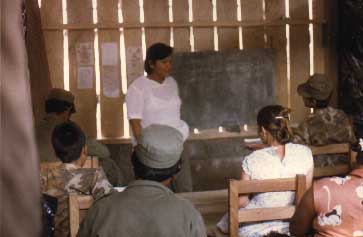
Local man returns from service in Nicaragua
The Marion Record, Thursday, June 19, 1986
Mark Becker, son of Harold and Irene Becker of Marion, has recently returned from a six-month term of service with Witness for Peace in the Central American country of Nicaragua.
Witness for Peace is a Christian, faith-based organization which works both in Nicaragua and in the United States. Its purpose is to stand with the Nicaraguan people and to oppose U. S. covert or overt intervention in their country.
Witness for Peace began in summer of 1983 when a group of 150 North American Christians visited the town of Jalapa on Nicaragua's northern border with Honduras. U. S. backed Contras attempting to overthrow the government of Nicaragua sought to capture Jalapa and there set up a provincial government. The group of North American Christians were in Jalapa to pray and share with the Nicaraguan people in the midst of this war situation, but people also noticed that there were less Contra attacks in an area with U. S. citizens.
Since then, at the invitation of Nicaraguan Churches, Witness for Peace has expanded its work to include thirty to forty volunteers working in all areas of Nicaragua. Also, each month, three to five delegations of about twenty North Americans each visit the-country for a two week stay.
Becker, along with three other Witness for Peace volunteers, worked in the northern part of Nicaragua in the Department (or State) of Jinotega. Becker traveled to isolated villages to meet with the people in an attempt to understand their situation, and to document effects of the war between U.S.-backed Contra forces and the Sandinista Army.
The present Sandinista government of Nicaragua came to power of July 19, 1979 after overthrowing the brutal Somoza Dictatorship. The Contra forces are led by former officers of Somoza's hated National Guard.
"Many times we would meet people who would tell us of being kidnaped, raped, tortured, or of having loved ones killed by the Contras," Becker said. "This is the sort of activity that the U. S. government is supporting with our tax dollars."
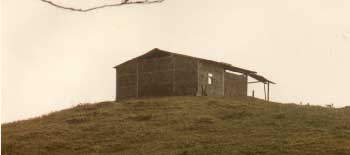
On the other hand, Becker continued, his encounters with the Sandinista government were more positive. "We saw the Sandinistas, working in isolated mountain villages, bringing in teachers and health care workers, building houses, schools, and health centers. The Sandinista government is committed to improving the lives of peasants in Nicaragua, but often times Contra attacks prevent them from moving forward with their programs."
However, Becker emphasized, "Witness for Peace does not work for the Nicaraguan government. We work with Nicaraguan Christians and their churches. But we stand with the Nicaraguans in saying that the U. S. should stop its intervention in their country. Nicaraguans should be free to choose their own government, free from outside intervention."-contributed.
U.S. compounds errors in Nicaragua
Rocky Mountain News, Denver, Colorado, July 6. 1986
Editor: I see that once again the CIA is, in its backhanded way, giving the contras $400 million worth of covert support ("Contras to get secret CIA aid, paper says," June 30 Rocky Mountain News).
I lived for 6 months in Nicaragua, in the northern Department of Jinotega, working with Witness for Peace. In the course of my work, I met numerous people who had escaped from the contra forces.
The contras are not comprised of Nicaraguans who have voluntarily picked up weapons against the Sandinista government. On the contrary, the rank-and-file contra army consists of kidnapped peasants who are forced to fight against their will. if these peasants resist, the contra commanders will torture them and take revenge on their families.
The contras are not a popular cause, not in the United States and definitely not in Nicaragua. For 50 years under the Somoza dictatorship Nicaraguans suffered the effects of U.S. intervention in their internal affairs. If the United States invades Nicaragua, almost all Nicaraguans would fight against the hated imperialistic invaders, regardless of their attitudes toward the Sandinista government.
Continued U.S. support for the contras demonstrates an inherently flawed way of doing foreign policy, and it shows the Reagan administration's contempt for democracy and self-determination in Central America.
Mark Becker
Arvada
Bethel grads spend time in Nicaragua
The Newton Kansan, Thursday, July 10, 1986, page 5
By MATT BARTEL
Kansan staff writer
Tim Lohrentz and Mark Becker say that between them, they've seen "about 90 percent of what's going on in Nicaragua right now."
The two recent Bethel College graduates returned in June from eight months of work there-Becker as part of the "long-term team" of Witness For Peace (WFP), an international human rights group, and Lohrentz as a computer programmer at a Nicaraguan agricultural school.
On Monday night, the two will discuss their experiences in a forum at 7:30 p.m. at Faith Mennonite Church. They plan to tell about their work in Nicaragua and their urban and rural experiences, in that wartorn nation.
Becker, a 1985 graduate in history, was in western Jinotega province of northern Nicaragua starting in November 1985, working for WFP to document human rights abuses there.
Lohrentz traveled, unsponsored by any group, to Estelí about 50 kilometers west of Jinotega, last September- his personal interest was combined with the efforts of a Bethel professor to arrange his stay.
Being stationed in northern Nicaragua- the area near Honduras in which U.S.-supported Contra rebel activity is most prevalent- meant that both had a chance to observe a nation at war, an experience they agree helped satisfy their purpose in going there.
"To learn about what is going on there is to learn what life is like for (Nicaraguans)," Lohrentz says. "For me, that's what politics is- what life-is like every day.
"People who have been (in the United States) for nine months could have a better overall understanding of Nicaragua than I would have living there for nine months as far as what is considered to be normal politics," he says.
"But I think my understanding is a much more human understanding of the situation," says Lohrentz. "I saw a lot of the trees and not so much of the forest."
Lohrentz and Becker's experience in Nicaragua at once presents a paradox- Lohrentz lived in an urban setting while running computer programs for an agricultural and livestock school, while Becker worked farther east in rural areas, concerning himself with what is usually a more urban concern: The political agenda of WFP.
But says Becker, "Where we come out is that we had a very similar experience. "Witness For Peace works in a rural setting because that's where the war is and that's what we're really concerned about," he says.
"There is little urban warfare because the Contras have so little popular support, plus there is an effective state security force," Lohrentz says, assertions based on his direct contact with the people there.
While Lohrentz worked to help manage the agricultural programs of the private, Jesuit School of Agriculture and Livestock of Estelí, Becker was working with other American visitors and Nicaraguans, interviewing survivors and viewing scenes of destruction from Contra attacks in northern Nicaragua.
"I could tell you many horror stories that we came across during our work there," Becker says. "People are kidnaped to serve in the Contra army." About a month before he left, Becker interviewed three men who escaped from such a kidnapping after several months of indoctrination.
Side-by-side in the rebel camp were initiation rites involving the forced consumption of hot peppers, forced daily prayer, and long lines of rebel troops at huts that served as brothels.
Although WFP documented as many human rights abuses as possible, those committed by the Sandinista government were reported through "channels to the government"' and punishment was handed out regularly, according to Becker.
Abuses that could be attributed to the Contras are recorded and reported publicly and privately in the United States, which supports the rebel forces, he says.
"We investigate all abuses by either side," Becker says. "But obviously, if you have a political agenda-which In our case is to stop U.S. support of the Contras-then it doesn't help to publicize the abuses of the Sandinistas."
Nevertheless, Becker's opposition to the Contra activity in Nicaragua does not necessarily lead to support of the Sandinista government.
"It's hard for me to defend a Sandinista government, especially when I disagree with many of its policies," Becker says. "And the vast majority of abuses that we were able to attribute to one side or the other were Contra abuses.
"For each one Sandinista abuse-which usually resulted in punishment for those involved- we documented 20 or 30 committed by the Contras that nobody ever does anything about."
Lohrentz says the Sandinista government probably has gone too far in placing restrictions on press freedom and declaring the state of emergency there, especially considering the widespread support it enjoys among its people.
"But Nicaragua today is a wartime situation and I guess they feel that everyone has to unite," Lohrentz says. "In wartime, speaking out against what the government is doing makes you guilty of treason in their eyes."